
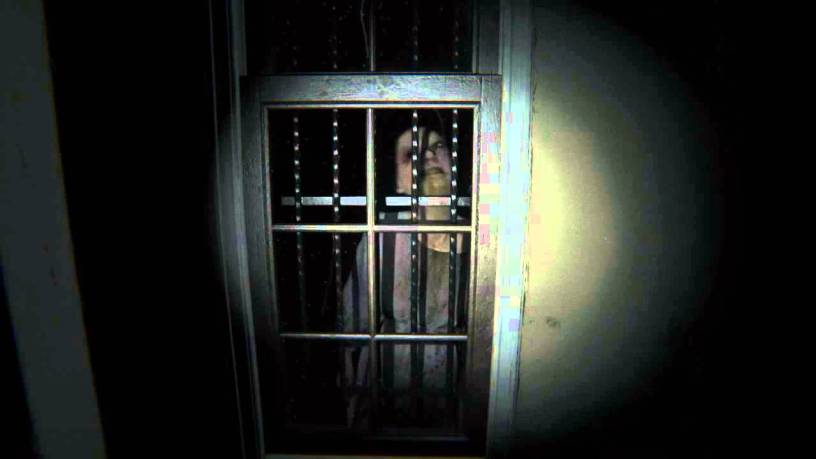
Full spoilers for not just P.T. but Silent Hill 2 follow.
Content Warning: discussion of familicide, suicide, toxic masculinity, and depression.
This replaces for the week the regular post I’d be doing on Silent Hill. It will be back next week!
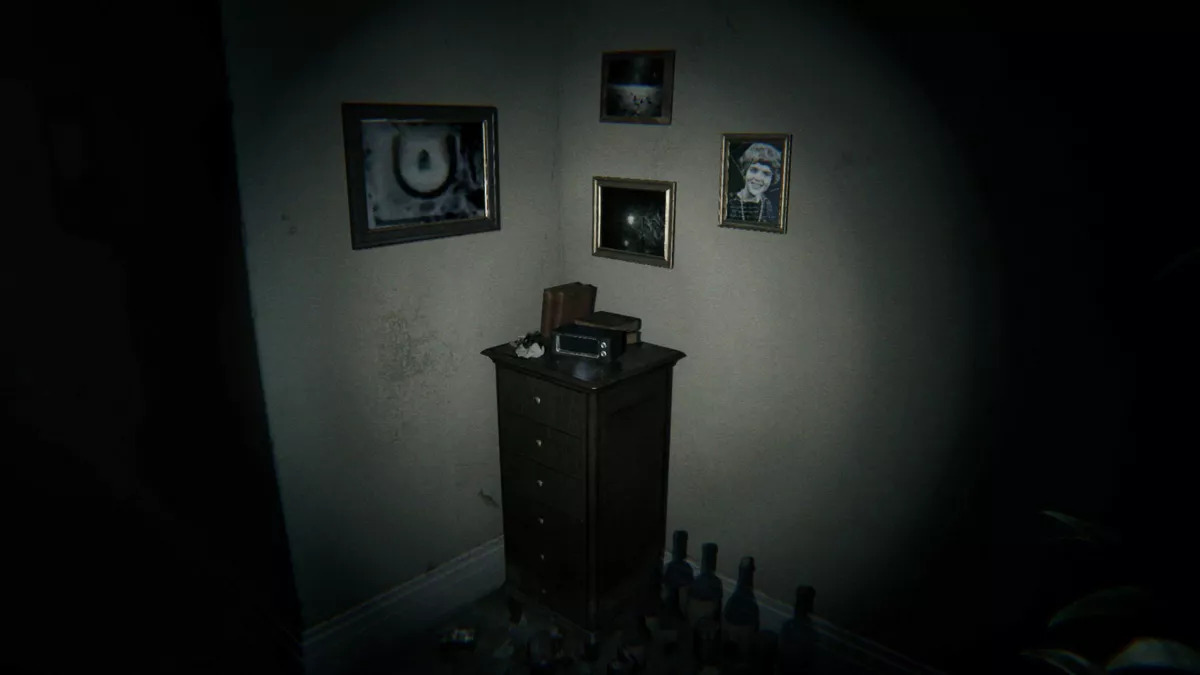
P.T. is, on its face, a story about a man trapped in a house, forever stalked by a ghost and haunted by the screams of a wailing child in the sink. It is a story about reliving some terrible event through a radio broadcast, then suffering for it.
It is a game about purgatory, or hell, some say. Speaking to the general theme of Silent Hill, this fits as a motif. James Sunderland from Silent Hill 2 discovers that the town of Silent Hill has manifested to him his subconscious desire to be punished for his sins. Silent Hill as an entity latches on to the guilty, or even those merely believing that they are guilty, and forces them to confront horrors relating to their guilt and trauma. It is this grounded approach to telling a horror story that makes Silent Hill virtually untouchable in the horror department for me.
P.T., then, focuses on the story of a murdered family. An ordinary suburban nuclear family – a husband, a wife, and two children, with one more on the way. At the core of the story is the idea of shame; that is, “an unpleasant self-conscious emotion typically associated with a negative evaluation of the self; withdrawal motivations; and feelings of distress, exposure, mistrust, powerlessness, and worthlessness”. A simple but effective definition from Wikipedia. The most relevant words within the definition are “mistrust” and “worthlessness”.
The story in P.T. discusses the idea of shame in a seemingly tangential way. As the story unravels, it is discovered that the father was out of work, and unable to supply for his family. Traditionally of course, many societies see the “man of the house” as an important role. The money-earner, the breadwinner; the one who supplies for the household and keeps everyone happy by working hard. When the husband couldn’t find more work, the wife had to go and work. She was hired apparently because she looked good in a skirt, implying that a boss or someone in an important position at work was sexually attracted to her.
The story brings shame to the surface with its implication that traditional ideas of masculinity have damaged the psychological state of the husband.
In the bathroom, the player finds a strange fetus creature wailing away. A potential interpretation of the story – “[t]he mother, who was shot in the stomach, was pregnant at the time”, says the radio – was that the wife had sex with the boss, the father found out, and killed his whole family. Not out of a sense of revenge, though – out of a sense of shame. He not only had been unable to provide for his family with a job and a steady income, but he could not provide anything for his wife sexually, it seemed. The father after the murders is then placed in two seemingly different places – keep this in mind.
The first broadcast of the radio (heard the first time you step into the hallway) says that “[p]olice arriving on-scene after neighbors called 911 found the father in his car, listening to the radio.” It also talks about numbers that the father was chanting, as well as additional familicides committed by other fathers across the country. The most interesting part of the radio broadcast is as follows:
“There was another family shot to death in the same state last month, and in December last year, a man used a rifle and a meat cleaver to murder his entire family. In each case, the perpetrators were fathers. State police say this string of domestic homicides appears unrelated, though it could be part of a larger trend, such as employment, childcare, and other social issues facing the average family.”
Masculinity is tied up in ideas of self-worth as measured against material goals. The size of one’s genitals or muscles in comparison to another man’s, a man’s earning power, or the ability a man has to boss around other people – position at work and in the general hierarchy. “Man of the house” symbolizes that they are in charge of the house, the leader of the family, representative of the best the family has to offer in terms of the artificial and thoroughly material construct of “supplier” of the house, and contributor to the economy / their job. These ideas, when causing harm to the self or to others, are labelled as “toxic masculinity”, a genuinely large problem that affects many facets of our society.
When these ideas of masculinity are challenged, P.T. argues that men, so wrapped up in these toxic ideas relating to their own place in the world, will lash out. And it is a familiar enough scene in real life, or (especially) on the internet. You can read many stories or even travel to a comments section and find yourself amidst a lot of response from fairly fragile people. This is because western society is intrinsically connected to the idea that the man is the one who should supply for the house, and who should be big and strong and obscure emotion whenever possible. These ideas cause harm for not just the individual in the long-term, but the family unit the man harboring harmful ideas about himself is a part of.
I don’t want to sound critical of individual men who feel this way in particular, as casting judgement on the vast majority of individuals is unhelpful and gets people nowhere. P.T. is also similarly uncritical in this fashion. What is it about the man “repeating numbers”, on the radio? Why is the man sitting and listening to the radio after the killing?
I suspect it is to do with the consolation and validation that one feels when you go to find refuge in places that reinforce ideas of “toxic masculinity”. Men who feel this way go to these places to seek validation and advice and often end up feeling worse about themselves in the process as they realize they can’t possibly stack up to idealizations and impossibly difficult fantasies. The numbers on the radio? Reinforcements of the “by the numbers” overly toxic masculine lifestyle the man has been living.
The other place the man ends up? He hangs himself in the garage. The depression that he feels after being hounded by impossible idealizations that are constructed a) by other people and then b) within his own mind. He kills his family and then himself because he can’t stand to resolve his problems with words or through any other means; the society he listens to, half-constructed in his own mind, tells him that violence is the appropriate response to the problem. So, he resorts to violence.
The purgatory of walking those endless hallways, stalked by a ghost of a pregnant woman weeping – they are most likely very similar to James’ purgatory in Silent Hill 2. It is not the town that punishes James. James creates everything, all the punishment in his own mind is made manifest by the town itself. It is the same for the nameless protagonist in Silent Hills.
The same endless hallway is a repetitive desire to be punished for his sins. But which sins? The sins of murdering his family? Or the sins of failing to live up to impossible, toxic masculine ideals? The way the ghost, Lisa, kills the protagonist is particularly chilling – your neck gets snapped, and you are dropped to the ground. Then you hear your pants being unzipped, and a strange, awful noise – as though your genitals are being devoured, or you are being castrated. Another insult to the ideals of toxic masculinity – what is a man, without his dick?
P.T. is not critical of the men who fall prey to such thoughts and harmful ideas that serve only to hurt themselves and the people around them. P.T. seems to be more critical of the people in power who help to perpetuate similarly harmful ideas. The people on the radio speaking the numbers are the perpetrators. The way the men repeat the numbers days before the murders – they are victims, just as their families are, of harmful ideas that they can’t seem to escape, that they feel they can turn to no-one for assistance.
This is what the uniquely awful purgatory of the single hallway of a disturbed family home represents in P.T. It’s not just that the game has an expert amount of restraint (it very clearly does) in terms of the way it scares the player – it has an immense amount of respect and understanding for the topic that it covers. It is a game about many things – some say it is an allegory for Kojima’s relationship with Konami, and you can see tumultuous hints there, final parting shots at the corporation that did him and his team so wrong.
But I think the more powerful stuff lies outside of jabs at corporations – although I do believe that’s quite fun, especially towards Konami, who don’t have the best track record right now in the games industry. The meat of the game is contained within the guilt and the shame that causes the reliving of awful days and trauma, over and over again.
Silent Hills, if it explored similar themes, would have knocked it out of the park if P.T. is anything to go by. But all we have now are memories, a cancelled game, a game itself trapped in purgatory, slowly to fade from existence, leaving behind only fan recreations and games inspired by it. But none are as clever, nor have anything as interesting to say, as the original masterpiece itself.
I really hope you enjoyed this article and found it interesting. I put quite a bit of work in to present these ideas sensitively and with as much respect as possible.
If you did enjoy this article, please consider visiting my Patreon and giving me a hand. Thanks for reading.
 Horrorgameanalysis