
As a person who’s played a lot of both contemporary and retro video games, the difference between the two is most often markedly noticable in the way the developer wants you to experience the world. Compass and map markers often lead you to where you need to go in more modern times, even highlighting specific objects that need to be interacted with with a diamond-shaped indicator.
Mini maps and the aforementioned compasses are seemingly indispensable tools that allow the player to contextualize the world around them with directions that don’t have to be memorized in the player’s head. So what happens when a player has to explore a claustrophobic setting after missing a map pickup, since there was no marker ushering me to the very important pickup, a tool that acts as a comforting guide for the player?
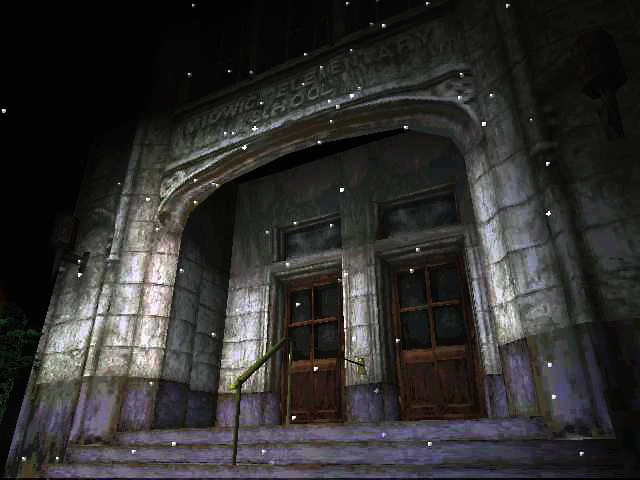
Well, I’ll tell you what happened, because yes, I missed the map for Midwich Elementary School in the lobby and proceeded to explore the place mostly blind, requiring myself to memorize similar-looking classrooms and hallways, remembering which doors I could open and which doors were forever locked, and which doors might be able to be returned to later.
Midwich Elementary School itself is, like so many areas in the game thus far, a masterclass in video game level design. Something I’ve wondered for a while is whether older games had a more powerful sense of place simply because the player’s imagination picks up some of the slack and fills in some blanks? Or maybe it’s something more potent than that – something poetic. But I found wandering the hallways of the school to be a truly intoxicating horror experience. The place is richly detailed, but not to the point of insanity. There was a great amount of detail, though – posters for school events, noticeboards, and kids’ drawings. The things that can be interacted with stand clearly out from the bits and bobs that are merely set dressing. Health drinks, ammo pickups and first aid kits, as well as the save point in the Infirmary, were all immediately recognizable.
This made for a pleasurable experience, as I didn’t have to go around mashing “X” a lot of the time while trying to examine things that couldn’t be examined. Notes were covered with blood, and the vivid red indicated to me that I probably should read them – even though it’s not exactly the friendliest sight. I also loved the puzzles here, but I’ll chat about them a little bit later in this post.
Maybe it was just my simple ignorance. Perhaps I’m the only one who missed the map. But the quandary is – do you make item pickups so obvious that they pop out as game items? Because the other items were all obviously able to be picked up, and I did so. They stood out, they were either brightly coloured, differently coloured, uniquely shaped, or they were locker doors set slightly ajar, for instance. The map, however, seems like it would have impacted a lot of player’s personal experience of the school. I’d be curious to hear whether people rely on the map in Silent Hill, or whether they are able to explore environments just as easily without it.
I enjoyed the experience of being without the map. It was like I was without eyes, or without one eye, at least. I was utilizing skills that modern video games had taught me not to use. It was a genuinely exciting way to experience the game for the initial hour or so that I explored the school. But the one problem I did have was that after I had retrieved the golden medallion, I wasn’t sure where to put it. I explored the place a lot, finding the puzzle areas for the next two puzzles, but I couldn’t find anything. Eventually I wandered back out into the lobby and found the map, which immediately hooked me to the next clue, which I’d read about on one of the notes – the clock tower in the courtyard, which I had no idea existed.
The map labels that indicate which rooms are which make finding a spot on your map a mere triviality, and just a matter of running to it from there. Sure, Silent Hill loves to put blockages in your way to make the path slightly less obvious, but you still know your destination, and know that you just have to brute force a number of paths to get there. Weirdly, I found myself wishing that the map wasn’t quite so powerful and ubiquitous in its use, even while I remembered the feeling of eventual annoyance I had trying to find where to put this medallion.
So, how to fix this feeling..? Make it so that you do have to explore a room to have its name on the map, perhaps? Silent Hill 2 has a section with no pre-drawn map available, so James has to draw it himself. This makes exploration feel more like stepping into the unknown. The moment you get a map, you can contextualize the area around you, see the size of each room, where it connects to, and so on. This is a problem when considering you want the player to feel some sort of disorientation when they enter a new area. Silent Hill 2 generally also gives players a map fairly early on in each new area.
Of course, you can choose to shun the map and do it yourself, but I love the aesthetics of each map too much. The moment I pick one up though, it feels like a crutch. The area becomes less memorable if you aren’t forced to memorize it for your own survival, but the moment you stall after having killed all the enemies in an area, you need the map to figure out which rooms you haven’t been into. It’s a tricky problem, but I’d love a map that was procedurally filled in or drawn by the protagonist themselves, as James does in Silent Hill 2 as a nice middle ground. You don’t get the names of each room, but you do get the layout of each room immediately as James steps into it, and you can identify where exits and entrances are from that too, allowing you to explore in an organic way. That’s my optimal solution, I think.
Anyway, back to the puzzles.
Puzzles in horror games are hard to pull off. They seem like they should be a natural fit, but if you get stuck on a puzzle, suddenly you are transported out of your character’s head and the wonderful immersive state we horror fans love, and into your head. And your head is suddenly frustrated at an obtuse puzzle. And the longer the process continues, the more annoyed you get, and the less likely you are to look favourably upon a stretch of the game.
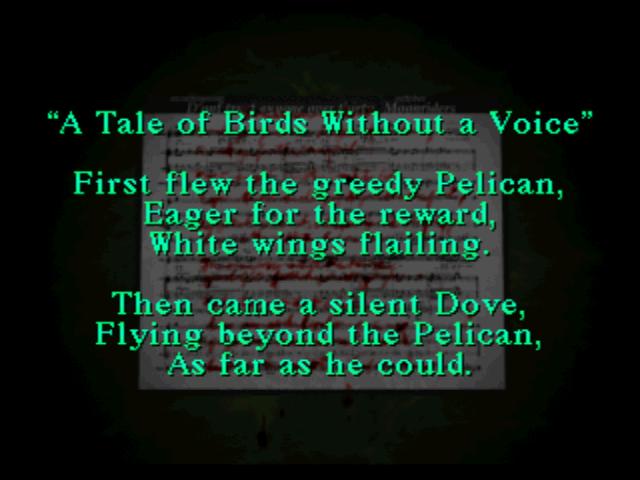
Fortunately for Silent Hill, most of the puzzles in Midwich Elementary School, bar one, were frustrating. My favourite was the piano puzzle, which by now is of course a fairly ubiquitous puzzle. Play a particular sequence on a piano to unlock a door or get the next puzzle. Puppet Combo’s 2020 game, Murder House, has a puzzle that is exactly this. It’s nice to see that even in the modern era, some games are still taking from Silent Hill, already proving that this project of the long analysis has at least some merit.
Silent Hill’s puzzles are never obtuse enough to make you scratch your head. You generally know what you have to do, just not how to do it. Most of them involve the combinations of a variety of items, which generally just mean you have to survive the area long enough to find them. I liked the piano puzzle mainly because I didn’t have to run around and search the corners of rooms for something I’d missed – but this is a minor complaint, as it really only happened once in the school.
The puzzle I found the weakest in this section of the game comes before the boss fight. I think I’ll be dedicating an extra post (that’ll be next week’s) to the Otherworld section of the school, primarily because some interesting stuff happens there that I want to talk about, that I think would make this already long post even longer.
Anyway, the most troublesome puzzle I found was the one where you have to turn the valves to get the turnstile to open up completely. There’s a turnstile on the left and on the right, and two valves that each move them in different ways. To me, puzzles like this aren’t interesting. As far as I could determine, there were no hints on the wall, no cryptic poems or anything like that, stuff that I quite enjoy, even just for the fact it helps characterize the world. Instead, it felt like I was just doing trial and error. I get that at some stage all puzzles come down to trial and error, but I didn’t feel particularly clever when I solved this one. I’d turned some valves for a while and eventually magicked my way to the solution.
Perhaps this is not the best way to play it, perhaps there is something else I missed. Alas, this puzzle (and the subsequent boss fight) left a pinch of bitterness in my mouth the way I experienced them. For as great as the school itself is to explore, a dull puzzle immediately followed by a boring, easy boss is not a particularly great way to finish the segment. But I’ll get into that next time.
If you did enjoy this article, please consider visiting my Patreon and giving me a hand. Thanks for reading.
 Horrorgameanalysis
You didnt mention this here, but in your silent hill 1 anaylsis youtube videos you said several times that the ntsc version of the school enemies were censored or not as impactful as the other regions. But its the opposite, ntsc is the noncensored one, the enemies look more human than the jp/eu ones, not less.
LikeLiked by 1 person