
When the indomitable warrior, Countess Joan Colvile of Northamptonshire, breathed her last, her lands were divided up amongst her six surviving children.
Joan herself had lived a tumultuous life. A warrior woman who could have united the entire English isles with her martial prowess, as no warrior who had ever stood up to her and her army had ever succeeded, she lived a life of relative obscurity due to her position as a countess of considerable loyalty to her king, but an obsession with the new Iconoclast heresy, which she insisted on converting her family to, over and over again. This earned her few favours with the royal family. But her legacy was bolstered by her attachment to the Duke of Mercia, a man who was once third in line to the dukedom, before a series of wars left both his brothers dead. Now her children were able to take power of Mercia, the realm to which she herself owed fealty.
And yet, both sons who took power meddled in their mother’s realm. While the elder, Matthew, eventually allowed her religious freedom to her heresy, he also attempted to forcibly convert her. Her refusal granted him a reason to imprison her, which, after some deliberation, he did. This move proved to be one of his last as the Duke of Mercia. Matthew was overthrown and replaced by one of his younger brothers, Paul.
Paul was a tall man, the tallest of Joan’s children. He was also the kindest of heart when it came to personal interactions. Those who knew him closely always spoke of kind nature and gentle speech. And yet, Paul’s actions were the ones who would doom the Colvile family to years of infighting. When he came to power, at first it seemed he would be greatly different from Matthew. Paul took a beautiful wife, a daughter of the King, and spent a few years raising his family and securing Mercia against its enemies. And then, Paul quietly sent a decree to his mother, requesting that she give up Northamptonshire.
Joan thought for a while. It was a warm day in Northamptonshire. The sun shone through the curtains, and hit the letter, which seemed so fragile; how could such a cruel thing be so delicate? She thought about tearing up the letter and hurling it into the fire, trying to pretend that her own son wasn’t trying to usurp her throne. She, who had nurtured him, who had defended him against peasant uprisings, and the uprisings of the Count of Nottingham, who insisted Paul was a tyrant. She had sent good men to their deaths for her son; and now, it turned out, he was indeed a tyrant.
The letter she penned back was delicate in wording, but its meaning could not be mistaken. She would not be giving up her autonomy for Paul. It would ruin both Northamptonshire and Mercia, she thought.
Paul’s reception of the letter was less cordial. He read it, and tossed it into the fire. His marshal frowned. The man looked nervous. Paul looked at him directly, and nodded. “She has refused,” he said.
Over the next week, both armies were rallied to their capitals. Paul, seemingly a newly Christened tyrant, against his mother, a woman who had fought Norse in the north, Welsh in the west, and fellow Anglo-Saxon, the woman who had taught her sons everything they knew about warfare.
The war drew on for two years, but for most, there was no doubt in their minds as to who would win. Paul’s army lost the first clash, and never truly recovered. Joan’s troops occupied the heartland of Mercia, and eventually cornered her son and his army in Northamptonshire. The place where he had grown up, where he had played at battle, then learned battle with her knights; those same knights slew Paul’s own, and Paul saw his battlelines crumple, til it was just him, standing alone in a field, surrounded by over eight hundred of his mother’s troops. Joan herself made her way to the front of the circle, and nodded. Paul sighed, and tossed his sword away. He found himself in the prisons of Northamptonshire, along with a few far more insignificant men; murderers and peasants. They looked at him, and sneered.
A few days later, Paul acknowledged his defeat. He had no choice. He signed away the deed to Mercia to his one and only son, and abdicated; but maneuvered his son to give him Leicestershire, gutting the Dukedom’s military capacity.
Joan’s last two years on Earth were spent carefully investing in Northamptonshire. When she died on the 11th of October, 1112, her lands were divided up. The two counties she had won for England in Wales were given to two of her sons. Paul retained his land. Another took Huntingford. Matthew, the original duke of Mercia, stood now as inheritor to Northamptonshire.
The Colvile family were the owners of Mercia, of central England. This was Joan’s true legacy.
In just twenty short years, four of the six surviving children of Joan Colvile would be dead, leaving behind only Matthew and her beautiful daughter Brigitte, and Paul’s son would be on trial in the king’s court for high treason, and executed just two weeks later.
This is the legacy of the Colvile dynasty.
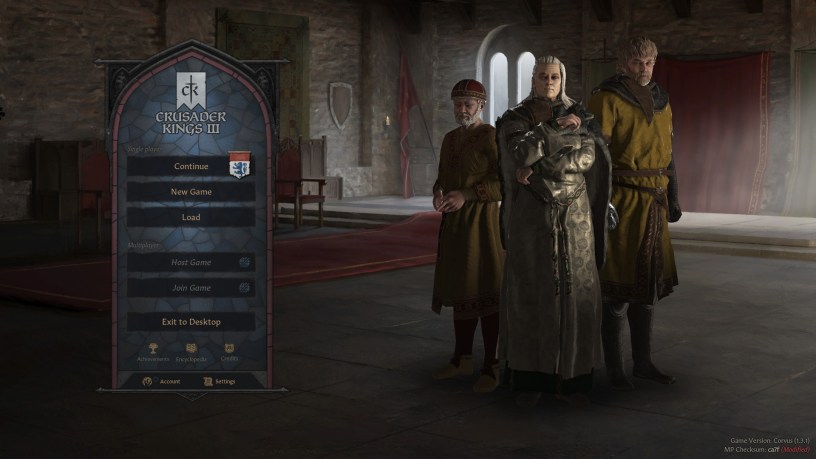
Crusader Kings III is not quite as strategically heavy or as deep and complex as its predecessor, but it makes up for that with generative storytelling that is engaging and interesting, measured against a roleplaying system that works far better than II’s. As an interactive narrative with player-set goals, Crusader Kings III has almost no equal. If you enjoy roleplaying games, this should absolutely be on your list.
You can buy CKIII from several storefronts, including Steam and Paradox’s website.
 Horrorgameanalysis