
Far too few games try to challenge the player in non-traditional ways. Ice-Pick Lodge are masters of experimental gameplay, but in Knock-knock, possibly their most traditionally mainstream title, they manage to pull off a feeling of ritual that encourages every single player to experiment with what is a very shallow set of gameplay tools that you are given.
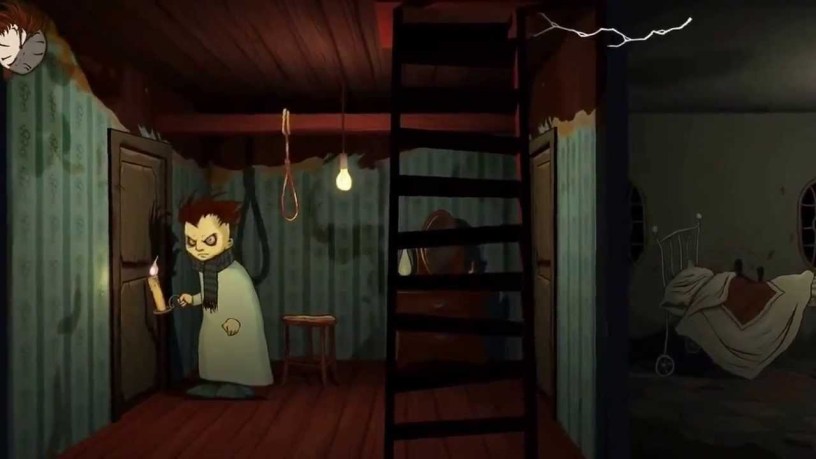
The basic premise of Knock-knock is that you are trapped in a strange, randomly-generated house with surreal, nonsensical layouts and items within each room. You have to survive the clock reaching a certain point in time, meaning that you escape the house alive. The “twist”, of course, is initially rather predictable – monsters (truly creepy and weird monsters, mind) spawn in the house, and if they get you, the clock goes back a few hours, or, if you get hit early enough in the night or when the clock has already been set back a long time, you get sent back to the start.
What separates Knock-knock from other games where you are trapped in a creepy building and have to survive is that Knock-knock’s isolating atmosphere and unreliable narrator give you no reliable source of information on which to base anything. You can piece together a sort of story, but gameplay-wise, not even players who have managed to make it all the way to the end of the game can guarantee certain outcomes. This is because Knock-knock encourages play by personal ritual.
In Knock-knock, there are doors that can be slowly opened, and lights that can be turned on. There are some moments where the protagonist says that lights should be kept off – but the game has taught you how to turn them on! When they’re on, more and more items are revealed in a room – but when the items are revealed, do you turn the light back off? Play becomes paranoia as you have to determine what exactly it is that wards off the monsters, and how you can survive each dreadful time you’re locked in the house.
Knock-knock merely encourages such paranoid play by claiming that the game was made because of a mysterious email sent to Ice-Pick Lodge, with cryptic rules and notes given to the player in between each part of the game. Players naturally begin to wonder whether to incorporate such rules into their play – and also might even be inspired to try out the creepy games with a group of friends! But it’s the very fact that the game remains fairly static when you come to understand the actual reactivity of the game – that is, not very much – that makes the game’s ritual element so interesting. There’s not very much you can do, and the game knows this. It’s not a huge game, but it creates a stern atmosphere of foreboding, encouraging the player to begin acting like the bleary-eyed protagonist themselves. Ice-Pick Lodge encourage consistent, personalized play, even in a game environment where limitations are everywhere on the 2D plane with just a few different actions you can take. Every player ends up picking a slightly different ritual, a way to play that keeps them alive – and that’s what makes the game so appealing to watch and share with others.
The code behind the game is not hugely complex, but it’s the intelligence of the game’s framing that gives the gameplay an inherently personal quality. Whether you flick the lights on or off, the gameplay transcends traditional barriers of mechanics that are set in stone. All of a sudden, you are a crazed person living in a lodge, doing manual wiring and climbing ladders into insane basements, conjuring up insane theories and believing in visions and inspecting every random bit of detail in the environment for a clue. Knock-knock is a treat of experiential gameplay, where your style of gameplay develops into personal ritual as you progress – and I think that’s just magical.
Light, Ritual & The Joys of Experiential Gameplay in Knock-knock
 Horrorgameanalysis