
I can’t see a game like Forbidden Siren ever being made again.
It is a survival horror game of the old style, with tank controls, slow aiming, and a reliance more on atmosphere and storytelling than jumpscares and loud noises. It is genuinely disturbing and unsettling, but mixes in with its survival horror gameplay the required fastidiousness of a 90s adventure game, with all of its puzzles and hidden items.
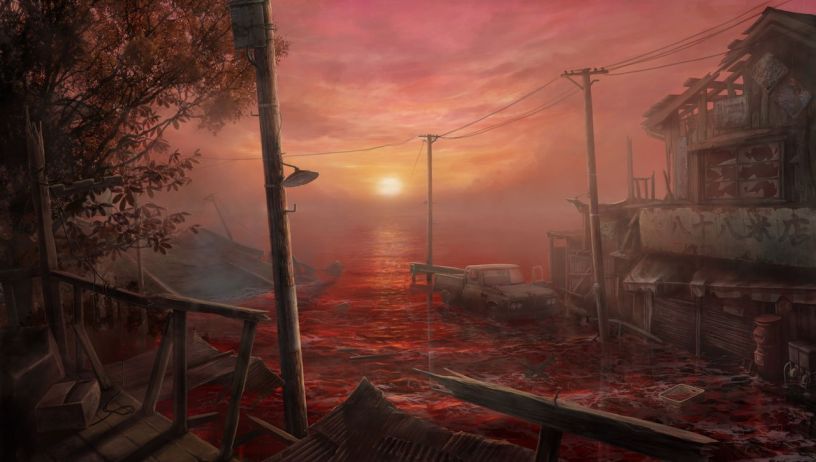
Forbidden Siren (known as Siren in the US) is a tale of a small, rural village brought into a strange “otherworld”. Yes, it sounds remarkably like Silent Hill (probably because the lead director for the original Silent Hill, Keiichiro Toyama, was also the lead director on Forbidden Siren), but it goes for a slightly different approach.
If you thought the Silent Hill protagonists were “everymen”, then Forbidden Siren’s ten protagonists are several steps below that for the most part. They don’t take much to put down (a couple of gunshots is enough, which is quite rare for video games in general), they aren’t particularly fleet of foot, and very few of them actually know how to use a weapon properly. Only one character could be said to have real experience with a rifle, but he is an old man, and is, as a result, the slowest character. The hunting rifle that should make you powerful forces you into first person, making you feel vulnerable. You have given up visibility and maneuverability for the potential of power. In several missions, in fact, players are supplied with no weapons at all, meaning stealth and careful observation is the only way through.
That careful observation is assisted by one of Forbidden Siren’s greatest innovation – the Sightjacking mechanic. By holding down the L2 button, players can then rotate their analogue stick like they are tuning an old television. If you point the stick in the direction of one of the enemies (the immortal Shibito, undead villagers who can only be temporarily knocked down rather than killed), their vision will fill up your screen. You can see through your enemies eyes – which adds rather potently to the fear factor when you realize they are looking right at you!
Forbidden Siren is hard, there’s no doubt about that. Most players don’t even make it beyond the first level or two. This is because Forbidden Siren does not operate as other survival horror titles do. You really are weak and vulnerable. Being seen by an enemy (especially an enemy with a gun) is a genuinely tense affair, and can often result in death if you didn’t see it coming yourself. Stealth, therefore, is the key component of completing missions. Creeping behind a Shibito in the mist of a grey morning, above an enormous red lake, while you can hear its eerie breathing, is a memorable experience few horror titles can replicate.
Where Forbidden Siren stumbles is in its obtuseness. It is not just a hard game in relation to the gameplay. It is a hard game in relation to the objectives you must complete. Playing this game without a guide handy would undoubtedly require over one hundred hours of careful experimentation, as the game provides you with zero hints as to what secondary objectives you must complete in one level to make a level in future actually solvable. While this is, evidently, not good game design, there’s something rather defiant about it. I had a similar experience with Pathologic.
The original Pathologic really does not give a damn about you. There is no nice structured tutorial like there is in the second game. You are tossed into a world and expected to figure it out. And while it is not as immediately hostile or as obtuse as Forbidden Siren, Pathologic contains the same kinds of feelings. Forbidden Siren is not for those who spook easily or jump at shadows, but nor is it for the impatient or the players who like to be gunslingers. Every level in Forbidden Siren has hidden depth, and every level has a problem to overcome. It is satisfying when you take a risk, resolve a problem, and make it out alive. Forbidden Siren pushes survival horror out to its natural, chartable extremes. What if your character was even more regular? What if your character could only survive by creeping around most enemies, rather than blasting their faces off with a shotgun? Your maps don’t display where you are, so you are forced to look around for landmarks to identify your current position, creating a familiarity with your surroundings in a way few other titles encourage. The Shibito enemies are inhuman and dangerous, but retain just enough of their humanity to be thoroughly disturbing, the sound design is off-kilter and very disturbing, and the game uses photos of faces as the faces of character models to provide this hauntological feeling of things being off, of having a lost place in history. The voice acting is terrible only because everyone is doing a British accent, which really is confusing.
It is a shame that the video game market that existed once for Forbidden Siren now seems only to (sort of) exist for indie horror titles, and even then, such titles aren’t really being made, or simply can’t be made by one to two person teams without it taking up a significant portion of a person’s life. Survival horror as a genre will never be quite as obtuse or disturbing as Forbidden Siren makes it. The golden age of the genre has passed us by, and perhaps in our lifetimes, we will see a genuine resurgence – but as it stands today anyway, Forbidden Siren is one for genre enthusiasts and game historians alike. While we might never see its like again (and for most, that’s probably a good thing), Sony fortunately made it accessible for a new generation by making it a downloadable game on the PlayStation 4. The second Forbidden Siren, which I plan to write an article on later, didn’t even make it to America. It is even more lost, even more forgotten – but shaves away the things in this game that turn away most modern titles. This game, however, should retain a place in the halls of survival horror history, if simply for its incredible atmosphere and Sightjacking feature.
You can purchase Forbidden Siren from the PlayStation Store.
 Horrorgameanalysis