
The fear of being chased is a pretty common one. Humans tend to have a visceral reaction to pursuit – the kind of gut reaction that gets the heart pumping faster, the adrenaline racing through your veins, and the fight / flight response completely activated. Haunting Ground, a now-cult-classic developed by Capcom from 2005, gets that feeling exactly right.
Survival horror often relies on the tension between fight / flight. Resources in older titles (like Resident Evil and Silent Hill) were often integral to the experience. You had to manage them carefully to ensure that you could beat the tougher enemies in the game. So, you had to weigh up whether you could actually afford to fight that zombie lurking in the corridor, since you didn’t have enough bullets left to kill them and then maybe fight the giant snake that might be waiting for you later on. Five Nights at Freddy’s, a stripped-back survival horror from 2013, (that long ago?), exploits fight / flight to such a degree that both flight / fight are removed from the player’s vocabulary. All you can do is sit and wait. Haunting Ground switches up the traditional survival horror dynamic by forcing the player to run away from all the enemies in the game – a gameplay feature that is somehow tired in many modern indie first-person horror walking simulators, but feels dynamic and exciting in Haunting Ground.
These enemies, known as “Stalkers” in the game’s vocabulary, are unkillable and can only be slowed down (or fended off for a short amount of time with enough persistent damage done to them). Think of them like the encounters with Jack Baker in Resident Evil 7 – you can’t actually hurt him until the scripted boss fight segments of the game. So the enemies are implacable and unstoppable – mostly. The option of flight is the best one, though you can fight back a little bit – perhaps what separates Haunting Ground from run ’em ups like Outlast 2. The thing that makes that possible, and makes the game stand out today is the character who helps Fiona, the protagonist – you get a white German Shepherd, Hewie, to help you.
Hewie really is the star of the game. His AI begins a bit clueless; he has an instinctual desire to protect Fiona, but doesn’t really obey any of the commands that he can be given. Those commands are “Stay”, “Go,” “Attack”, and “Retreat”. Contextually, they do a few different things depending on the situation – go might get him to run to the top of a pile of rubble. But early in the game, when you tell him to attack, Hewie might lunge with gusto, but when you tell him to retreat, he might simply not listen. You can reinforce that he’s done the right action by saying “Good boy” (with its own dedicated button, something every game with a dog needs), and scold him for bad actions. Though I just couldn’t scold the little rascal.
So you have a tough and loyal friend in Hewie – you might not think the game has the capability to be scary. But the developers know how to hold a player’s attention and keep them immersed in a state of uncertainty by including prolonged periods of suspended activity, where the stalker isn’t around. These sequences of puzzle-solving and exploration should be very familiar if you’ve ever played a survival horror title before, and do an excellent job of setting the mood. The setting, a crumbling castle, seems like it should be fairly played out, but exploring it is a genuine joy. There is always something interesting to see in practically every room, and the level of detail the artists and level designers managed to cram into the game spaces is magical.
When the chase sequences start, they are almost always without any warning beyond the music changing subtly. When the stalker themes (of which each of the various stalkers have their own unique one) begin to get louder and louder, you realize you’re in real trouble. Hiding places, in a clever addition to the game’s AI, can be “overused”. If you hide too much in a particular room, the stalker will invariably discover you and drag you out to be murdered. While the chase sequences remain pretty tense and frightening throughout the whole game, the stalkers sometimes happen to pop up one too many times, especially if you aren’t quite sure what to do, as the game has more than a few puzzles. Most of the puzzles are great, but some are quite strange and require time to find items and figure out what to actually do. Most dedicated puzzle rooms have a flag in the code that stops the stalker spawning in the area until after you’ve completed the puzzle – but some areas just don’t have this, and it can get a bit tiresome to have to evade some of the stalkers in the same area over and over again.
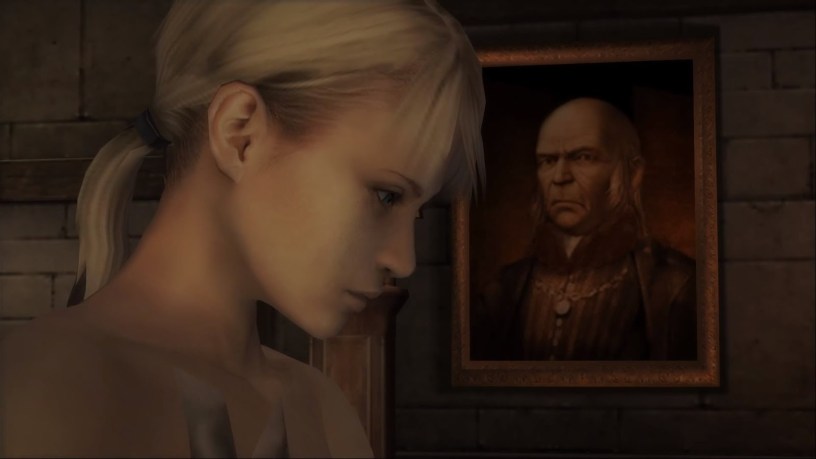
Those two, however, are about the only real complaints I can level at the game. Haunting Ground is an accessible survival horror title with some surprisingly heavy themes for a title that, on its face, is all about evading your typical slasher enemies. The odd sexualization of Fiona throughout the entire game is sometimes somewhat at odds with the story and mood the game is trying to achieve, but I am aware that in doing this, it does ape the feeling of B-movie slasher it is probably trying to go for. The facial animations and overall level of detail and polish that have gone into the game’s presentation do make the game a stunner, even today.
It is simply a shame that Haunting Ground, like so many classic titles, is so hard to get a hold of these days. Second-hand copies are some of the most expensive titles now for the Playstation 2 (I think second only to titles like Kuon and Rule of Rose). Emulating it might be your only real chance these days to have a fair shot at playing it without dumping hundreds of dollars on a physical copy. So many games have fallen by the wayside as time marches on, and live on only through memory or slightly crusty YouTube videos – and that’s a huge shame. Don’t let games like this be lost, is what I’m saying!
You Should Play: Haunting Ground
 Horrorgameanalysis