
The following piece contains some light spoilers for a frightening moment or two in Silent Hill 4: The Room.
There are many vital and interesting approaches to video games, but since it is such a young field comparatively, many scholars and academics will approach video games – especially the very well-mined territory of horror video games – from a film & media angle. Quite often, that academic study or even humble YouTube analysis will bleed over into the way designers create their horror games, even unconsciously.
Think about the way the last horror game you played tried to scare you. Was it frightening in the way you expected? Bad horror games will take control away from the player with scripted scares, panning the camera over the monster or tearing control away from the player in order to show them the spooky thing. But this doesn’t work. While we often have no way to know in a film when “control” has been taken away from the main character necessarily, or when a scare is about to occur, the removal of control from the player in horror games is a sure-fire sign that the player is about to be “spooked”.
But this is only the surface level means by which a horror game will try to frighten you. Think of other cues that a developer might put in. Sound cues – such as an audio sting growing louder or quieter depending on your proximity to whatever big nasty thing is chasing after you – can train us to react neutrally to scares. Sometimes, the knowledge that the monster is nearby can frighten us even more, but quite often, that approach has to be handled with caution. It can inadvertantly create situations where the player can ready themselves for the scare, rather than be caught off-guard by a monster’s sudden appearance. Visual distortions as well are my least favourite method of “proximity alarms”. I think they do this in Observer, which was an otherwise engaging horror game with a fun cyberpunk dystopian setting. If I am running from a monster, I do not want it to get harder the closer the monster is to catching me and ripping my spine out. That’s simply not fun game design, and it removes the fear if all you’re seeing are flashing lights or increasing amounts of frustrating static.
These audio, visual, or perhaps even haptic cues (done through the vibration of a controller) can be valuable tools in a horror game designer’s arsenal when used sparingly, making us react to nothing, raising and lowering our defenses almost at random, which means we have a higher chance of being caught off guard and frightened half to death when something actually happens. But, at the same time, the seams can show very easily on these kinds of cues. Horror in games needs to have an element of spontaneity to be truly effective. To narrow it down, horror in video games actually needs to lean into the ludic qualities of the medium. The player must willingly walk into the horror in order to feel that they are being dynamically frightened – the feeling of confrontation is just as important as subsequent feelings of avoidance.
The perfect example of this, and one that works for every single player I have tested it on, is what I have since come to refer to as “the moment” in Silent Hill 4: The Room. I’ve written about Silent Hill 4 before; it captures my imagination endlessly. Playing it in lockdown recontextualized it for me in a way I did not quite expect. It is a crushing game, with odd controls, an odd protagonist, and a bizarre, surreal atmosphere. “The moment”, however, is one of the most effective pieces of ludic horror, a pure piece of horror that could only have been achieved in the medium of video games.
The player, upon entering the hole in the apartment for the third time, finds themselves in Water Prison World, a delightfully strange and eerie place. This is the ambience that plays there. It is worth noting this also plays in the Silent Hill 2 Labyrinth, another masterstroke of “horror as play”.
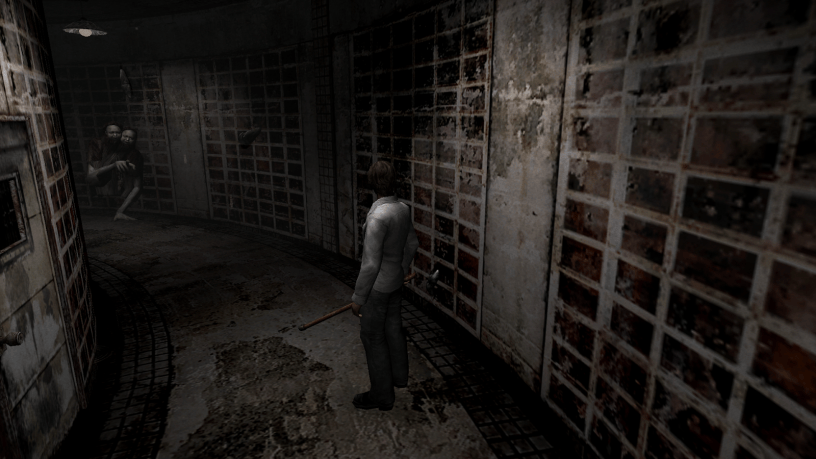
The visuals in the Water Prison are controlled, with a camera angle that fixes sternly over Henry Townshend, our protagonist, and almost seems to be alienating us, the player, from him. The colours are drab, mute, depressing. Leeches suckle against the wall, and explode into bloody pustules when we step on them. The entire prison is a panopticon – a prison where no-one can hide from the guards. Windows in the prison cells, and the circular design, means that nowhere is safe to hide. You can never have your back against a corner, can never be quite sure that something is behind you.
When you reach the third floor, “the moment” strikes. A player guides Henry along the circular corridor as they have done for every floor previous, searching each unlocked cell for supplies. Until – there is an awful, horrible moment. Every player I have tested this on does a double take, freezes in shock, as they see a giant, two-headed apparition, standing stock still, staring right at them. There is fear there, fear that did not exist before on that level. It’s a shocking moment, to be confronted with an enemy without any cues, and without the enemy immediately launching into the attack. There’s something dreadful about the Twin Victims, both in their subtextual meaning within the game world (as the representation of two children hacked to death with an ax), and the simple way they appear. They are one of Silent Hill‘s best monsters, even putting aside the effectiveness of “the moment”.
Then the player does one of two things. They either turn around and leave, or they steady themselves. The player who leaves has been shaken, and genuinely quite confronted by the very act of confrontation. It is only through the act of moving themselves into this space voluntarily that the effect was captured, and the fear resultant.
The player who chooses to confront is in for a very nasty surprise. The large and frightening creature is expected, as in most games, to move slowly and predictably. It might look like a heavy hitter, but you’ll have to time to deal with them. Except, you don’t. Coming too close to a Twin Victim means they will leave their “accusation” pose of staring at you and charge. It’s legitimately terrifying.
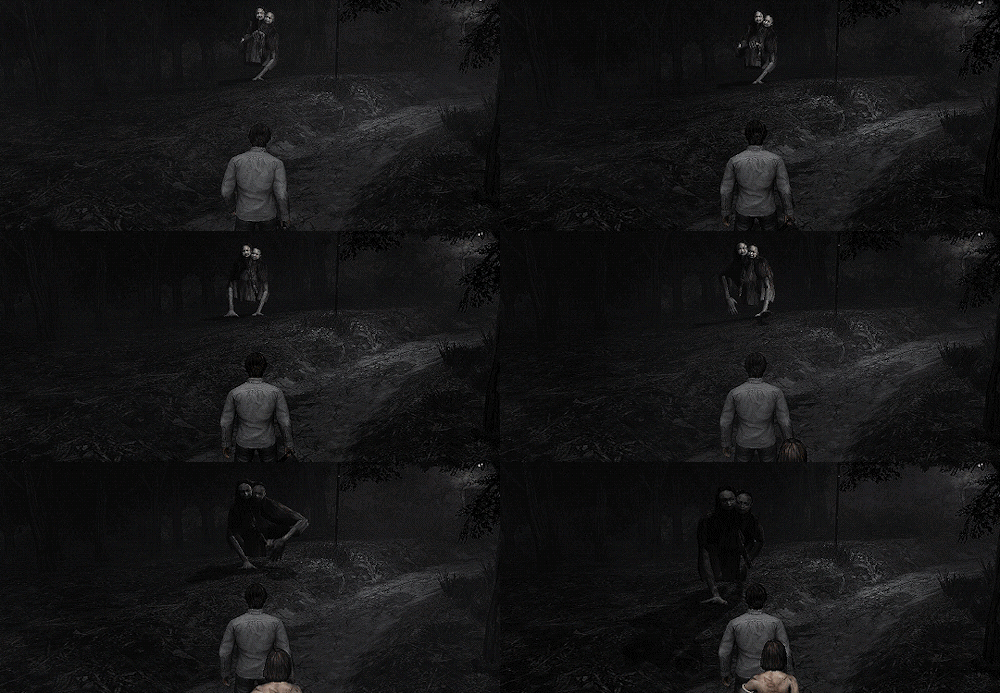
It is important to note that, aside from a very gentle whisper that occurs when you can see the Twin Victim where it whispers “receiver… receiver…” at you, and the sound of its palms hitting the floor heavily as it charges towards you (by then it’s already too late…), there is no indication that a Twin Victim is waiting for you around the corner. There is, legitimately, no warning. The only way you can find or confront a Twin Victim is by play. Such methods of experiential horror, wherein the player is trusted to find the horror of the situation themselves, are surprisingly rare considering the sheer volume of horror games – though I find myself impressed by titles like Nun Massacre and Aka Manto for their dynamism and “scares without warning”.
Silent Hill 4 even manages to replicate this trick. When a player revisits Water Prison World later in the game, they enter into a wide corridor, which is lined with what must be six or seven Twin Victims. They all just point and stare, confronting the player with the inevitability that they must somehow be confronted, must somehow be fought. That increasing sense of dread is made effective this time by the knowledge that yes, play against these horrifying monsters is inevitable, but also by preestablished notions that these bastards are fast, and they don’t go down that easily. Horrifying play becomes more horrifying in situations where you know you have to confront the monster – and it is even more effective when you know the monster in question is dangerous.
For me, “that moment” is a priceless reminder. A reminder that, despite some people’s understanding of horror films and other, older forms of horror, that a played, interactive experience wherein the player is trusted to make the decisions that will cleverly lead them to a genuinely frightening experience is an extremely powerful and novel one. “That moment” remains one of my favourite things to share with people, a moment to luxuriate in. Only through trusting the player (even if it is through carefully guiding them through a linear (or mostly linear) level) can truly effective and confronting ludic horror be created.
 Horrorgameanalysis