
Does anyone ever get this right?1
There are many anecdotal stories I could utilize to demonstrate the impact that Pathologic Classic HD had on me back in 2017 / early 2018, when I first played it.
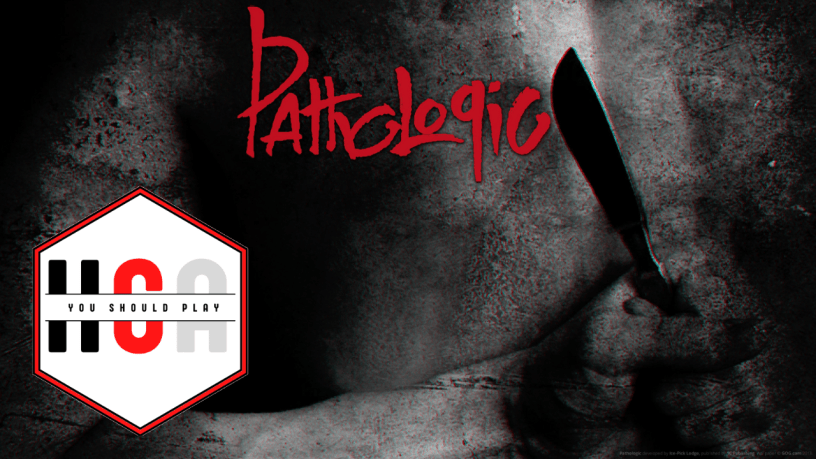
The game, ostensibly a simulation of a town as it slowly falls victim to an overwhelming plague, initially held nothing to me but an interesting situation that video games had never placed me in before. On starting the game, the lurid and fantastic chanting that opens up the main menu (and the pause menu) makes a dramatic impact. A scalpel, clutched in a strongly defined hand with vein popping out of the arm, is held behind the person’s back. In that single image, it is amazing how much they were able to encapsulate. Death, a hint of medical intellectualism and difficult, incisive decisions, and an overwhelming hint of treachery to come.
The game’s subversion begins quickly, and for me the most obvious and noticeable subversion of expectation is the typical “character select” screen. When you pick a character, you don’t expect that the other characters you didn’t pick will still be present in the game, do you? Worse, the characters instead still try to scheme against you, trying to bring their own ideas and motivations to fruition. This is the beginning of the game’s genius, but by no means its final trick.
As the game continues and builds, the economy fluctuates in response to the terrifying plague that is sweeping the streets, washing them with blood and dragging human beings down into the muck and the mud. All of a sudden you find yourself having to trade your guns and bullets for bread. For a game played from a first person perspective, having to give your guns away feels almost a betrayal of the First Person Shooter games that you have no doubt already played. From there the game gets muddier and muddier.
Traditional shop economies no longer are your only source of resources and survival – your once noble character might find himself scrounging through the garbage to grab a needle to trade with a young child, in exchange for the bottle of morphine the child inexplicably had a hold of. The morphine is needed to stave off the pain that was caused by the robber that attacked you while you were rummaging through bins, but in taking the morphine, exhaustion washes over you like a wave. While you sleep, you recover from your wounds, but you get hungrier. And so the cycle continues.
Everything is a perfectly interconnected set of systems that, at least on your first few playthroughs, push you to the limits of your skills. But not just your skills – perhaps your drive. Is it worth finishing such a miserable, dreary experience? As your efforts to fight the Plague seem to end in nothing positive over the twelve day experience, it can be hard to muster the energy to fight on.
That is where the game’s exquisitely rendered characters come in. Each of them with their own unique photographic portrait, style of dress, place of living, and, most important of all, distinct voice. The characters are rendered so beautifully, so poetically, that it is easy to forget you are playing a video game at all – instead, it feels as though you are the one holding the conversation as they try to convince you of their personal beliefs and steer you towards their own ends, whether it will benefit you or not. You must always stay on your guard and think twice about what is to come. The new translation in Classic HD erases much of the needless ambiguity of the original English translation, but still leaves in some astounding prose that contains a lot of room for interpretation while still constructing a dreamy atmosphere.
The other thing that keeps driving you through the game is the sense of survival; the desperate hope that human beings have in the end for life to one day right itself, to restore a sense of normalcy, or even to just get through the next day alive with the people you love. In that sense, Pathologic is one of the greatest, most successful simulations ever. Because you are not just inhabiting a character. You are pushing yourself into this game space, experiencing the vagaries and oddities of a world almost like our own, but with elements of magical realism that change your perception of our own reality.
It is one of the most successful simulations ever because what it really simulates is a state of mind. At the end of each day, you wonder to yourself – what have I actually done with my day? Have I made the right moves? Said the right things? What right did I have to rob those people of their food, or euthanize a dying man on the side of the road? It might contain an amount of jankiness that is unacceptable to a modern player, or the vagaries of the system (and occasional boredom of wandering the streets, just looking for a purpose) might drive people away.
But to the people who stay; to the people who keep pushing through. There is light at the end of that tunnel, regardless of what happens along the way. There is hope, even in the face of a tidal wave of death, a tsunami of pox and pestilence, that puddles around the foundations of the buildings of those you love. Remarkably there are small pockets of silliness and humour to be found even in the bleakest stretches of the game. Even despite the inevitable regrets, there’s the knowledge – you did it.
Pathologic made me realize that even in a video game, I cannot be the center of the universe. That vehicles for power fantasy are remarkably uninteresting; that in fact, the feeling of doubt in the pit of the stomach at the end of an in-game day is a much more monumental achievement. I consider this game perhaps the greatest game I have ever played on certain days. But, to put it more simply, I love this game. I hope you do too.
Does anyone ever get this right?1
You can play Pathologic Classic HD on Steam or GOG.
If you enjoyed this article, support me using the links below. If you join my Patreon, you get early access to future video essays, plus a place on the Wall of Fame on this website!
PATREON: https://www.patreon.com/hga
PAYPAL: https://www.paypal.com/donate/?hosted...
TWITCH: https://www.twitch.tv/horrorgameanalysis
YOUTUBE: https://www.youtube.com/@HorrorGameAnalysis
1. Queens of the Stone Age, “The Vampyre of Time and Memory“. …Like Clockwork. 2013.
2023, Pathologic, You Should Play
You Should Play: Pathologic Classic HD
 Horrorgameanalysis
Thank you so much for this review, this game sounds epic, and wouldn’t have know about it without your review, love the tie in of the morphine thing.. I am an addict in recovery, this sounds really freakin’ cool. Thank you so much, oh and I gave you a shout out here,
I hope you don’t mind, I wanted to make a mental note to come back to your site.
LikeLiked by 1 person
Hey, thank you very much for the kind words. It means a lot.
The game really is about approaching a game or a simulation from a humanist angle and trying to find the human in the muddle of reeds that is a localized disaster (as well as in the stark brutality of a digital simulation of that disaster). It is all about finding what you really value when it comes down to it. Wishing you all the best with your recovery. You sound like you are on the right road.
Stay safe, hope to see you around again.
LikeLike
That is very cool. I like that is the real meaning versus my initial drug addict reaction. That makes it even cooler! You really helped me.
LikeLiked by 1 person
There is a character in Pathologic that touches many people, who struggles with a locally harvested narcotic called “twyrine”. The character’s name is Peter Stamatin and a large part of his story is learning how to relate to him, and learning how to re-engage his spark, his lust for life, his creative and artistic fire. He is one of the best characters in video games I think, and everyone can relate to him in one way or another as we struggle together through life. Hope you are well 🙂
LikeLike
Really a remarkable piece of writing! I find it phenomenally difficult to take something you love so much and condense all your innumerable thoughts into something concise, but you’ve done that beautifully. If I ever make a friend that wouldn’t bounce hard off of Pathologic (something that thus far seems unlikely) I think that I’ll show them this.
Also, I was reading this the other week and thought you might get a kick out of it: https://archive.org/details/in-the-society-of-dead-poets-english
It’s a decade old by now, but if you have the time for it (and haven’t read it already!), you might find it as exceptional and revelatory as I did.
Also also, a typo from near the top of the article: “Death, a hint of treachery, and an overwhelming hint of treachery to come.”
Love your work!
LikeLiked by 1 person
Thank you for your kind words 🙂 The essence of this piece is indeed to show to someone who doesn’t know quite what to make of the game – so I am glad you think it shall suit that purpose. Whether or not there is anyone it can apply to these days is another question, but it exists, nonetheless.
That interview was one I think I managed to stumble upon two years ago maybe? Linked by a friend I met through another friend? It’s a really wonderful interview, thank you for bringing it back to my attention – I really must go back through it and find the bits I liked, to frame them in my memory again.
Thanks also for bringing the typo to my attention… not sure how that slipped through my re-read! Great to have you around!
LikeLiked by 1 person