
I have, over the last year or so, seen a rise in the internet usage of the term “media literacy”, which by itself seems like a good term. It indicates that people will have skills required to engage with the media they consume and think critically about it. But the usage on in the internet, at least as far as I have seen, has “media literacy” as a tool which people often use to point to interpretations of works that they see as being in some way invalid. I have seen people use this term to disregard interpretations, often saying “I wonder how people have such little media literacy”. And there are a few takes that, I admit, make me scratch my head and wonder how people came to certain conclusions. BioShock, for instance, is by no means a work that supports any form of Randian ideology; the very fact that the city lies in ruins, its inhabitants all drug-addled maniacs or pompous recluses by the time you arrive… surely these should be red flags that the ideology, in the eyes of the creators (and myself) is a ludicrous one that cannot work. There are also arguments and interpretations of certain works that are bigoted or hateful in certain ways, that reinterpret works to reinforce a viewer’s own hateful prejudices, and twisting works in this way towards propagandistic purposes is a reprehensible thing to do.
But despite some of the interpretations I see that I simply cannot fathom, I also see people earnestly trying to engage with works through more personal lenses. I saw someone post a small, oft-agreed with Silent Hill 2 analysis on a forum somewhere, and the response to this theory (that the game is an extended metaphor for grief) was shut down by someone who had come along and decided that the game couldn’t be all about grief. In fact, it was a meditation on trauma, the person insisted. And a very specific kind of trauma, and how James Sunderland deals with it – not anyone else. They claimed they got this reading from a YouTuber or someone similar, to my recollection – and I find that very disappointing.
The term “media literacy” troubles me because it points towards a trend I find quite worrying – the deisre to find “empirical readings” of texts. You might not consider it in those terms, but think of all the “MOVIE EXPLAINED” videos that pop up frequently on YouTube and social media websites. These are videos that make an argument (generally) for a single reading of a text, and most people are happy to take those interpretations and use them as their own.
I think that’s a fact that troubles me about my own output. I don’t want people to come to my videos and accept what I have to say entirely. I would certainly like people to walk away convinced of an argument or even just remember a good statement I have made, but for people to walk away and utilize wholesale my argument without a deeper reflection on what it means to them is to damage their own sense of self.
Exploring art, whether it be books, films, music, games, or any other weird, wild, and wonderful mediums out there, should be a process that involves a certain amount of self-discovery. I am not saying that criticism of texts should not be shared, or that discussions should not be had – absolutely they should, because that is what I do, that is what I am always doing. Art is made to be discussed.
But there’s something that troubles me about the tone that people approach these conversations about art (which, for the most part, should be wholly interpretive) with. If you can find enough evidence to support your argument within the text, I am willing to at least acknowledge that your interpretation has merit. To shut someone down and say “no, that’s not what this is about” is reductive and cruel. This is even worse when someone approaches a discussion about a work without having experienced it themselves, or at least trying to engage with it. It would be like trying to debate the meaning of a painting without having looked at it first. Showing up to a discussion and trying to utilize someone else’s argument about a work you haven’t seen never goes well in reality – so why try it on the internet?
Art is explorative, experimental, and free-flowing. I am quite tired of people arguing that media is something that can only have one possible meaning, or worse, that it should have one possible meaning. Perhaps I am simply tired of the regurgitation of ideas, of the prescriptive idea from corporations and even some consumers that “(especially mainstream) art can only be about these things”. It feels in some places like there is a relative infantilization of certain avenues of media, but art has at least the potential to be challenging. I want people to engage with the material I am writing and think about it from their own perspective. As readers, we bring our own “literary canon”, our own interpretive lens, which, for the most part, is wholly unique. Certainly we bring cultural or sociological lenses to readings of artworks, but we always bring something unique to the table.
Art is not something that can or should be boxed up and sold as having a “definitive ending”. The remarkable thing about art is that, no matter how long someone debates it, or finds evidence towards one thing, someone can just as easily argue from the other side. While not every work needs to be hugely complex, I think we need to recognize that works shouldn’t be pigeonholed and audiences shouldn’t be forced to think of things in a certain way.
Empirical readings of art, I think, are relatively impossible. Perhaps there are things we can agree on, baseline things – BioShock is a game about a failed society. Silent Hill 2 is a game about a man who has lost his wife, and is searching for meaning in that loss – or trying to make it right. But beyond that, you and I might have totally different ideas about what that means. And that’s okay.
The next time you go to argue with someone about an interpretation of art, just remember your tone. You are approaching the work from perhaps a completely different angle than they are; perhaps it is gender, sexuality, culture, country, geography, family – whatever it is, there is likely to be a point of personal experience that colours your own reading. Don’t let that destroy other’s readings. Let art be a more diverse, vibrant place, so that our world may become so also.
A famous New Zealand poet, Charles Brasch, writes in perhaps his most famous poem, “The Islands”, that New Zealand’s landscape had “stones bare for us to write, ready to be written on. In doing so, he erased the literary history of the Māori, the tangata whenua (“people of the land”), who had oral traditions aplenty, like waiata (songs). But he might not necessarily have done that out of malice, just lack of understanding. I give this example to demonstrate that while unconscious bias is rooted in all of our psyches (whether we are colonialist figures where we live or not, that is not the point), we can think carefully and critically about how we use our words and where we approach art from.
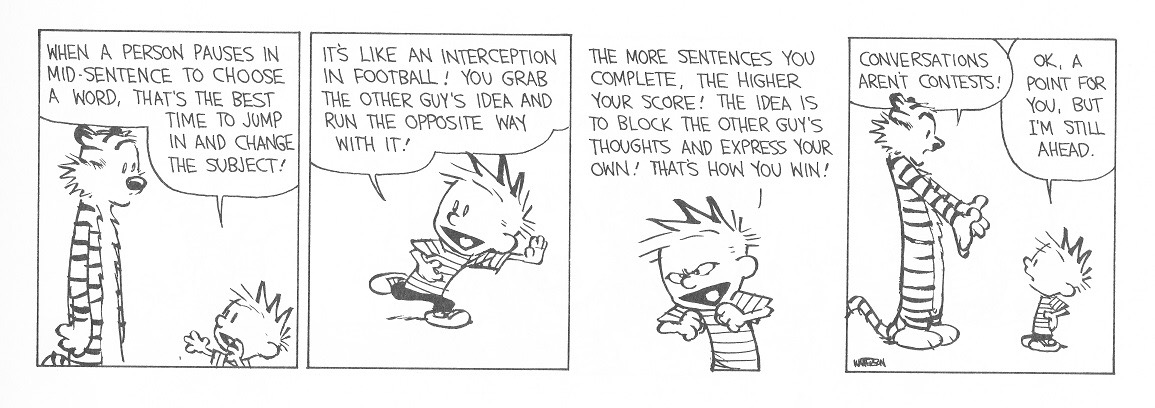
Art is not a contest, and rhetoric should not be something that destroys our fellow human beings. It should be something that enriches each other; but we have to be mindful of those around us, of the environment that we exist in, and the places we come from. We have to remember that we shouldn’t be out to get each other, to prove that we’re right – just like in that old Calvin and Hobbes comic strip, conversations aren’t competitions.
We have to remember that when we engage someone on that front – when we make the argument that someone’s interpretation is entirely invalid – that the person we are talking to is another human being too. That they have a totally unique past and history of their own. Just as Brasch inadvertently disregarded the complex and beautiful history of the Māori literary tradition (just because it didn’t present itself as he expected it to), we can’t disregard the complex and remarkable history of the other human beings around us. This isn’t a dig at Brasch’s personal character, either – he was a remarkable poet and a great lover of the arts. He just happened to be a colonialist figure, and as such brought with him complex ideas and baggage as a writer that we as modern readers can grapple with today – and debate civilly, without attacks on another person’s perspective or interpretation of a work.
The point of all of this is: remember your tone, the next time you decide a work of art has an empirical reading, that it has one and only one correct path to follow towards understanding. Because the chances are, it probably doesn’t.
(I might expand this into a full video one day, should the mood strike me. It feels an important topic.)
If you enjoyed this article, support me using the links below. If you join my Patreon, you get early access to future video essays, plus a place on the Wall of Fameon this website!
PATREON: https://www.patreon.com/hga
PAYPAL: https://www.paypal.com/donate/?hosted...
TWITCH: https://www.twitch.tv/horrorgameanalysis
YOUTUBE: https://www.youtube.com/@HorrorGameAnalysis
 Horrorgameanalysis
What an honour it has been to witness this new HGA golden age! Fully agreed. I think that when it comes to art, actually experiencing the damn thing is just the start of the discussion, and that the myriad interpretations of others – agree or disagree – only enrich your own personal understanding of the art, if you should let them. The idea that there should be a definitive end to the discussion at all seems a shame, let alone when it comes immediately after an “explained” video or something similar. This is something that’s bothered me too, great to see it put into words.
LikeLiked by 1 person
Thanks for this comment and for your prompting of an extended discussion in the latest stream (Amnesia: Rebirth [2] for anyone who wasn’t there).
I think I am just opposed to needless reduction of art. Art should be wonderful and sprawling and colourful. It should be a chameleon capable of changing itself every time it looks in the mirror. For someone to argue that there is only one authoritative way to consume a particular work art… well, that’s just perverse.
LikeLiked by 1 person