
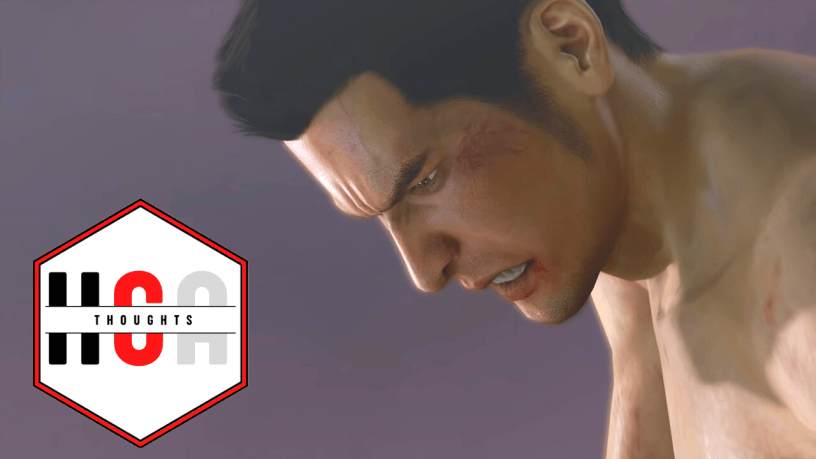
SPOILERS FOLLOW FOR YAKUZA 0

I will be the Dragon of Dojima.
Yakuza 0 is really a wonderful game. I am of course, still in the middle of the epic quest to 100% complete it, which is proving to be a truly herculean task. I will no doubt write a post (or posts) detailing further the process, as well as any particular standout moments of either pleasure or difficulty. But I wanted to take some time today to talk about the final boss of Yakuza 0 – specifically the final boss of Kiryu’s story, Keiji Shibusawa.
Yakuza 0 manages to evoke a kind of dual mood for this boss fight. Firstly, and most obviously, it generates a feeling of excitement, or hype, along the kind of track that the best action movies generate for their final confrontations. I am reminded of the Schwarzenegger movies of the 1980s, most of which end in a thrilling climax. Commando, perhaps, might be the quintessential example: Schwarzenegger’s character infiltrates an enemy island, and singlehandedly slaughters dozens of highly trained soldiers in a fantastically macho climax. It is memorable because it is so over-the-top, yet retains a strange emotional resonance. Commando is a film about getting revenge, and in some sense, Yakuza 0 manages to achieve that with the climax against Shibusawa. Yet Commando is also emotionally resonant because Schwarzenegger plays a vulnerable character (albeit still with enormous muscles).
Much like Commando, Kiryu must fight his way through a flaming boat, filled with the lackeys of the Shibusawa family, in dramatic fight after dramatic fight, taking down dozens of men in great action sequences. The key difference, of course, is that you yourself play out the action sequences. The best parts are left for you. Whereas in Commando you get your validation from seeing Schwarzenegger kill bad guys left and right, in Yakuza 0 you achieve your satisfaction from beating down rooms of thugs.
The other mood that the boss fight evokes beyond this epic action mood is one of emotional satisfaction. Kiryu is a surprisingly vulnerable male protagonist, especially when you line him up against other prominent video game male protagonists, who seem to exist only as vehicles for gruff introversion. Kiryu is one of my favourite examples of positive masculinity, as there is a selflessness and an honour to him, as well as still that strength. He is not afraid to confess his feelings, nor to stand up for himself – and most importantly, for others.
Kiryu’s entire character arc through this game is learning to not be quite so brash or hotheaded, to not pick fights he can’t win. Yet the game culminates with a fight against a much older, more experienced Yakuza lieutenant, Shibusawa. Shibusawa has already gone through his character arc. He has nothing left to “learn”, as it were: his father committed suicide because someone else mooched off of all of his hard work, and Shibusawa uses a Freudian excuse for his bloodthristy ways, saying that without being cutthroat, there is no way to achieve victory.
This is all explained in a classic villain monologue before the final boss, but what I find most interesting is looking back and realizing the whole plot was set up by Shibusawa, who really wasn’t a big cog in the story until about two thirds of the way through. He’s one of the best examples of a villain playing the long game, and one of the best final boss fights because there’s a real sense of catharsis about fighting him.
Shibusawa is set up as the dark reflection of Kiryu. His tattoo of a dragon on his back is fully coloured, whereas Kiryu’s is just the outline. Kiryu is just beginning his journey, whereas Shibusawa has basically already finished his. I think there must just be something hardwired in our brains to enjoy such contests between a hero and a villain, with them just being, in a sense, two sides of the same coin. Maybe that’s why the deplorable MCU keeps trying it? (Words cannot describe how loathsome I find Avengers: Endgame, but methinks that’s a story for another day.)
This is furthered by one of the best video game boss tropes, where the villain literally is a dark reflection of the protagonist’s fighting style. Seeing Shibusawa with his own Rush style, his own Beast style, and his own Brawler (or Legend?) style in each section is pure awesome. When he yells “I AM the Dragon of Dojima!”, there is hardly a better feeling than switching to Kiryu’s Legend style and whooping his murderous ass.
A wonderful game, and a wonderful way to finish it gameplay wise. Satisfying, just difficult enough, with an epic, awesome scale, and emotionally resonant. Awe inspiring.
Also, the music. I mean… it doesn’t get much better than this.
 Horrorgameanalysis