

“It contains for me a strong indication of how beautiful and wonderful life is and how I regret that I will have to relinquish my hold upon it.”
Bowie, on his song “Heathen (The Rays)” in an interview with the BBC
When Heathen was released on 11 June 2002 in the United States, it received a reception that was somewhat warmer than some of Bowie’s previous output. While every album since that of the release of “Black Tie, White Noise” (1993) (in other words, the post “Tin Machine” era) has been hailed as a “return to form” after the twin nadirs of “Tonight” (1984) and “Never Let Me Down” (1987), Heathen was the beginning of Bowie’s truly “mature” sound. Bowie in the 90s was an experimenter, trying to find himself after his commercially successful but artistically struggling 1980s. But in Heathen, Bowie grapples with his own mortality and a feeling of profound change. As the first David Bowie album of the twenty-first century, Bowie is particularly melancholic about that change.
While many point towards the album’s mood as capturing the state of America post 9-11, the album was actually recorded over a two year period, from October 2000 – January 2002. Yet the attitude towards the 21st-century is a frightening one. Tony Visconti, producer of the album, when reflecting on the creative process on Heathen, said: “David was very jovial, but he would go somewhere in the mornings when he was writing these songs. You could see he was really struggling with questions. After a few weeks I said: ‘It seems like you’re addressing God himself.’ The concept of Heathen is a godless century. He was addressing the bleakness of our soul… and maybe his own soul.” Bowie reunited with Tony Visconti for the first time since 1980 and the album “Scary Monsters”, and together the two of them searched through the past to find something worth salvaging to take into the future. “Sunday”, where Bowie sings about how “everything has changed” and how “nothing has changed” pits the two contradictory statements against each other. The song is an alienating but paradoxically absorbing one, and almost religious in quality.
Bowie was particularly pensive throughout Heathen. Not just pensive, but at times actively frustrated. Bowie put it to German news company Der Spiegel in 2002: “Why now, when I [finally] understand myself and others, should I die? What a shit game. Is there no one with whom you could revise the rules?” Bowie retired for ten years after a heart attack suffered at a Reality Tour show in 2003, a retirement most people never thought he would emerge from. He retired because of the health scare, but also because he wanted to spend time with his family and live a life that wasn’t consumed by creating for the sake of others. Yet what he did create, Heathen included, remains the soundtrack to many people’s lives, even after his death.
Heathen for me has soundtracked a not-insignificant portion of my life. My dad would often listen to it when I was very young (it was a new album, then, you see), and as such it was a Bowie I could claim as “my Bowie”. It was also the first Bowie album I bought for myself on CD. The songs are weighty thematically, and at times alienating to engage with musically. As such, it was a fitting soundtrack to write much of my Pathologic Tabletop Campaign to.
My tabletop campaign, developed over 2018 while I was still actively playing the game, was a version of Pathologic that existed in the moment, in a weird state of half-appreciation, half-teasing. It was a trailer for the game, in some sense. Taking place over eight days, the game would place a set of character archetypes (The Doctor, the Priest, the Gravedigger, the Soldier were the archetypes selected for the campaign) on a journey through the town of Pathologic, sans polyhedron, in an effort to keep something for the game to show. Heathen refracted the campaign through its own unique prism. “Slow Burn” is perhaps the album’s most iconic song. It was often the only one to make it onto “best of” compilations, appearing on several countries’ versions of “Best of Bowie”, including New Zealand’s tracklist. In a way, Slow Burn could play alongside a memorial video of Bowie’s life; “Slow Burn” is a song I anticipate wanting to have played at my funeral. It is one of the first songs I remember really finding beautiful, rather than just danceable or sing-alongable. The way his voice soars during the chorus is gorgeous – words cannot quite describe it. I recommend listening to it yourself. (link)
Often I would dwell on the imagery of the song in an effort to visualize certain setpieces or character locations; “the walls shall have eyes, and the doors shall have ears”, Bowie sings paranoiacally, perhaps prophetically, ever-distant from the listener, but also defiantly saying, “but we’ll dance in the dark”. The single was accompanied by an image of Bowie holding a child in a blasted wasteland, striding confidently towards the viewer – there’s nothing to be gleaned from looking back, the image seems to say. Nothing left of value, anyway.
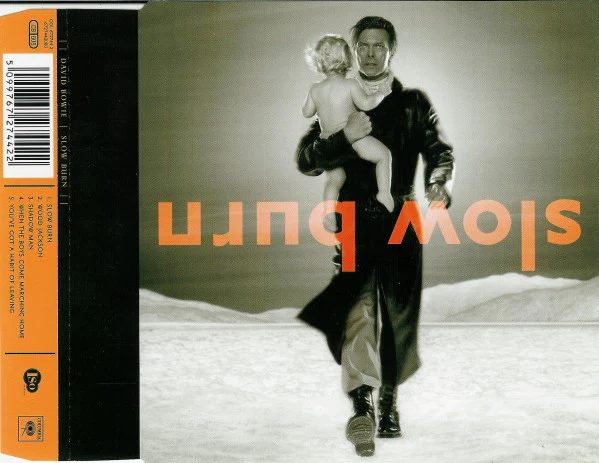
“Slow Burn” is also one of the few songs from this era of Bowie that got an accompanying music video (even if it went unreleased at the time). Bowie didn’t believe there was a point in making music videos anymore (a shame, as he was just as good a visual artist as a singer), so left it to languish.
It raises an interesting question for me, amongst Bowie re-releases, Bowie box-sets, and a glut of Bowie songs remastered from the backlog. I think Bowie – like many artists – should not have everything they ever worked on shown to the world. If I ever became famous (somehow) for my writing, I would not want people posthumously to go through my folders of poems and short stories and so on and share them. Humans want to have secrets, you know? And people like Bowie deserve secrets even more than the rest of us – he can’t give everything away.
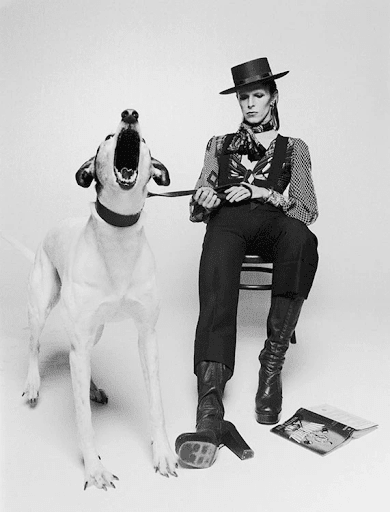
There are a few covers in amongst Bowie’s originals – evidence that there are things that can be gleaned from retrospective thought, just like the emulation of “Diamond Dogs” photoshoots from 1974.

“I Took A Trip On A Gemini Spaceship” was adapted from “The Legendary Stardust Cowboy”, whose “Stardust” moniker inspired, of course, Bowie’s “Ziggy Stardust”. On Heathen, Bowie attempted to revisit that relationship, covering “I Took a Trip On A Gemini Spaceship”. Both a callback to his past and inspiration and a long-overdue royalty check for the Stardust Cowboy, the song is about the lamentation of a lonely man, gazing up at the stars, dreaming of another. Loneliness and space – some familiar Bowie topics, but revisited through a fresh lens. The original song is weird and kind of comedic, whereas Bowie turns it into something slightly more profound – but remember, weird doesn’t mean bad, either. Both versions of the song are great.
I remember I think in the throes of designing that campaign – or really, in the midst of running it – I had this concept for Mark Immortell as a kind of arbiter of justice, a madman just waiting to snap. I discarded the idea of a psychopathic Mark as a useless one. I instead introduced Inquisitor Orff, a replacement for Aglaya (again, me pulling punches to do the game a favour). But Orff actually became a central piece of the campaign. I ended up fusing him and Blok together for the sake of brevity (as the campaign was already very stressful at that point), and made his obsessive pursuit for “justice” reflect on the growing madness of the town. He ended up drowned, his cruel nature cut short. I definitely based his character, at least in part, on the song “I Would Be Your Slave”, a song about a man wanting to have a rigid God in place, an order and hierarchy to things, but ultimately unable to find those things.
“Cactus“, an obsessive, addictive song about a man trapped in prison desiring his lover’s dress that smells of them, is a cover of The Pixies song. The song spells out D A V I D and B O W I E, a cheerful little moment of joy. The live version I have linked also has the remarkable Gail Ann Dorsey on vocals alongside Bowie, and is also worth a look. I remember finding “Cactus” oddly punchy compared to the song placed next on the track listing, perhaps the most strangely melancholic song on the album, a song called “Slip Away“.
The song is a dirge for “Uncle Floyd”, a children’s television program with an odd bent, aired from ’74 to ’98. Bowie used to sit around and laugh at the show’s absurdity, and it was a bit of a cult classic. The song namedrops a variety of puppets from the show; “Oogie waits for just another day”, “Bones Boy talks and flickers gray”. But the most affecting part of the song is Bowie’s chorus, Bowie letting go.
Don’t forget to keep your head warm
Twinkle twinkle Uncle Floyd
Watching all the world and war torn
How I wonder where you are
Sailing over Coney Island
Twinkle twinkle Uncle Floyd
We were dumb but you were fun, boy
How I wonder where you are
I think what comforts me most about the song, despite how melancholic it is, is that while it accepts things are over for us, for that moment, Uncle Floyd’s show still sails “over Coney Island”. Maybe we will die, maybe all things will flicker and shut off, and our appliances will fail us. But Uncle Floyd, and Bowie – and me – still waver somewhere on a wavelength, pressed out into the stars. When I was, I think about fifteen years old, I had to give a little poetry reading on a radio show. It may be romantic to think so, but I like to imagine that in countless centuries, some alien will pick that signal up, and understand absolutely none of it – but it will still sail past that alien too, and bounce off of the stars themselves.
Heathen is at once cold and terribly emotional; it is a cold scarf wrapped around the throat, something that slowly warms on subsequent relistens. I think it is one of the most remarkable albums of Bowie’s career (in a career full of them), and certainly one of the best of his latter-day career. It is worth listening to Bowie in this interview, I think, because he portrays the album in ways I can’t, and has some very interesting things to say.
“It was, an idea, a feeling, a sense of what 21st century man might become, if he’s not already. Someone who’s lowered his standards; spiritually, intellectually, morally, whatever. Someone who’s not even bothered searching for a spiritual life anymore.
Just using the word “Heathen” is better than explaining all that. Because if you wrote all that on an album cover, no-one would bother buying it, would they?”
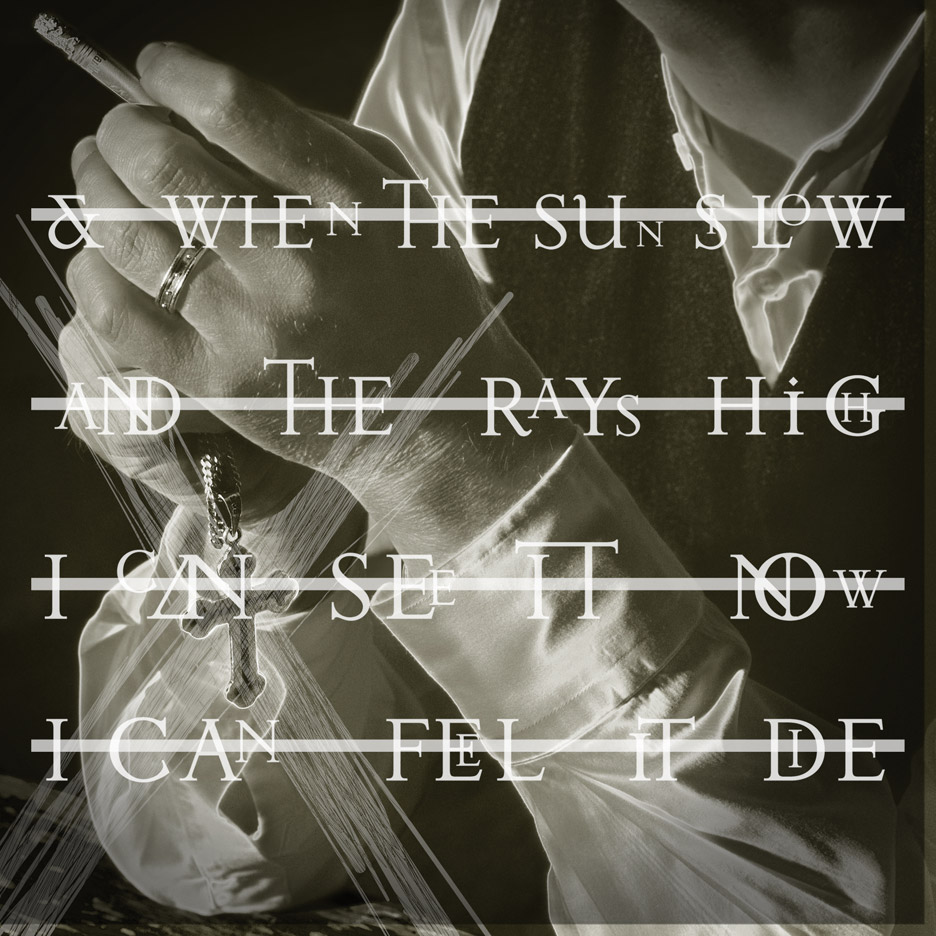
Bowie’s album-closer, titled “Heathen (The Rays)” was actually one I’d never quite understood. That was until I listened to the Reality Tour version, which clicked in a profound way, one day sitting in high school, listening to mp3s in the back of class, watching the sun trickle in through the window. Sadly I can’t find that version on YouTube, but there is a Heathen Tour version of the song which is basically just as good. “Is there no reason?” He laments. “Have I stayed too long?” The version I have shared demonstrates what a fine performer he is. Whether it is an act or not, the emotion on his face his evident as he steels himself to sing. It is a wonderful song. Maybe my favourite on the album, now (whereas it used to be “Slow Burn”, or “Slip Away” – but then again, this can change on every listen). The active musings of a man uncertain of his place in the world, but performing that uncertainty beautifully. And isn’t that the most we can ask for?
(I have one or two more album recommendations if people are interested!)
 Horrorgameanalysis