
The anointing was always done at midnight.
The shadow was cast long over the stone floor. A gilded metal chalice was illuminated by the stubby collection of candles. Stepping close to it, Arkhem watched out of the corner of his eye as the Inquisitor’s gaze followed his movements. Arkhem reached out and grasped the chalice.
“Drink.” The Inquisitor said, eyes buried within the pit of their hood. The word rolled around the cathedral’s cavernous reaches, until it seemed to be all Arkhem could hear.
It was, at last, time to cast off that name.
He touched the goblet to his lips, and felt the sting of God’s venom in his throat.
This was the price one paid for power beyond one’s means.
—
There was certainly interest in Lord Ethal’s government when I last did one of these posts. I thought it was time to finally do some more worldbuilding, and share the world I am constructing with you all again. The government itself is strongly bureaucratic, with pockets of authority installed throughout the Isle.
Lord Ethal, blessed be His name, commands ultimate respect and veneration. In the centuries since He rose to absolute power, the Isle transformed from a once splintered conglomerate of cultures into a supposedly homogenous whole. Yet maintaining a solid grip on the Isle itself – defeating the forces of Chaos and Disorder that threaten its cohesion at all moments – requires Ethal’s full attention. He is preoccupied then by high-level matters at almost all times, and is rarely seen in person.
He instead utilizes Envoys, which are either physical manifestations of his power – akin to ghosts – or are otherwise possessions of Inquisitors. Creating Envoys still allows Ethal to act independently, meaning that while His power might never be felt in person, a fraction of his power – or several fractions – can often be found wandering the Isle, performing tasks that Ethal does not have the time to do in person, nor that He wants to delegate.
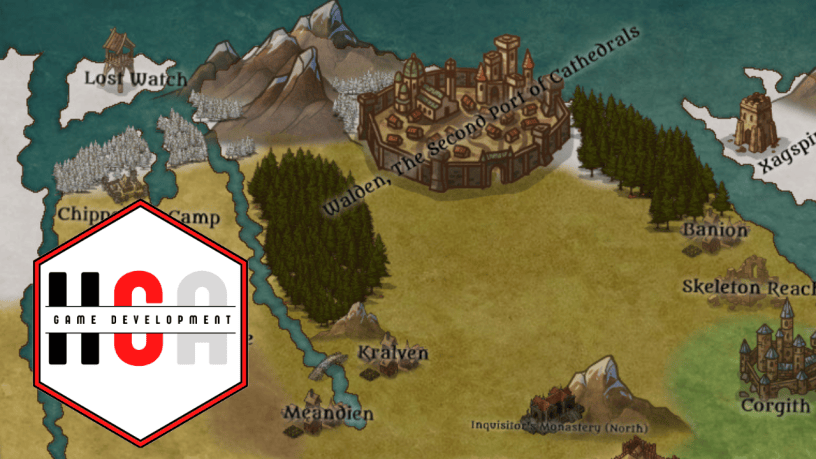
But of course, Lord Ethal, despite his remarkable power, cannot do everything. Delegation is the key to a successful empire, of course, and Lord Ethal’s is no different. There are swathes of bureaucratic administrators at many levels of government, both at an empire level and a regional level. Tax is collected by caravans of guards sent from the capital, which resides just to the southeast of the center of the Isle. Laws are, for the most part, decreed from the capital and established for the entire empire. However, certain laws are regional, and come into effect based on the individual cultures that once lived there, and are also responses to certain monsters and monstrous entities within those regions.
The government is responsible for a lot of overhead administration that pays for empire-wide roads, security, and other infrastructure. Generally, the further north you go, the worse central governmental oversight becomes. The northern territories were the last to fall to Ethal’s rule, and are also the most distant. The snowy peaks are home to all kinds of monsters, and, some whisper, even unconquered tribes who do not pay even lip-service to the glory of Ethal.
Governmental structure obviously has Ethal at the head. There have been, over the centuries, a few times when Ethal is, for one reason or another, unable to rule, nor to delegate. During these times, the Assemblage runs the country.
The Assemblage is a parliamentary body made up of three distinct groups, none of which have gender restrictions. The first, the aristocracy, is simple enough. Nobles often elect within their own families a representative, but other times, the head of the family, or the eldest, is assigned to represent their family at the Assemblage. As long as a noble family has representation at the Assemblage, they are not breaking the law. A family who goes too long without representation at the Assemblage is punished for a lack of engagement in relation to their responsibilities.
The second seats within the Assemblage are the academic or learned seats. Many of these individuals come from the various higher learning institutes around the empire. In fact, most are representatives from a particular university, monastery, or religious college. There are a few independent representatives within the Assemblage. These representatives are generally learned and venerable alchemists, who are put forward by certain towns. The academic seats are hotly contested, and many of the independent seats are open to the highest bidder for certain regions. Clusters of villages or towns often compete to put forward the representative that will best represent their interests, rather than their neighbours.
The third category of Assemblage seats are warrior seats. Most, if not all, warriors are expected to be highly religious. It is not unheard of that those Assemblage warrior members can be hand-picked to undertake Inquisitorial training. Warriors in the Assemblage are often famed and reputed for slaying enemies of the realm. While there are occasional rebellions, in which generals or esteemed fighters are awarded Assemblage seats, most of those sitting in warrior seats these days are monster-slayers of one kind or another – or either are, or were, Inquisitors. While all of the Assemblage categories are expected to be highly loyal and religious, it is often the warrior class that has the most fervour.
It is important to note that even the esteemed members of the Assemblage are expected to answer to Inquisitors. The Inquisitors’ mysterious ways, and powers granted by Lord Ethal Himself, mean that there are very few within the government who do not take them and their threats seriously.
Beneath the Assemblage are other servants of government. There are an enormous number of individuals employed as scribes, for instance, as there is much information that must be ferried back and forward between centers of civilization. Most noble families employ multiple scribes, as they are each in the business of needing their thoughts transcribed into written form. There are also priests, who give weekly rites, if not in a religious building, then in a town square or other public forum. Government-hired heralds are entrusted with spreading the correct news.
Soldiers are an interesting case. While tax collectors, scribes, and messengers are often given state-paid guards and soldiery to travel from town to town (avoiding bandits and monsters), there often is just not enough funds left in Lord Ethal’s coffers to pay for all the soldiers required. This is where the local ruling class is expected to pick up some of the slack. Local nobles often field retinues of their own – from the size of fifty men in the cases of smaller families, to over a thousand in the case of some of the larger towns – this is to say nothing of the number fielded by those in the cities. Though the city’s nobility-hired soldiers are often bolstered by state-paid soldiers. This is to ensure balance. Restrictions are ultimately placed on the number of soldiers each aristocratic house can hire, and if you are found to have been going over the limit, your books tend to be balanced for you.
There are a variety of vocations for the less-educated types, those who cannot afford to learn how to read or write. In modern times, we often take “literate” to mean this ability – but wandering storytellers, for example, are not “literate” in that sense, but have a keen mind for stories. Wandering storytellers are often also able to play instruments, such as the hurdy-gurdy, the flute, or the lute. There are also, of course, a lot of farmers. Farmers generally tend to own the farms they work on, though in poorer regions, quite often the nobility or merchant class will “sponsor” farmers, and will take much of the profit from the farm in exchange for keeping people fed and in work. Lumberjacks often fight losing battles with the particularly large wilds in the west of the Isle, and enormous forests permeate much of the Isle anyway. Only in the north and south are there flat, arable plans for large, seemingly endless stretches of farms. This is not to say there are not farms everywhere – there are – but it is in those places that food production is, in some sense, industrialized to a larger scale.
Technology is, by and large, totally anachronistic to a particular period. I will utilize whatever technologies I feel are appealing. The telescope, for instance, which appeared in our world in the late 16th century, is a feature of the Isle of Ethal. By and large, though, you can imagine the 1300s. The Isle is also totally isolated. Sailors who have attempted to find new lands never returned. Whatever it is they found out there, it seems no-one will ever know. Sailors instead are used to shepherd goods through sealanes, cutting out some of the travel time. Ships do tend to be expensive, however, and given that people in the Isle prefer to take boats out on less-tumultuous lakes rather than the legendarily frightening ocean, hardy seafarers are rare – and well-paid for their trouble.
Those who fail to get a job within the societal bounds tend to become wandering bandits, which plague isolated villages and back-country roads. Periodically, large forces of soldiers will sweep through and eradicate bandit influence from a particular area – but often it is left up to local heroes to deal with criminals wherever they appear.
—
Three blades draw in front of me, each one shimmering in the summer twilight. I take one more puff of my pipe, then toss it towards the three figures. It clatters across the wooden floor to rest at their feet.
I stand to my feet, grasping my ax, which, as always, is resting right beside me. It is heavy in my hands. The burden of death rests on my shoulders.
A blade moves towards me in the coming darkness, and I shift the ax up to meet it.
In my dreams, I always do it right.
—
I have been reflecting recently on the potential of game development. The problem for me is the knowledge that if I was to make something with the scope I wanted, this would consume my creative schedule for years. To commit to a large project individually is to commit at least some of my free time, wherever it may be found.
The text-based story is first, rest assured. I feel as though I may need to move from Twine, as after writing a prodigious amount for a couple characters’ conversations, the editor itself has actually clogged itself up. What is normally a node-based system, which is so delightful for smaller stories, has become a labyrinthian, overlapping mess. I searched for a way to increase the size of the editor, but so far, have found nothing. Maybe I’ll find a solution soon.
But after that project is done, I have three places to turn. First, a classic survival horror game with a comprehensive design document already finished. Second, a smaller survival horror game with a tongue-in-cheek style. And thirdly, another game set in the world of the Isle of Ethal.
Words can’t describe the joy I feel in resurrecting a world like this – and not just resurrecting it, but giving it new life, giving it more than it ever had before. My list of created worlds is still long, and many will likely never see the light of day again, but it has been a pleasure to reforge it, to make it what it perhaps always should have been. The third potential project, a game set in the Isle of Ethal, would pursue an aesthetic similar to that of Din’s Curse and Dungeon Siege, but would utilize cRPG-style conversation trees and a choice-based system. Of course, this is a dream likely long in the future. But it is a dream nonetheless.
I plan to use the end of the year to finish a first draft of a novel I’ve been writing, as well as to finish some videos. I also plan to use the time I will be given after finishing a particular project in October to work on this game. It feels like a privilege to be able to have this time, to be able to work on creative things that I care about. I recognize how fortunate I am, and I am grateful for that every day.
There will be more to come. For now, I’d love to hear if anyone has any thoughts on what I’ve detailed today, or if there are more details you’d like to hear! I’m happy to oblige and indulge.
Game Design Reflection 3: Government
 Horrorgameanalysis
I really love the lore-building in these articles, it builds such intense fascination in a way that a lot of other fantasy media never does for me.
Also, thanks for elaborating on the specifics on His Lordship’s government in such detail, it certainly answers everything I was curious about! I was a bit worried that my last comment rambled too excessively to get my point across, but I’m glad you found it helpful rather than nitpicky!
For the record, I first read this article not long after you published it, but I’ve put off commenting for quite a while due to being busy – I figured I’d either comment now or randomly remember to comment three months from now, so here’s hoping I’m not too late.
LikeLiked by 2 people
Thanks for replying, no matter how belated! It’s always appreciated. I am glad you enjoy reading them. May I ask what it is about my articles that builds this intense fascination, which does not exist for you in other fantasy realms?
LikeLike