
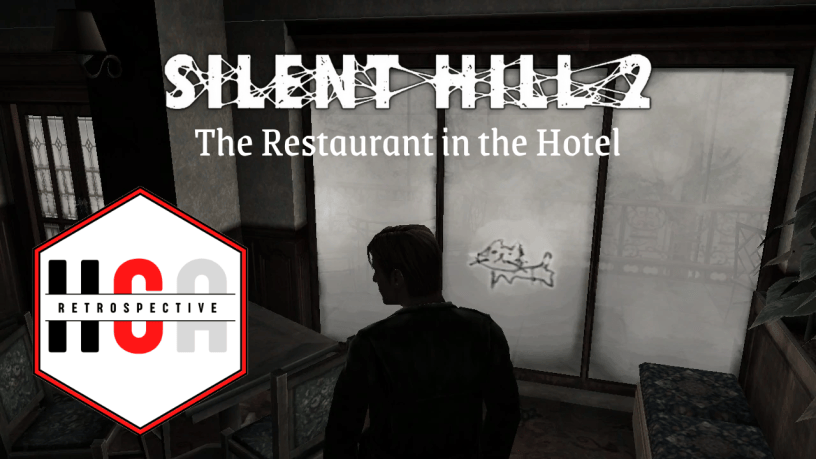
In many ways, I already consider this video to be the misbegotten child of my videos. It was written over a period of time I would consider to be too lengthy, then left to fester in my documents folder for far too long.
I’m being awfully cruel, aren’t I? No, what I really mean is that this video was almost like hitting a restart button. Or at least, beginning the next step of my channel’s evolution. There’s a lot to learn from this video – how and why I should continue to cite other sources. How I should make academic content more digestible for audiences on YouTube. Academia doesn’t have to be dry and boring, nor should it be focused entirely on classic texts, or canonical texts. That latter point was a particular sticking point for me in relation to this video.
I’d already done quite a few Pathologic Character Analyses by this point – I was comfortable with that format, with just speaking in front of still images. Those videos involved doing the bare amount of editing, because I was terribly inexperienced at it. Editing together a video was another thing, a different beast entirely. Even worse, was editing together a video on Silent Hill 2. A truly wretched idea, looking back on it. Like facing off against a tidal wave of expectation. Even just by starting here, I had corralled myself. What new things could I possibly say? To say that it is a part of horror game canon is an understatement – it is the horror game canon. The gold standard.
This was, however, my first real attempt to crystalize my thoughts regarding spaces in video games. Looking back on it, I relied too much on plot recap and overly descriptive prose rather than researched analysis, but I was still pleased with it at the time. I’m still pleased with it now, despite my admittedly harsh self-criticism. My favourite takeaway from that video was actually a descriptive passage that nonetheless sums up my thoughts on the space using tactile sensations like feeling and smell, something that a game cannot provide by itself:
“So the restaurant is definitely closed. You haven’t seen any locals here your whole way through Silent Hill. There’s certainly no reason to guess there’d be any here. But it doesn’t seem like a place for monsters either. No particular grime or decay, no shuffling noises. The chairs are stacked quietly on one side of the room atop tables, which seem to have been packed up one night. They have been left all alone. It is as though the restaurant closed doors one day, and never reopened. No-one, it seems, has bothered to sell or throw anything out. The things in this room exist in some weird flux state. A lot of the town is bitterly decayed and abandoned, but in here, there’s a gentle stillness. An unspoken melancholy in the space, a lament for the things that go without goodbye.
[…]
I don’t need high-fidelity graphics to understand the way in which the window must be wet with condensation, how if I rested my forehead against the glass, it would come away cool.”
I’d probably write it a little differently today (but what writer wouldn’t mess with their previous work?), but I think what I’m trying to say still stands. The actual feeling of the area and how we relate to it ourselves is what is most important. The subjectivity we bring to an experience is just as important as the objective elements of a text. Nowhere is this more relevant than a video game coloured by intense emotions. We define the pace of those kinds of texts, meaning that it’s not just the traditional narrative sections that have to do a lot of narrative lifting. Instead, it’s the stretches of gameplay in between that have to create meaning.
Some games might be totally unsuccessful at doing that for some people – again, the subjectivity of play is, well, at play here. The restaurant did that for me, despite the fact it’s so short and almost meaningless in the grand scheme of things. It’s a wonderful area, as I elucidate in the video.
But it is curious how some games can elicit deep emotive moments of reflection from me, while others, even in the same genre, totally fail. Some of this comes down to deliberate design, but other times, I find an area or a gameplay beat, or even an item, that hits me just right. I’m a naturally melancholic person, and despite my best efforts, I think I find myself haunted more often than not. This video was, even if I didn’t quite realize it at the time, my first movement towards haunting. Towards the tantalizing feeling of self-discovery, as processed through now-ancient survival horror video games. What a strange, wonderful journey I’ve been on.
I wrote in the description of this video, “I hope this video essay is also a step towards better, more exciting video content for this channel”. I think it was. It’s a long road from here, though, past-HGA, and there’s still lots to go. And, even reaching the point I’m at now, looking forward – I can still see many more mountains to climb. I’m looking forward to them.
Here’s to you tagging along for the ride too.
—-
There’ll be more of these reflections to come. Later ones will probably be a bit longer, and a bit more detailed, because there’s more to respond to. I’ll probably also post (or repost them) in a series on my Youtube Community tab at the end of the year, leading up to Christmas and the release of my Silent Hill 4: The Room video.
My sincere thank you to everyone, and a deep apology to people for not being able to stream recently. Turns out the reason I can’t use the streaming room for a little while was down a noise complaint… apparently I’m just that passionate about horror games 🙂
 Horrorgameanalysis