
“Hide in your caves, in your ruined forts, in your secret lairs. Raise your minions, summon your servants, cast your spells. Answer the call of the Order when you are needed. Watch and listen.”
– An excerpt from “Brothers and Sisters of the Worm“, a readable text in The Elder Scrolls IV: Oblivion
“Necromancy is inherently dangerous. One cannot ‘dabble’ in it. The simplest spell requires the spilling of blood, and immediately begins to corrupt the caster’s soul. This is not conjecture, but simple fact. It is irresponsible of the Guild to teach and thereby encourage a sort of magickal study which has proven itself, time and time again, to bring nothing but terror and misery on the practitioner and world.”
– An excerpt from “The Black Arts on Trial”, a readable book in The Elder Scrolls IV: Oblivion.
The following contains spoilers for The Elder Scrolls IV: Oblivion (2006).
When you think of the word necromancer (particularly in relation to the fantasy genre), what do you think?
I think of lurid darkness. The allure of playing with the most primal force in existence – death and entropy – and contorting it, turning what was once a straightforward process into a subversion of power. But necromancers, as presented in many works of fantasy fiction, are also obviously, blatantly evil. This is easy to enforce; particularly given their dress sense. Some wear skulls; most are fond of sweeping black cloaks and the darkness of night. Bleached white bones contrast with the drooping, mottled flesh of the dead. The once-dead struggle to remember how to walk, and their actions are performative – performed in service of the necromancers, who leverage this most awesome of powers in the service of more power. They should be forces of nature – truly indomitable beings whose presence in a story upends the status quo and creates a deep uncertainty about one’s own life – and whether it is right to quest against the inevitability of death.
Yet, the necromancers in Oblivion are not like that.
The world of The Elder Scrolls IV: Oblivion is, for the most part, relatively safe fantasy. It is constructed of tropes we have seen many times before – albeit bundled in an elegant, fun package. It is a broad world made up of interlocking systems – that, while they are prone to failure, create a simulationist feel to the world. Particularly for me when I was younger, these simulationist elements – perhaps as simple as they might now feel, and as absurd and bug-ridden as they were – added dynamism. They created the impression that the world was different every time I played it. That because the characters had routines and moved around town, they were able to present at least the illusion of a world that lived without me.
The cities were legitimate safe havens for a younger, more easily frightened me. They were bastions against the untamed, demon-filled wilds of Cyrodiil. It was, for me, a world demarcated by the safety of civilization versus the unknown of the wilds. Worse than that was the fact that all around me was the evidence of the power of the wilderness. Venturing out of the cities or the sparse villages, one finds ruins of all kinds. Ruins of the ancient Elven Ayleid civilization, toppled in countless years past; there are caverns of mines that no longer function, and are inhabited by raiding goblins; there are, perhaps worst of all, the direct evidence of the failings of the empire that you are nonetheless entrusted to save – ruined fortresses.
There is a strange, perhaps even awkward, disconnect between what we hear about the glory of the empire, and the desolate nature of the landscape of Cyrodiil. Fortresses, even placed in the middle of roads (such as Fort Ash on the route to Chorrol from the Imperial City), are not manned by any state military. They don’t even sit abandoned – they have been invariably claimed by one faction or another. Fort Ash, for example, is occupied by goblins. But there are much worse things than goblins – at least for a younger me.
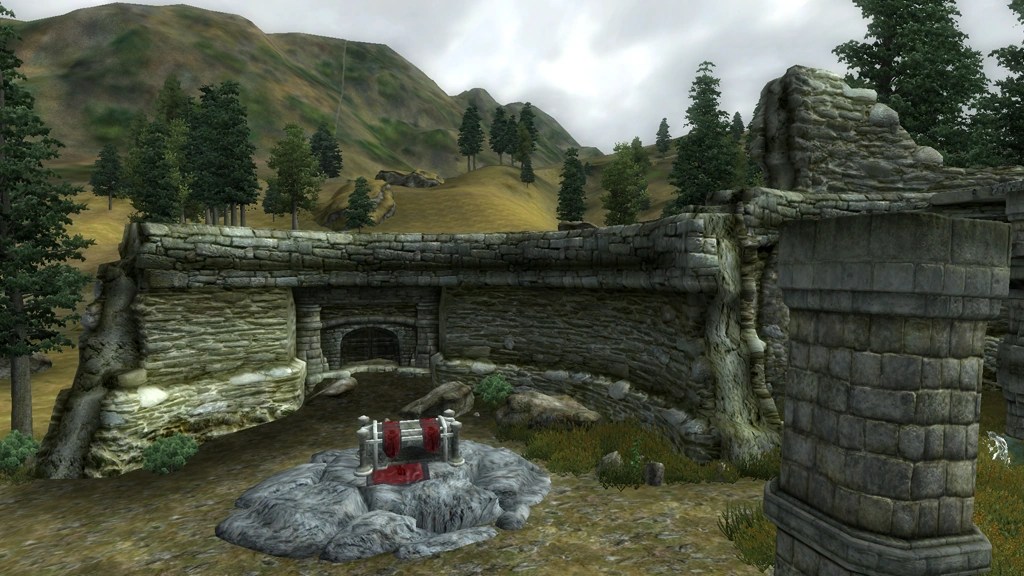
Take, for instance, Fort Linchal. It is fairly remote, built to the north of a city which was massacred before the game even began. It has, perhaps, been ruined for centuries; cited as it is in a necromancer’s handbook as a place to go to create the soul-stealing gems that capture sentient souls. But nonetheless, it has the trappings of Imperial splendour. That splendour can be nostalgic – but also like a siren’s call. Ruins are unique, as Paul Zucker argues in his article “Ruins: An Aesthetic Hybrid”, since “the emotional impact of ruins is ambiguous: we cannot say whether they belong aesthetically in the realm of art or in the realm of nature” (1961, 1). The ruins of this mouldering fortress contain a symbolically resonant kind of enemy. The necromancers.
They are, much more potently than perhaps your humble bandit or marauder, symbols of resurrection. Of an obsession with death, to such a degree that they live amongst it. Worse – they pervert the cycle of decay by changing the certainty of death into something else. Florence M. Hetzler writes in their article “Causality: Ruin Time and Ruins”, that the “castle of Siegfried de Rachewiltz, the grandson of Ezra Pound, provides a good example of what I term a ruin […] one cannot say where that nature ends. One is aware of clouds, snow-capped mountains and wildflowers; the sound of hand scythes as the farmers cut the hay, the sound of cowbells as the cows go down a path near the castle; the movement of the black-and-white cows and the maids who lead them down the path; the musty smell within the walls and the touch of the ruins includes the experience of oppressive heat and the presence of sheep, goats and shepherds as well as the edifice itself […] One is also aware of the fact that the castle is placed on top of a mountain and stands as a presence in the shape of a great ship. Instead of being surrounded by water, its location is enhanced by fir trees and the sound of birds. The walk up the mountain to the ruin is also part of the ruin.
This castle is a ruin, whereas Schloss Brunnenberg, in Merano, Italy, where Siegfried de Rachewiltz lives with his family, is a ruined ruin.” (1988, 52)
Necromancers create these ruined ruins naturally; rather than leaving the body to decay, or the spirit to pass on and become something new, they draw them back to the earth, making them perform like puppets or act as monsters. Within the world of fantasy, necromancers are uniquely perverse, disallowing our cultural concept of the end, refusing the junction between human and nature that always erodes the human, creating ruins out of our bodies, edifices from our bones.
To that end, the zombies within Oblivion were always so striking to me. Because they are so obviously monstrous. Hideous green flesh, with exposed innards looming out of both their bodies and the darkness, these zombies lurch with a surprising speed to their gait, and make horrible noises to accompany them. They are genderless, yet visibly, identifiably human. They are the second enemy type fought in the game – the tutorial dungeon is made up of rats, up until the player rounds a corner and meets one of these nasty looking creatures. Their monstrous features are so simply done – in a way, they are zombies at their most raw and effective. The vision of the body destroyed and distorted by death – an obviously dead body – is distinct. The rest of the dungeon has goblins, sure – and they stuck a goblin head on their goblin magic staff – but they are not as exact reflections as a human zombie.
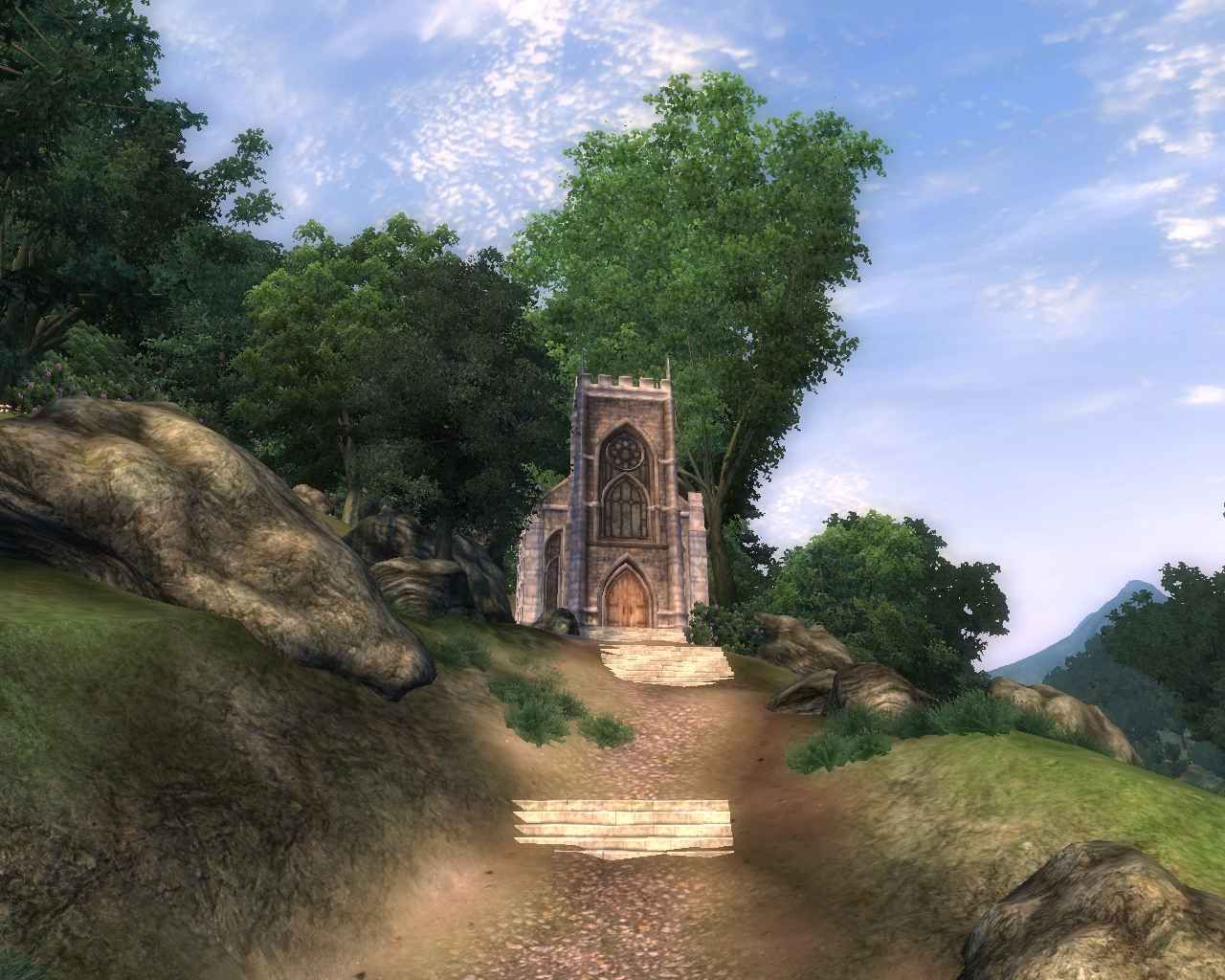
I will always, always remember Cadlew Chapel. Fort Linchal is so distant, so isolated, and almost forgotten. It is a ruin that became ruined a long time ago. The walking corpses within them – and the necromancers that occupy the place – may be ruins in motion, but they themselves are couched in a kind of comfort. The disaster that struck this place, this monument, has passed. All that remains are small evils; we can deal with those with blade and ax.
We can deal with evil with blade and ax in Cadlew Chapel too, but the evil is much more recent. We get the impression that we could have saved them, somehow, if we’d arrived there earlier. Two necromancers have killed and looted their way through what we can presume was once a humble chapel on the edge of Niben Bay. These ruins were striking to me because the icon on the map was one I should have been able to trust. It was the symbol of civilization, not a ruin, nor a dungeon; yet it had been destroyed. The symbol remained the same, though. Periodically, I would return to this place and kill whichever new necromancers had come to occupy it.
Necromancers feature large in the Mages Guild questline, where they become the central antagonists. I always found them wobbly and unconvincing while playing through the quest. They are easily defeated, and their boasts, far from making them more threatening, merely make them sound like whiny brats, unsure of their power. One of them – their leader, in fact, Mannimarco – rattles off boasts about your “vain attempts to destroy me”, but is felled in less than a minute afterwards. These enemies, which are supposed to be so lurid, so taboo, end up as nothing more than fodder for the sword of the adventurer, or their spells.
Necromancers are historically very interesting. They were an intermediary between our world and the spirit world; for the Western world, these ancestral beliefs come from the Greeks and Romans. Given that this is Western fantasy, it is worth examining this tradition. Daniel Ogden, in his book “Greek and Roman Necromancy”, writes that “Death, the dead, and eschatology were subjects of infinite interest and reflection and, consequently, subjects of many contradictory attitudes. In such a context, it was inevitable that necromancy or something like it should thrive, and that it should itself in turn be a topic of much thought and of much contradiction” (xvi, 2001). Necromancy, in reality, is a way of coming to terms with and examining death, and what it means to us as human beings. If the resurrection of the dead was universally available and possible, I do not believe I would necessarily be in favour, due to my own personal beliefs about the importance – however terrifying – about a natural end to one’s life. Necromancy was a way of examining that. Provocatively, Ogden writes: “In other words, the pressing question at the broad psycho-sociological level is not ‘Why did the ancients practice necromancy?’ but ‘Why don’t we practice it?'” (xvi, 2001). In other words, why is necromancy as a concept so distant to us today, so relegated to the aisles of fantasy fiction? In a world where death is just as mysterious as it has always been, just relegated to the periphery of our ever-busy modern minds, should we not all be trying to communicate with the dead?
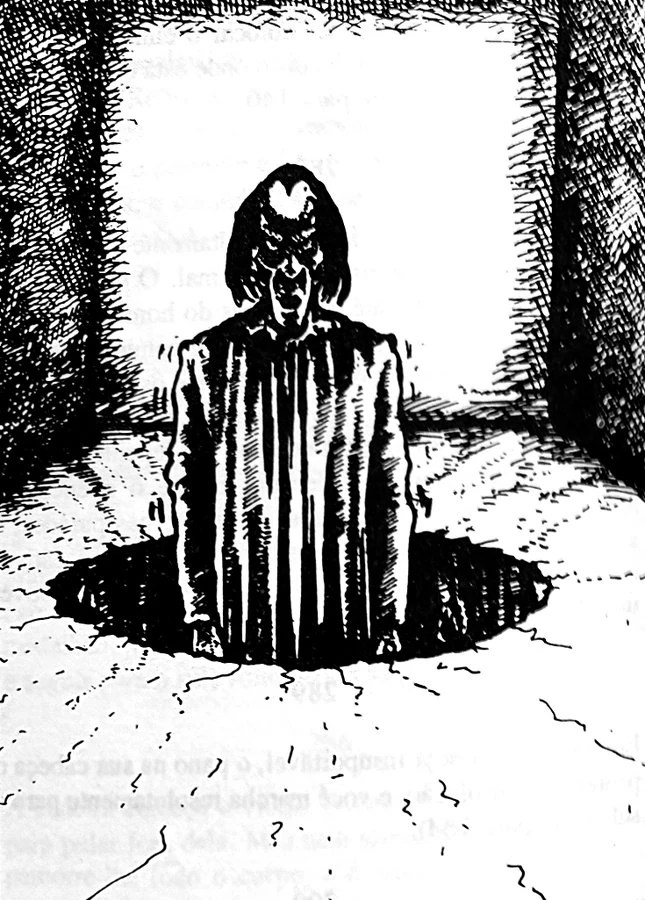
Necromancers are such a good idea within fantasy fiction, regardless. I think I probably first encountered the idea of necromancers – or at least evil sorcerers – within the pages of Fighting Fantasy, the gamebook series from the 1980s. The book Temple of Terror, for example, has a fairly one-note evil sorcerer known as Malbordus. The image of Malbordus rising slowly from a pit in the ground is fantastic, because firstly, I think it speaks to a stereotype. But that can’t have just been it. Malbordus rising from the ground is a promise of darkness, of something unfathomably powerful and malevolent – but he’s also afforded that status because he’s embedded within a static narrative. The dark necromancers and sorcerers of those gamebook are fallible, and are meant to be defeated by the player – but they’re also (generally) competent, threatening, and quiet, looming presences in the story.
The stories are shorter than hundred-hour-long RPGs, meaning that they can be scarcer on the combat, having enemies appear as more distinct threats than in an action/adventure RPG like Oblivion. When a truly threatening enemy does appear, they can act within the bounds of your imagination. When you face off against a necromancer boss enemy in other video games, they are often threatening, imposing, and perhaps speak few words. But in Oblivion, they spout hackneyed, vain boasts until they are slain. They are all flawed.
To make these figures – supposedly representations of the nature of evil and death themselves – weak, distinctly human entities is a choice that, I think, works – despite my argument to the contrary just a minute ago. Because these necromancers, far from being representations of evil, manifestations of humankind’s collective dark desire to break the “shackles” of death – well, these are just people. Misguided ones, and still pretty cartoonishly evil – but the fact they’ve got nothing to show beneath their bravado makes these some of the most unique necromancers in video games, I think. They are empty, vacuous enemies, who summon undead and try to constantly flee players in order to fire off more annoying spells – or, in their more foolish moments, run straight into a swinging blade. They populate the entirety of a sidequest questline, and feel remarkably ineffective. It is all just made worse by their boasting. They are monsters who believe they are gods.
When they are defeated, and the player rises to the top of the Mages Guild in Cyrodiil, the necromancers still populate the world. Independent cells still crop up in Fort Linchal, Cadlew Chapel, and other such pockets of the wilderness. I often wondered about them. What drew them to the cause? They are, of course, just meaningless enemies generated as fodder for you, the great hero, to slay.
Within the narrative of Oblivion, the necromancers are an underground movement. With the practice banned from the Mages Guild in some effort to sanitize the outward look of the guild, they drive the study underneath the surface. Suddenly lawless, these various necromancers take flight and become generic enemies to be slain. They are forces who are demonized within the gameworld, and made pathetic by their inefficacy.
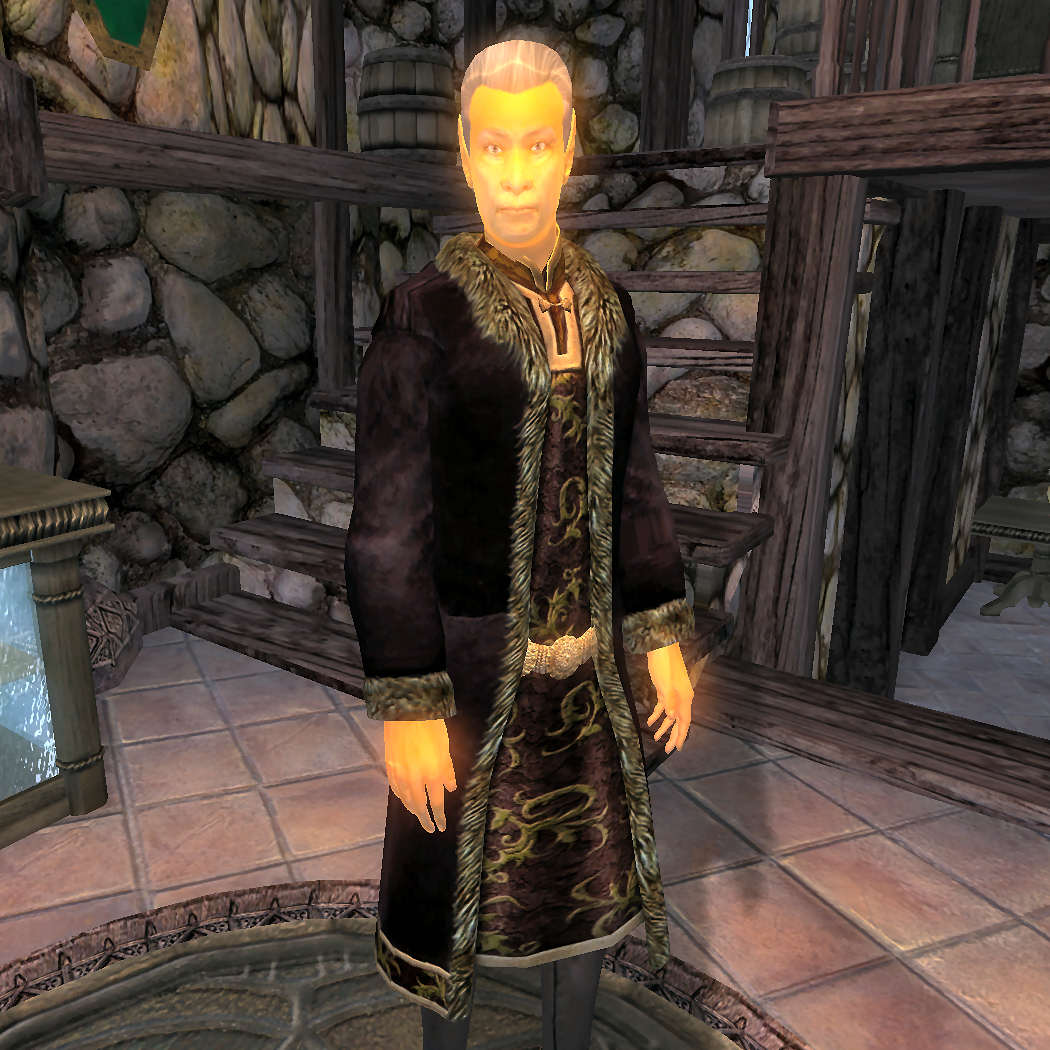
There is one real obvious exception to this rule, and that is the High Elf known as Falcar. He is, at one point, the leader of the Cheydinhal chapter of the Mages Guild. Cheydinhal is a small city in the province of Cyrodiil, and the questline in that city for the Mages Guild is one that revolves around investigation. Falcar asks you to swim into a well and retrieve a ring. But when you go to get the ring, you find that someone is already down there – a corpse. The corpse of a previous student who failed Falcar’s little test. He picked up the ring and found it unexplainably heavy – so heavy, in fact, that he drowned trying to take it out.
When you inevitably circumvent Falcar’s murderous trick, you return to the guild to find him gone. He flees, so visibly, cartoonishly evil as to be almost parodic. He was a total jerk, aloof and mocking. It is no surprise he is evil. Oblivion often signals its villains in this way – deserving of comeuppance, because they violated social norms in this way. Falcar is yet another pathetic necromancer, who has no backup plan, no extra scheming spell he can throw out to deal with you. He reappears briefly as an enemy in a quest much later on in the whole Mages Guild storyline, but is pretty easily slain.
Then you have, finally, curiously, the case of this obscure NPC known as Baeralorn. Baeralorn is a Wood Elf mage who serves as the court mage for the far western port city of Anvil, one of my favourite places in the game. It is scenic and melancholic and resides at the edge of the world. When I was younger, I saw Anvil as the final point to the world – that beyond it, there was nothing. That when I had explored the highlands surrounding, I had, in some small way, conquered the known world. What a fantastic feeling that was.
But Baeralorn – he’s a complete and utter nobody. He has no greater part to play; he’s not even got, to my knowledge, any real, unique dialogue. His introductory line is about it, and it is painfully dull: “I’m Baeralorn. Anvil’s castle mage. Perhaps you’ve heard of my work on magical resistances.” No offence to the man (he does have quite an awesome mohawk), but he’s so forgettable. Soporific, even.
Unlike Anvil, and the exquisite beauty and adventure that surrounds it, there’s no substantive feeling to Baeralorn. He is, on the surface, the ultimate in non-player character design; seemingly a total void. Insubstantial. Yet, the game marks him inside the code as part of the “Necromancer’s Cult” faction, same as Falcar is marked later on in the game. The factions essentially tell the character who to side with during certain combat sequences. They don’t attack members of their own faction, unless forced by a Frenzy spell. So Baeralorn, this absolute nothing-nobody of a character, who spends three hours a day outside from 2 til 5, then spends literally all night (til 6am!) studying… necromancy. Sure, the game doesn’t exactly show it as “necromancy”, per say – he doesn’t have skulls or effigies strung up in his room. There are no grotesque blood rituals. He doesn’t rise from the floor like a Malbordus, or even have anything cool to say, or to do.
But he functions, in the end, as a character illustrative of the best of world design mixed with world building. Baeralorn has a forbidden necromantic text in storage. He performs quiet experiments, then sleeps from 6am til 12pm. He does this because necromancy is a demonized practice. But not demonized in the way the Darkest Dungeon Necromancer is, say. That necromancer is a void in a cloak and hood. But in Oblivion, necromancers aren’t cool. They’re a bunch of rebellious chumps and/or dicks, who lurk in these distant ruins. Baeralorn reveals the one and only possibility (to my knowledge) that necromancers might be something else. But he also doesn’t create ruined ruins without a player provoking him. He does not shatter death or summon zombies or skeletons on his own. He is, still, a necromancer only when the player appears to challenge him.
Their influence on the world is minimal; their threat level might start at the “intriguing” stage, but they become more and more sad the longer you face them. Worst of all is Mannimarco, again, whose presence on the screen is that of a limp noodle. His vain proclamations do not match with his mechanical deficits; the developers did not give him enough defences for the abuse the player is able to hurl at him. The reality of Mannimarco destroys the necromancer’s finest hour, which is when they storm the Bruma Mages Guild hall, and kill everyone there, barring one survivor, who was invisible. But the survivor relays:
“I couldn’t believe my eyes. I think the only reason I’m alive is because I was invisible… but even so, I think he saw me. He killed them, one by one. Volanaro was last, I think. He was trying to run away, but he didn’t make it, did he? The King of Worms stood over him, right before he died, and he… well, it looked like he sucked out Volanaro’s soul! He said something about Echo Cave, and destroying the Mages Guild. Then he looked right at me, and grinned!”
What else is there to say but how chilling? How chilling is that? You wander through the flaming wreckage of a building destroyed by an evil death cult of people, and find that this necromancer is so evil, so powerful, he can suck out a person’s soul and see through cloaks of pure invisibility.
The political reality set up by the game is more interesting than the story the game is ever allowed to tell. The framing is great; here we have a story about an outlawed scholarly practice, however flawed or stereotypically evil it is. There should have been a stronger undercurrent of betrayal and uncertainty; who can you trust? You could have had a deeper meaning to Falcar, a greater arc for him. What if Falcar (or an equivalent) had been someone who slowly decayed as the story went on, someone whose faith in the system was shattered. What if necromancy had been something not just luridly dark, something malevolently evil, but something that had manifested as a scholarly desire? Something that wasn’t just patently evil, but either a curiosity – or as something akin to how the Dark Side is presented in Star Wars. A road paved with good intentions, as they say.
But it is no use speaking in these hypotheticals. Oblivion released in 2006; a world away from me writing this piece now in 2024. The necromancers in Oblivion are figures, ultimately, like Baeralorn. They exist in the shadows of the world, scuttling around in ruins or backrooms, and who flinch from the light. They exist either to be slain, or to be ignored. Their few dastardly feats are overshadowed by their various incompetencies. Mannimarco is so poorly presented as a final boss for a questline, players believe that it wasn’t even the real Mannimarco, that it was some imposter. Sometimes, stories stumble so hard, we cope by fixing them ourselves. The person I was back when I first played it still exists, in a small, joyous kernel. Reflecting on it now is easy, because I spent so much time there. The act of reflecting on it is an act of resurrection. Perhaps I become a necromancer too, just by indulging myself in this way.
I can remember clearing Cadlew Chapel one time. It was late at night, both in my physical reality, and the reality of the game world. When I left, the song “Peace of Akatosh” played. It was a song I normally hated, as I found it too sad. But, perhaps finally, the song clicked with me. I had just slain the raisers of the dead. The monsters who tried to pervert nature and distort the inevitability of death. As I emerged from the chapel, I saw the enormity of the fictional stars above me, saw the scale of it all. I was confronted, in some weird way, by the repetitive nature of my own actions – and the knowledge that, one day, even I would cease to stop the necromancers. They would rise again – and I would retire. They are symbolic of Oblivion‘s unending nature. I believe it is a game I will never “complete”. Sure, I think I have completed every quest at least once, cleared almost every dungeon at least once, and done the larger questlines time and time again. But the game’s quiet systems of respawning, the way the NPCs walk around town, the fragile shelter provided by the town walls – these keep the game alive in my mind. I still believe that my character is living out his retirement on the waterfront, even after three hundred plus hours.
This article was originally meant to be about the zombie, or perhaps the ghost. These were enemies I was terrified of back in the day. But, slowly, the article was taken over by the necromancers, the people that summoned these creatures in the first place. They were interesting because of what they represented. They were respawning enemies that spawned enemies of their own. People that defied death, but died easily. People who were defined within Oblivion by their opposition to power… but who only want power over forces we have no right to control. They were so unlike the necromancers I met before in fiction.
When I think necromancer, I still think lurid darkness. But at the back of my mind, some part of me knows that necromancers are, weirdly, people too. The vile murders and desecration performed at Cadlew Chapel is still couched in the knowledge that these are people on the very fringe. Despite how evil they are, despite their immoralities in their quest for immortality and power, they are just these weird, pathetic loners. These people who barely know how to socialize; who live on the fringes of society. People with aspirations for power, desires to be somebody. In another world, Oblivion‘s necromancers could have been subjects of a study on radicalization at the fringes of society. As they are, they are a category of enemy whose presence defies the previous characterization I had come to expect. They are not the hyper-competent, super-cool sorcerers I had read about in books before. They were just… lacking, somehow. But in that lack, they become more interesting than they ever had a right to be.
 Horrorgameanalysis
