
Some spoilers for Forbidden Siren and Siren: Blood Curse follow.
Siren: Blood Curse (also known as Siren: New Translation in Asian territories) is a very, very odd game. At times, it is hard to know who exactly the game was for. Released four years after the original Forbidden Siren (2004), Sony Interactive Entertainment’s Project Siren team has created something smarter than it first appears. I recently played it to completion for the very first time, and I have some thoughts on it. Despite some of its good qualities, it is still deeply strange, somewhat misguided, and, at times, hugely frustrating for reasons that should ideally not exist.
Don’t get me wrong – the original Forbbidden Siren was a hugely irritating game at times, mainly by virtue of its difficulty. The shibito there were hyper-accurate and really, really deadly. If you got spotted by more than one shibito, it was likely game over. This, however, made everything incredibly tense – especially if your character didn’t have a weapon. The game maintained its fright factor, in spite of how cruel it could be. The bloody-faced shibito – humans slowly transforming into insect monstrosities – remained an awful, awful threat – and still remain so, even after a lot of playtime. They are scarier than almost every other horror game antagonist on successive playthroughs, just due to the fact that they actually mean business, and they never, ever die. Thus, no area in a level is ever truly safe. Crouching in one area for too long can mean a shibito you killed a few minutes ago comes back and gets the drop on you – maybe again!
The shibito in Siren: Blood Curse are a little different. They can still be a bit of a threat, but they go down for much longer than they used to. Gun shibito, when downed, almost never seem to get back up – and, unlike the original, you can just grab their guns off them anyway. Sure, you can only pick up one weapon, but most weapons do the job against the much weaker shibito. Death is no longer as punishing either, as the game has (for the most part) exceedingly generous checkpointing. Alongside the infinitely easier combat, Blood Curse relents from punishing the player. Sometimes.
The challenge of Blood Curse tends to come from helping your hapless escorts – either Miyako or Bella – through shibito-infested territory. The problem is that Bella in particular has some awful companion AI. There’s a sequence where you have to escape the abandoned hospital, playing as her mother, Melissa. You have to creep through reception, past a shibito that either stares out towards the door (where you need to go) or back and the rear window. So, I dutifully wait for her to turn her back, and then creep down. But Bella takes her sweet time. So long, in fact, that she comes down the stairs just in time for the shibito to turn back around and see her coming calmly down the stairs. This loses me the mission. Well, glitches and flukes happen, right? But this happens three or four times in a row. It’s deeply frustrating. Eventually, I just use one of the game’s best new mechanics – the ability to hold a door closed – to shut the shibito in her office long enough so she forgets we were there. This is a predictably frustrating sequence. Another sequence (in the very next mission) requires you to bait a shibito away from a trapped Bella, who has fallen under a log. If the enemy is actively targeting Bella and is standing beside her for more than four or five seconds, the mission fails. This is frustrating when the shibito dodges your attacks – you need to hit it three times to bait it to follow you. The mission failure thing is a recurring problem. More than once the mission would fail even while I was hitting a shibito away from Bella. Once, a shibito was playing the “falling unconscious” animation and it still failed the mission.
But wait: Bella? Melissa? That’s right – the Japanese cast has been mostly replaced by American counterparts. There is only one playable Japanese character – Doctor Saigo Seiga, who is easily the most capable character of the bunch. This gives the narrative a particularly odd feel, as we’re no longer dealing with a game with distinctly Japanese folkloric roots. We’re now dealing with a deliberate American remake, as in the style of American-to-Japanese horror transcriptions in many films. Ju-On (2002) vs. The Grudge (2004), for instance. In a sense, this is quite clever. In practice, this is something that ends up feeling underbaked at moments where the game needs a sense of direction.
There are a number of really disjointed moments in the narrative that make the game feel undercooked in relation to its two excellent predecessors. Forbidden Siren 1 and 2 told deep, interweaving narratives with genuinely likeable – or hateable – characters. It is hard to forget, for instance, Naoko Mihama’s death and subsequent resurrection as a shibito in the first game. She comes after you, clamouring at you – look at me! Tell me I’m beautiful! A striking, memorable enemy encounter.
In Blood Curse, the closest we get is a weak confrontation with a couple of shibitoified members of the cast, but there’s no menace of threat to them as characters. We fear shibitoified characters in the originall game because they are legitimate threats. But the shibito just aren’t that tough to fight in Blood Curse. Every stage (almost) is littered with weapons. You’re rarely at the same gameplay disadvantage you were in the original game, particularly given that it’s much easier to find firearms, and they are about ten times as easy to fire. Instead of the wobbly, frantic gunplay of the first game, instead we have highly accurate, highly lethal guns that take enemies out for extremely long periods of time, making most threats fairly redundant, given the large amount of ammo most guns give you.
Sight-jacking is also radically changed. One of the most remarkable horror gameplay mechanics is reworked from a novel analogue television network into a split-screen mode. This is much less cool than the original two games’ methods (particularly from an analytical perspective), but the other drawback is the game’s framerate suffers. When you open the sightjacking menu, performance automatically drops to a rate of 15 frames per second. At first I thought I could handle it, but no – this is just a decision that makes the game look really ugly, with visual filters overlaid onto each individual visible screen. Gameplay lags badly, making everything feel even uglier. This has the unfortunate effect of discouraging the use of sightjacking. Another feature that disappointed me was the fact that sightjacking is no longer a television network, but just something where you look at the area where the enemy is standing to see from their vision. This is quite disappointing, and further serves to dilute the idea. It’s a huge shame, too, because the game has fantastic UI. Like, fantastic. Some of the best in the whole industry. The main menu is one of my favourite horror menus ever. The team that worked on the interface should be exceedingly proud of themselves. Aside from the lack of human faces and the sightjacking, the game is arresting to look at.
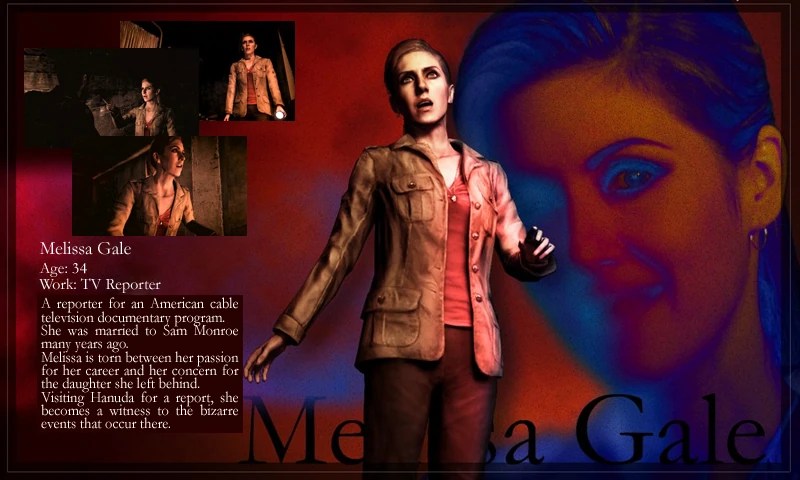
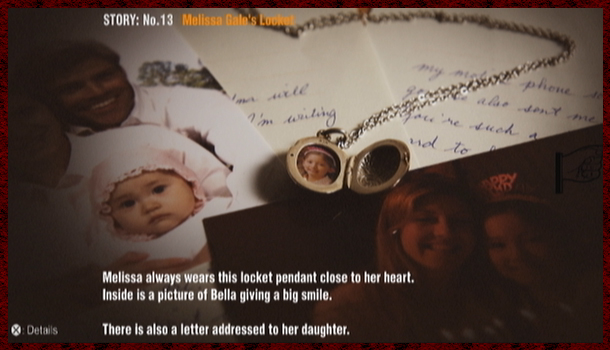
It can still be a pretty horrifying game. The shibito are great enemies, and this game fleshes them all out to have personalities and more of a shibito culture – even the ones who aren’t named. Can you help me out here? Some of them say, asking each other for help. You can’t get away from me! The graphics – when they’re not distorted behind the sightjacking – still hold up. It’s a great showcase for what the PlayStation 3 can do, and the shibito are all eerie, bloody-faced and nightmarish. But they still don’t have that crucial threat level, nor is any encounter as ingenious as the ones in the first two games. The only one that comes close is facing off against shibito Melissa, who talks down to her non-shibitoified child. Don’t fiddle with the lock, honey. It’s good, but it’s not quite enough. Oh, and returning to the characters more generally, Saiga also has some the best gameplay moments – not only is he the best character narratively, with both a tragic streak and a mean, arrogant demeanour, he has the best shooting sections in the game.
I feel for the designers, I really do – it is tough to remake a game like the original, smoothing over the rough edges, without losing what made those games special. Blood Curse ends with a truly trippy sequence, one of the most visually arresting boss fights in video games. You play in a rapidly shifting liminal space, where the sky and floor are both trippy, ever-moving kaleidoscopes. All while this music plays. It’s just a shame it’s so pathetically easy. He didn’t touch me once. In fact, I’m not sure he even can hit you, that’s how easy it is.
The soundtrack and audio design is still stellar, just like the previous entries in the series. The town has a high level of detail and the way in which the shibito evolve and become more dangerous remains compelling. It’s great stuff. It’s just also diluted in ways it didn’t have to be, as it struggles with a patchy narrative and wobbly characters, who we don’t really learn all that much about. The game is compromised by this inconsistent narrative. There’s a scene where two of the American characters are surrounded by shibito in a mineshaft. There seems to be no way out – but, the next time we see them, one of them has died, and the other inexplicably survives somehow. It’s almost like a chunk was cut out of the gameplay. This is to say nothing of the fact that the game is divided into twelve episodes, each with only two playable missions, aside from the first episode, which only has one mission. That’s still twenty-three missions – but it’s much, much shorter than the previous games. Each chapter also begins and ends with either a recap or “coming up next on Blood Curse!“, as though we are watching a really bad television show. Yes, that might be the point – defenders of the game often observe this authentic attention to detail, to recapturing the kind of rubbish, “off” vibe of American horror film remakes. In that sense, it’s very cool. But in a more practical sense, it’s just kind of annoying. Often I would just get frustrated with it and tune it out.
Overall, I am left with the overwhelming impression that Blood Curse wasn’t all it could be. Which is a shame, because I think it is the most accessible (playability-wise) in the series, with a good control scheme and smooth gameplay (aside from when you’re sight-jacking). I wish it had been able to pull off the sense of threat alongside the sense of horror and disgust. I wish it had been able to refine its fascinating narrative ideas about temporality while also creating characters worth caring about. I wish it had excised all frustration, if that is what the gameplay was going for when it cut difficulty.
All this criticism said, I think there’s more to praise. I will no doubt make a video essay on Blood Curse to complete my trilogy of videos on the series, because thematically there’s some good stuff there – but mainly stuff that still feels lesser than the first two games in the series. In a way, it is a sad capstone for a series that has, ironically, almost no chance of resurrection. But, as the game itself argues – there is always yesterday.
 Horrorgameanalysis