
There are discussions of rape, paedophilia, and gore in this article. It also spoils some of Murder House (2020) and contains a tangential spoiler for Siren: Blood Curse (2008).
Murder House, released in 2020, is one of Puppet Combo’s best games. Puppet Combo is known for sterling emergent horror, as seen in Nun Massacre (2018) or Stay Out of the House (2022). Murder House has a more cinematic framework, but still relies on the PSX / Retraux aesthetic.
Murder House utilizes the traditional fixed-camera-angle set up of classic survival horror games, and you do have to go around, scavenging items and searching every drawer in the place for stuff to unlock the next room, or just weapons to help you survive. Survive against whom, you may ask? Well, the easter bunny.
Specifically, the Easter Ripper. The Easter Ripper is one of the most unsympathetic antagonists in video games. There is nothing redeemable about him. Dressed in a large pink bunny costume, the first playable sequence of the game has us play as a child who must try to escape from the Ripper in a desolate, abandoned mall. The abandoned mall – ah, sublime.
It is a concept that has been used again and again in horror games, but for a game that uses the mall as its starting location, nothing more, it is a dark, dreamy place. As a child, you wander around for a while, trying to find out where to go. The darkness is just enveloping. It caresses like a blanket, and you move through it, all the while the retraux PSX aesthetic makes you lower your guard. The subconscious nostalgia that runs through you – even if you haven’t played a PSX game, cultural osmosis helps. Old technologies are weaponized now – they live on as ghosts. Ghosts papering over the newness of the machine, reminding you of who you used to be, and what you used to have.
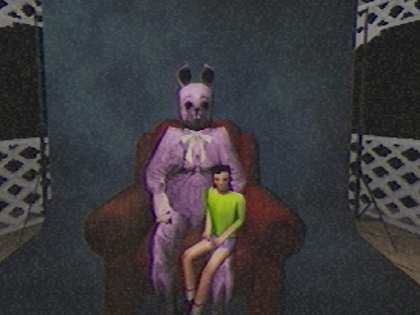
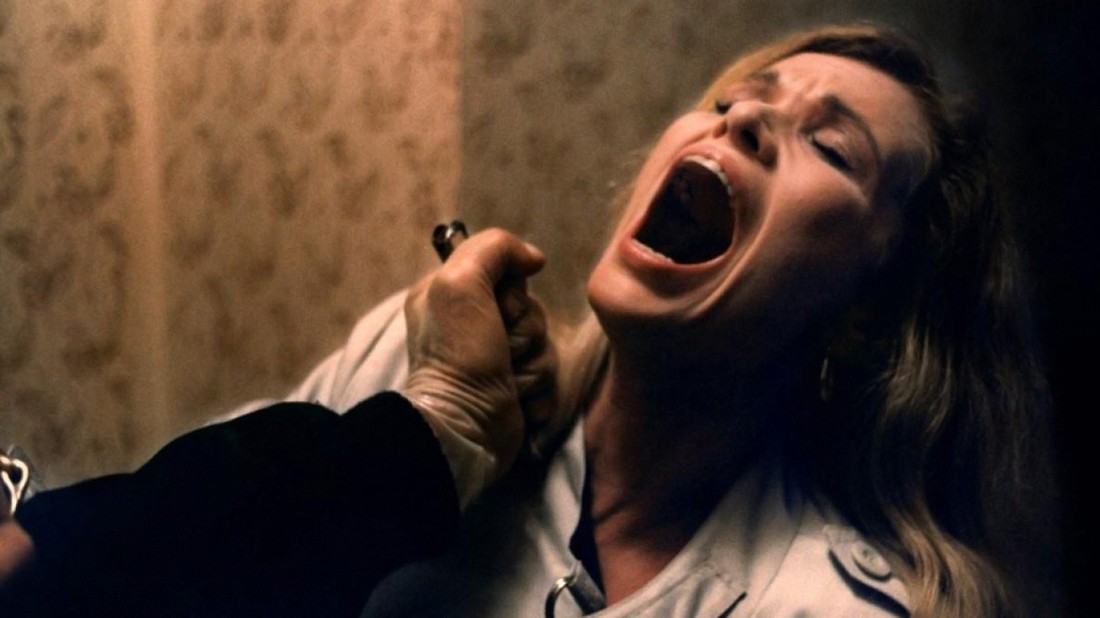
But – the Easter Ripper, yes? We want to know more about the Easter Ripper. That bloodsoaked killer, as we find out, specifically targets children. Later in the game, we find out (fairly explicitly, too) that he molested and raped the children he kidnapped. There are tiny skeletons in bondage gear and horrible notes about how he fed starving children easter eggs filled with razor blades. This stuff leans into shock value, one of the real “danger zones” of horror for me. I’ve discussed it before, in fact. If a piece of fiction sensationalizes horrible things happening for the purpose of entertainment, it can be hard to enjoy. It reminds me of the film The New York Ripper (Fulci 1982), wherein a horrible misogynistic serial killer murders defenseless women. He opens their throats, all while he quacks like a duck. We are made culpable in that violence, as the camera lingers long and sadistically on the horrible things that happen to those women. The question is – the question always will be – is it right to “enjoy” these things? What enjoyment do we get out of them, if anything?
The argument to be made is that we must be made aware of the horrible things that horrible people do. That we cannot shy away from rapists or depraved killers or war crimes or genocide – these are things that we have not just dealt with historically, but things we are dealing with in the now. I often remark that video games (and other forms of art) are safe ways to broach these questions, to ask difficult things of its viewer (or its player). Honesty is part and parcel of horror. I think for as much as we can feel safe in horror’s embrace, recognizing the thing in front of us is fiction, the honesty is part of what makes us feel discomforted. The cult in Silent Hill might have fantastical effects on the world, yet the trauma the cult creates is very real. Murder House does not necessarily linger on these details, but it makes them hard to miss. And Murder House does the clever thing of making us discover the events ourselves, allowing us to loiter (or get the hell out) of the awful dungeon-like basement of the house.
The legacy of the Easter Ripper is not easily buried. We are encouraged to try our damnedest to bury the Ripper, but it’s a hard thing to do. He’ll stalk you dynamically around the house, appearing at random intervals to try and hack you to death with his sickle. The game can now be played in either first or third person, meaning you can lean into the immersive approach, moving you closer to young intern Emma. Third-person, though, allows for a continuation of those Giallo themes, wherein we are watching brutality like that from a voyeuristic perspective.
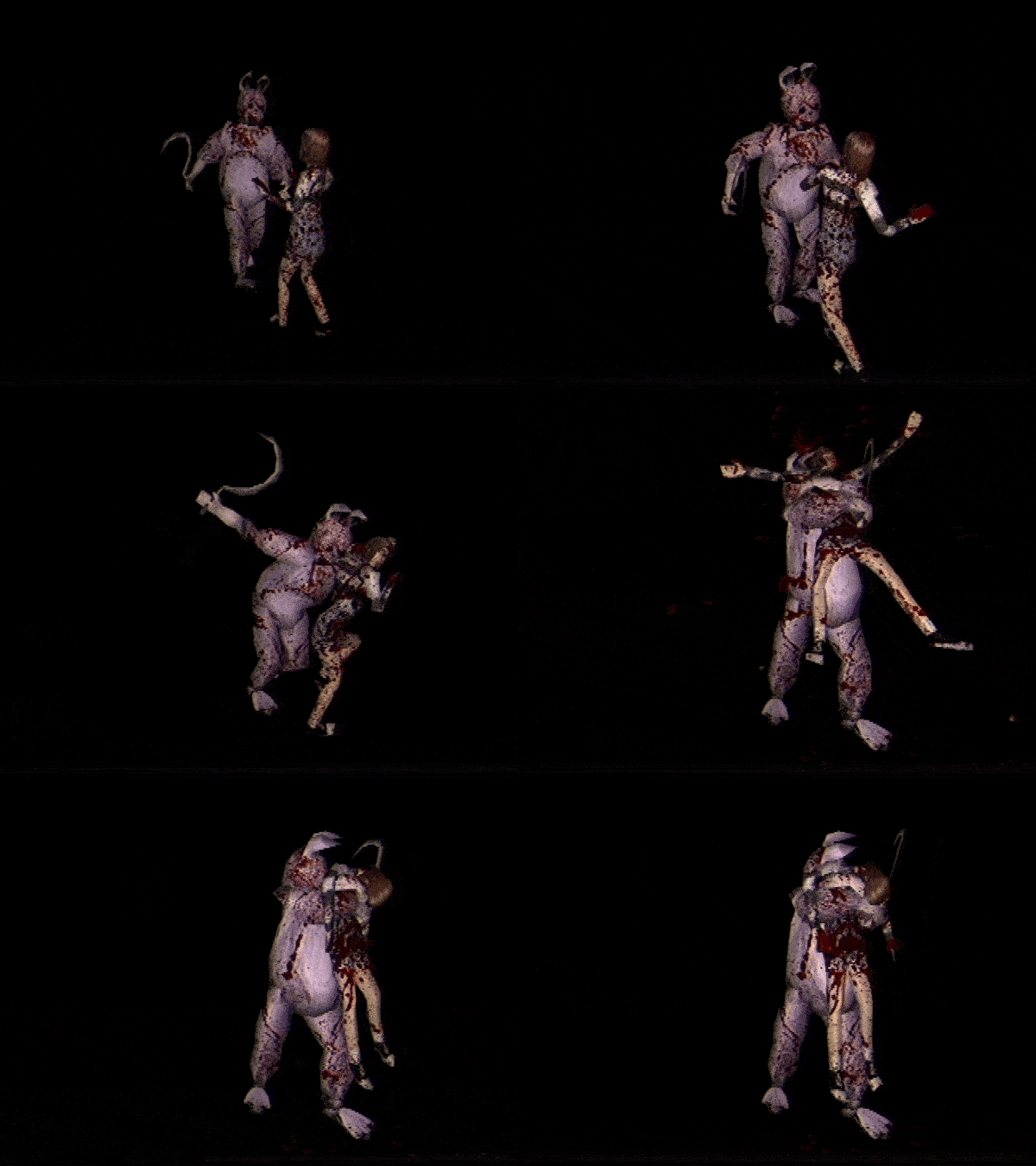
We watch Emma die in a couple of really terrible, brutal death screens (the Easter Ripper hugs her so hard she basically explodes). It makes me wonder – what about Murder House differentiates itself from the obvious exploitation and shock value present in my favourite horror whipping boy, Outlast 2? I think there is certainly a more tongue-in-cheek humour present throughout Murder House. Since you are part of a news crew, you have to run past the camera in a ghost outfit. Which is just a sheet draped over your head. These moments of levity are enough to get you to lift your head up. Just like the witness in The New York Ripper who tells the incredulous detective that the killer went “quack quack quack”. The sheer absurdity of the moment transforms – at least the scene – into something else.
I think it should not be up to me to have the final word on the authenticity of the violence and the horror expounded upon in the game. Believe me, I do understand when people say that events as depicted in games like this shouldn’t be depicted. Because they can be traumatic, and they can be horrible.
However, I do think there is something earnest and honest and important about depicting horrible events on screen. Discomfort is something I should feel, as a person who has lived a deeply comfortable and easy life. To bury one’s head in the sand is to admit defeat – to pretend humans are always getting better, all the time, that progress is a given, is a fallacy. At the same time, I am also not totally comfortable with having the disempowered, the disenfranchised, or minorities like myself brutalized on screen, with no hope of any other role to play. Yet, the Easter Ripper is one of the few monsters in Puppet Combo’s oeuvre that gets a definitive comeuppance. It is a joy to blast him with a shotgun, over, and over, and over again. The final cutscene also gives revenge to the children in a cathartic way.
Murder House toes a line that few other horror games have dared to approach. The death of children is a thorny subject in any media, and becomes particularly fraught in video games. Games that allow you to enact the death of the child will often pull away from the moment before it happens (a game over screen appearing before anything bad happens), but are happy to show it during a scripted cutscene (Siren: Blood Curse). The original Fallout allowed you to gun down children, but subsequent releases removed the children. Fallout 3 has invincible children (much to everyone’s frustration), and so does Skyrim. The fraught question is how far we go in search of realism. We do not need, for instance, a simulated Columbine massacre, although people have tried (see Super Columbine Massacre). Super Columbine Massacre, whatever else it is, or whatever else it did, opened a dialogue. It made people talk about the experience, and made people think about the presence of art in their lives. It made people think about the presence of video games and simulation in their lives. The bogeyman that is realisticness or realism remains a shadow, loitering near us. Do we need to stage, show, or enact the death of children? Should it be something that remains fairly taboo? Should it be something we act to stop, and totally out of our hands, in the control of the designer or the writer rather than the player? Murder House, for being a short indie horror game, raises many of these questions for me. The game’s new final twist ending (added some months after the game was first released) is clever and makes you rethink the whole game itself – no small feat. It makes us question our role as players even more. But I don’t want to spoil that here.
Murder House is a tremendous survival horror game. It’s frightening in its gameplay and its spaces are very well designed. The house where you spend most of the game feels like an authentically dirty, abandoned location in the middle of nowhere. It’s great. Every room has its own character, its own history, its own identity – and its own meaning in the story. Survival horror designed around one space and one enemy? Fiendishly good.
The plot unfolds at a great pace, and the characters are all extremely memorable. I still think about the game years after I’ve played it because of the sheer amount of effort that went into the whole production. It is well-balanced difficulty wise and fighting the emergent AI Easter Ripper is always fun. Exploring the house is never a safe bet, and they could appear anywhere at any time. Working out who the killer is and what their motives are is also fun – though again, not as fun as killing them. It is one instance of power fantasy being truly fulfilling in a survival horror game. It is a moment that is truly earned.
Clement Panchout’s tremendous soundtrack carries much of the game. He serves a similar purpose to Akira Yamaoka’s sound design in the Silent Hill series, in that without him, the game would not be able to reach the same emotional register. Panchout spent his time for Murder House creating tracks that evoke whatever mood is needed. Often, the mood dips into melancholy or uncertainty with tracks like “The Arrival” or “Emma“. The music can also be tense and thrilling with “The Glitch” or “Bunny“. I think the melancholic emotions appeal more personally to me, and I find these moments of stillness to be more effective than moments of explicit horror. This is because the unknown is inherently more frightening than the known, or the quantifiable. The moments before the Ripper appears are always more frightening than when they do – but when they do, it’s still tense as all hell. The Ripper’s pink costume and bunny motif brings to mind childhood innocence – and a rabbit’s rampant virility. Both things that indicate that the Ripper’s appearance was not idly chosen at random, nor were the acts they committed.
Murder House is a game I very much need to stream, and need to play again with a group of people, because I think the questions it inadvertently raises about violence in video games are extremely timely. No, video games do not make people violent – but video games can misdirect, or misunderstand, violence. Violence is a tool in storytelling. Like any tool, it must be wielded with thoughtfulness and consideration, lest it get away from you and wreck the whole place. We are often very uncritical of violence in fiction. We see it as a way to liven up our stories, to get us to pay attention. But violence should not be “brain turn off now”. Violence should be something that lights us up, makes us think, makes us despair, or think about how things might have gone differently. Violence, if we aim for higher standards, can be something that makes us want to think, or make us want to tear our gaze from the screen – or be terrified to look away!
I am not sure whether Murder House‘s use of child abuse themes – and in as graphic a fashion as a video game could achieve, I think, with skeletons tied up on beds – was as good as it could have been, or even if it was right. Does it need to be depicted? Is it just for shock value? It actually made me feel ill, and feel a sense of despair at reading about the girl who ate the razorblade easter egg. But Murder House is a damn good horror game, and a very, very well designed one. In the years since I have played it, I no longer see it as just another Silent Hill / Resident Evil alike. It has its own qualities within the genre that those two giants defined, for better or for worse. The questions it raises along the way might be incidental, but they are worth asking. Questions I will still be ruminating on for some time to come.
Also, the soundtrack is really good.
You can buy Murder House from Steam.
 Horrorgameanalysis