

The following article spoils Clock Tower 3 (Sunsoft 2003).
The old tunnels could be anywhere in the world. Stalagmites gather moisture and water runs fast through old pipes. As you flee from the ax-wielding maniac covered in body paint, you wonder how you ended up here, playing a game that’s twenty-two years old and much less scary than you supposed it would be. Aren’t old things supposed to take on mouldering, haunted qualities? You wonder this as you hide in plain sight behind a glass fishtank, as the ax-wielding lunatic looks around fruitlessly, staring directly at what must be your dumbfounded expression, bug-eyed and wondering how the hell he cannot see you. The psychopath concedes your cunning victory by saying:
“Oh, nice trick, muahahahah!”
If there’s anything that some video games could do with more of sometimes, it is theatricality. Clock Tower 3, developed by Sunsoft and published by Capcom in 2003, has pantomime rooted in its bones. The game was the last project directed by Battle Royale director Kinji Fukasaku, and his influence is quite clear on the game’s acting and art direction. Everything leaps off of the screen in an exaggerated fashion. You can see characters flail around in hyperbolic ways, making them easy to read on a boxy television with PlayStation 2 era textures. There are some scenes that are obviously done with the actors on wires, as they leap across the screen and hang in the air in compellingly real ways. Video games have a link to pantomime in their interactivity and the way in which spaces and bodies unfold. Grant Tavinor writes that “[b]esides videogames, the other rare exceptions in fictive practice that provide malleable and responsive props — such as fantasy role-playing games and pantomime—are cases in which the props are other people. Pantomime, Dungeons and Dragons, and importantly, childhood games of pretense, all derive their responsive malleability from the fact that other people are props that are responsible for the fictive content of the game” (2005, 31). The presence of the objects we can manipulate in video games is quite important, and we can watch in Clock Tower 3 as bed mattresses sink beneath characters, chairs are hurled across rooms, and bodies are desecrated in shocking moments of violence.
The presence of the stage in video games is oftentimes quite obvious, but only if you’re thinking about it. There is a lot of overlap between theorists of the stage and theorists of the game, and this comes in regarding interactivity. The boundary between the actors and the audience in a play is very thin, and in a game it is much the same. As Madeline Virtue observes in their Honours thesis, “[l]ike theatre, video games cannot truly exist without contact. A play needs actors and an audience and a video game needs players” (2022, 10).
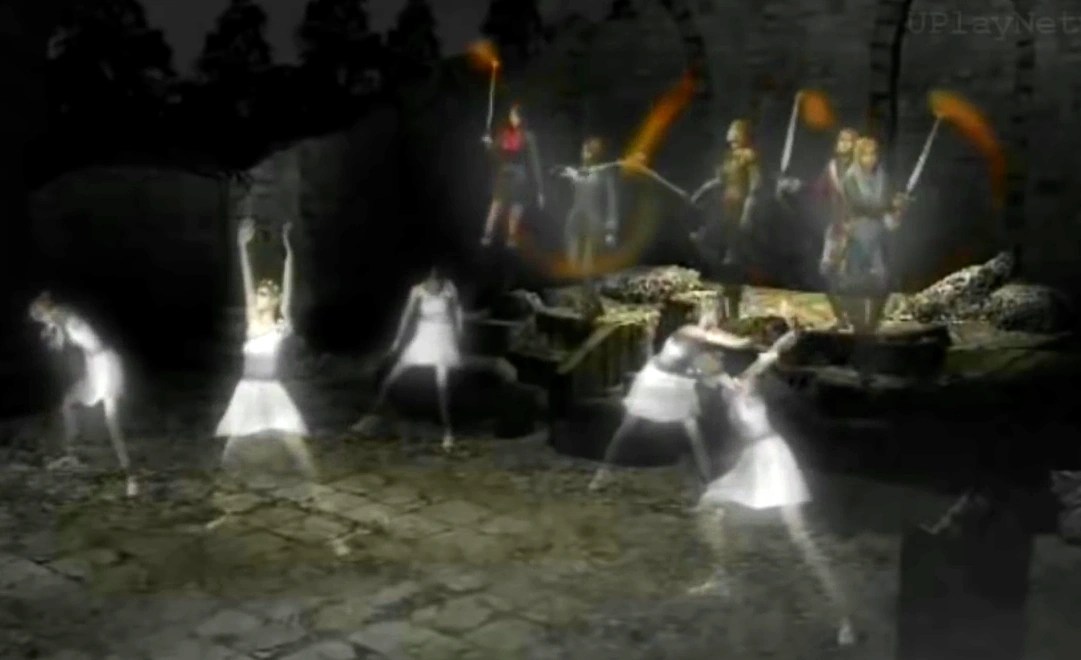
Clock Tower 3 is, of course, a sequel to prior games in the Clock Tower series, but doesn’t really function as a successor to it in strictly gameplay terms. It revolves around arriving in a new location and fleeing from “pursuers”, which are the resurrected ghosts or spirits of various serial killers. Weirdly, they get less frightening as the game goes on, with the game’s most serious and stoic killer, Sledgehammer, being the first. And he’s not exactly serious and stoic by any other horror game metric. He bounces, jumps, and swings around, and the music that plays as he chases you is kind of silly, a thumping bit of menace that has the air of pantomime about it again. It’s effective chase music for the kind of game Clock Tower 3 is, but it isn’t particularly frightening.
I think that’s the thing I come back to time and again when I play horror – is it scary? Clock Tower 3’s gameplay says “no” – it is predictable and death is a frustrating rather than a frightening prospect. You play as the fourteen year old girl Alyssa Hamilton, and whenever Alyssa gets too panicked by an enemy’s attacks, she enters a state called Panic. In Panic Mode, the next time she is hit, she dies. Unfortunately, it is hard to control Alyssa in Panic Mode – she stumbles around and trips and falls, and the controls become much looser. Death never really feels like “your fault” – it’s all chance. Does the killer spawn? Do they swing at you enough times to trigger Panic Mode? It’s all just too up in the air to feel legitimate tension. As you watch a meter arbitrarily increase in the corner of the room, you sigh as you realize that you’ll have to replay the last ten minutes of gameplay, just get luckier next time.

Despite all this though, in some senses, yes, Clock Tower 3 is very scary.
The violence on display in Clock Tower 3 is surprising given the game’s lack of seriousness elsewhere. You get to see Sledgehammer brutally murder a young girl, his sledgehammer launching her down a flight of stairs. Later, her bloody ghost plays a mournful tune she just can’t get right on a piano, unable to remember the tune after her traumatizing experience. Tobi Smethurst writes that “By innovating with the interactivity and player agency that define them as a medium, games have the power not only to match these trauma fictions in representing the trauma of the victim rhetorically but also to involve the player in the complicity, guilt, and potential trauma of the perpetrator through methods uniquely available to games” (2015, 821). Clock Tower 3 might not take full advantage of that, but it does allow us (in its best moments, the first two levels) to play through trauma and tragedy. As Alyssa’s home becomes more and more foreboding, and we see more and more victims of horrible tragedy, you can almost convince yourself that Clock Tower 3 is telling a good story. The interesting elements are swallowed at times by wonky gameplay and shoddy thematic throughlines, but there’s something here. Trauma at play, in play, spaces that are cleansed by an honest appraisal of the thing that caused the trauma. The trauma can be quite severe, too.
The second boss, Corroder, might be incredibly hamfisted, but the scene where he douses a loving mother and son in acid and blinds them for the rest of their afterlives while cackling like a lunatic is surprisingly quite harrowing. “THAT’S ENOUGH PLAYING HAPPY FAMILIES” screams the six foot tall bald guy, armed with a shower head that sprays acid as he kicks open a door – Clock Tower 3 is not shy about its absurd violence. Clock Tower 3 toes the line between humor and horror, with the game’s writing being genuinely absurdist but mixing with oft-horrifying imagery, particularly in the first two levels. The more graphic violence represented by Sledgehammer and Corroder is replaced in later levels by a fraught and disturbing depiction of grooming and potential sexual abuse, driven by a rabidly insecure old man that wants nothing more than to live forever. Alyssa is fourteen years old – and the old man is her grandfather, who feels as though he let his daughter down by marrying some low-born man. His controlling, domineering behaviour is effectively criticized by the game’s active repulsion for him, even though Alyssa should figure out who the big bad guy is much, much sooner than she does. He is a repulsive villain and probably one of the worst from survival horror games of this era, having no redeeming qualities whatsoever. He kills his son-in-law, murders his daughter, and seeks to molest and sacrifice Alyssa in a ritual that will allow him to inhabit her body – a literal form of control that reflects the control patriarchal power structures want to have indefinitely over other people’s bodies.
The scariest parts of the game have nothing to do with the gameplay. This is probably not a good thing. The hide and seek gameplay is either far too easy or just frustrating when the Pursuers won’t leave you alone. The game’s thematic elements can’t quite come together when the tone of the narrative wobbles and the gameplay struggles to follow through on the violence and absurdist vitality of Fukasaku’s cutscenes. Corroder attacks with a butt-slam move, cackling like a lunatic, screaming “FOUND YOU”; the third pursuer with the axes, called “Chopper”, is supposed to be the most competent of the Pursuers but is comically worthless, only able to be threatening in cutscenes and who relies on “cutscene power” to arbitrarily beat Alyssa after you triumph over him in his first boss fight. But the moments with Alyssa’s grandfather (aptly known as Dick) are layered with serious nastiness, the grimy feeling urging you on to kick his ass.
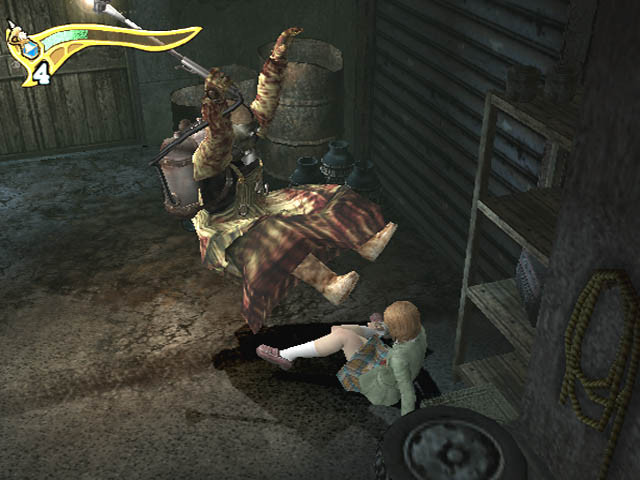
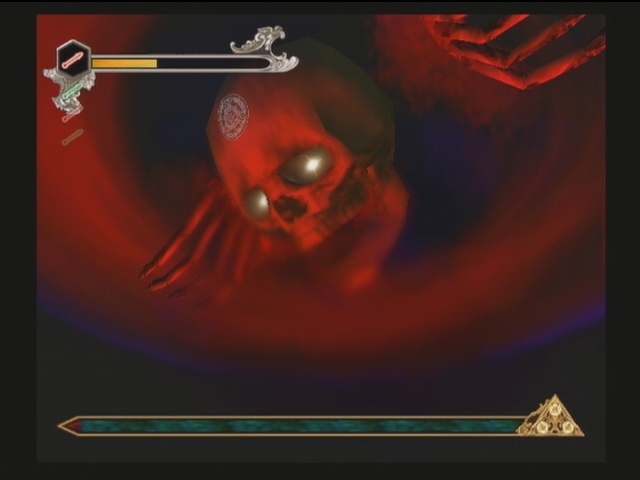
And kick his ass you do – at the end of every pursuer’s section, you transform into an angelic warrior, as Alyssa has the fabled Rooder blood in her veins. In these boss battles, you run around and charge up lightning arrows to deal damage to the Pursuers. It can’t be overstated just how weird this feels – it is like every part of the game is fighting another. We have a absurdist, violent story about a group of immortal serial killers returning to haunt their original victims in some other world. We have a game about Alyssa running around and surviving being pursued by these killers, and then we have a game where we get to enact divine punishment on them. I can’t say it’s not satisfying – and the theme of being able to fight for the victims who can no longer fight for themselves is particularly so – but it does feel odd. It is like the game is reaching for some greater point but the critique it is searching for comes out half-formed, the words slurring together: “kill killers… yeah… with a big bow… mmm… that’ll do it.” It is also worth noting that the final boss’ health bar is absurdly long – it is perhaps two or three times longer than the other bosses’ health bars, and practically stretches off of the screen. He also has a variety of bullshit moves, including an instakill sky-laser if you’re hit by three of his attacks in a row. He takes a herculean effort to beat, and you better have saved all of the collectible super-arrows throughout the game, but considering the narrative threat Dick poses, it feels satisfying regardless.
In spite of myself, I sometimes found myself genuinely enjoying Clock Tower 3, despite the frustrations of unclear boss fight mechanics and repetitive chase scenes. It has an undeniable amount of charm that a player like me is wont to enjoy. It was one of the largest gaps in my PS2 survival horror “yet to play” pile and it was good to have played it. Perhaps the best part of the game is Alyssa’s house, which is rich in backstory and detail. It feels like a space that is genuinely haunting to wander around. Foreboding and properly empty, it is a home without a heartbeat. Which is why it is a huge shame that the game smashes it to pieces at a certain point, demolishing the pacing of a slow descent into febrile madness. A home that becomes unsafe as Alyssa discovers just who her beloved grandfather is really. And instead of that being a subtle realization, it is about as Clock Tower 3 as you can get when the house explodes and Alyssa rides a flying clock face to the building it becomes. I still enjoyed it, though, sometimes.
However – big however – much like the game’s successor, Haunting Ground (Capcom 2005), Clock Tower 3 further muddies its critiques of the sexualization of the female body by including unlockable costumes. Reminding you that Alyssa is fourteen years old, you can give her a cowgirl outfit with an exposed midriff and cleavage, a suit of armour which does not cover her legs at all, and a leather outfit with a cleavage window. This leaves me with the impression that the game’s critiques have been missed by someone on the development team, or that the themes of the game escaped the team as a whole. It is a shame that this trope pops up in survival horror games of this era in particular, which did so much to empower the female character and give them roles that would not be given to them in other game genres. It is particularly egregious in Clock Tower 3 and Haunting Ground, which are both all about the deleterious effects of grooming and sexual fetishization of young women and children. As Behm-Morawitz and Mastro write, “[c]onsidering the scarcity of [female characters] in video games, the mere presence of a prominent female video game character may trigger attention and serve as a motivator for individuals to adopt congruent gender-related beliefs” (2009, 809). Considering its release date, Clock Tower 3 could have been a bold model for future female characters to follow – but the game itself frames Alyssa as desirable in some way (eugh) by giving her provocative costumes that traditionally signal sexualization, and that drags the whole message down. Clock Tower 3’s unlockable bonus costumes feel like the final odd choice in a game that can never quite sit down and figure out what it wants to be, or exactly what it wants to say. And that’s a damn shame.
Reference List
Behm-Morawitz, Elizabeth & Mastro, Dana. 2009. “The Effects of the Sexualization of Female Video Game Characters on Gender Stereotyping and Female Self-Concept”. In Sex Roles. 61. 808-823.
Smethurst, Tobi. 2015. “Playing Dead in Videogames: Trauma in Limbo“. In The Journal of Popular Culture, 48: 817-835
Tavinor, Grant. 2005. “Videogames and Interactive Fiction”. In Philosophy and Literature, Volume 29, Number 1, April 2005, pp. 24-40.
Virtue, Madeline. 2022. “Video Games, Theatre, and the Modern Oral Tradition”. Thesis. https://cedar.wwu.edu/cgi/viewcontent.cgi?article=1561&context=wwu_honors
 Horrorgameanalysis