
This game just keeps seeping back into my brain. I really can’t help it. Can you blame me?
3) FEAR & HUNGER | Miro Haverinen 2018
“There is beauty in this darkness that can be harnessed and used to usher something new.”
Yeah, let’s do this song and dance again, shall we? Fear & Hunger 2: Termina was my favourite game last year, a game of such unparalleled cruelty and murderousness that I could hardly put it down. Do I like Fear & Hunger as much? Not quite, but I think that’s for purely polish reasons. The original Fear & Hunger has an iconic callousness all to itself. Enemies get a bonus turn even after you’ve killed them. Bosses have devious tricks that take many attempts to puzzle out. Save points feel few-and-far between. You and your party members alike are equally fragile.
Fear & Hunger continues to hold my attention because of its depth of mechanics. It seems that there are dozens of options – some valid, some not – in every single combat. The demands the game places on you require you to pay attention. It is not a game you can coast through. As I wrote earlier this year, it is a game in which your soul can flourish in the harshest environments, that challenges you to rise beyond your limitations. Perhaps it is impossible to rise beyond your limitations without losing the humanity that makes you special, the game argues, but perhaps there are other ways to attain self-actualization.
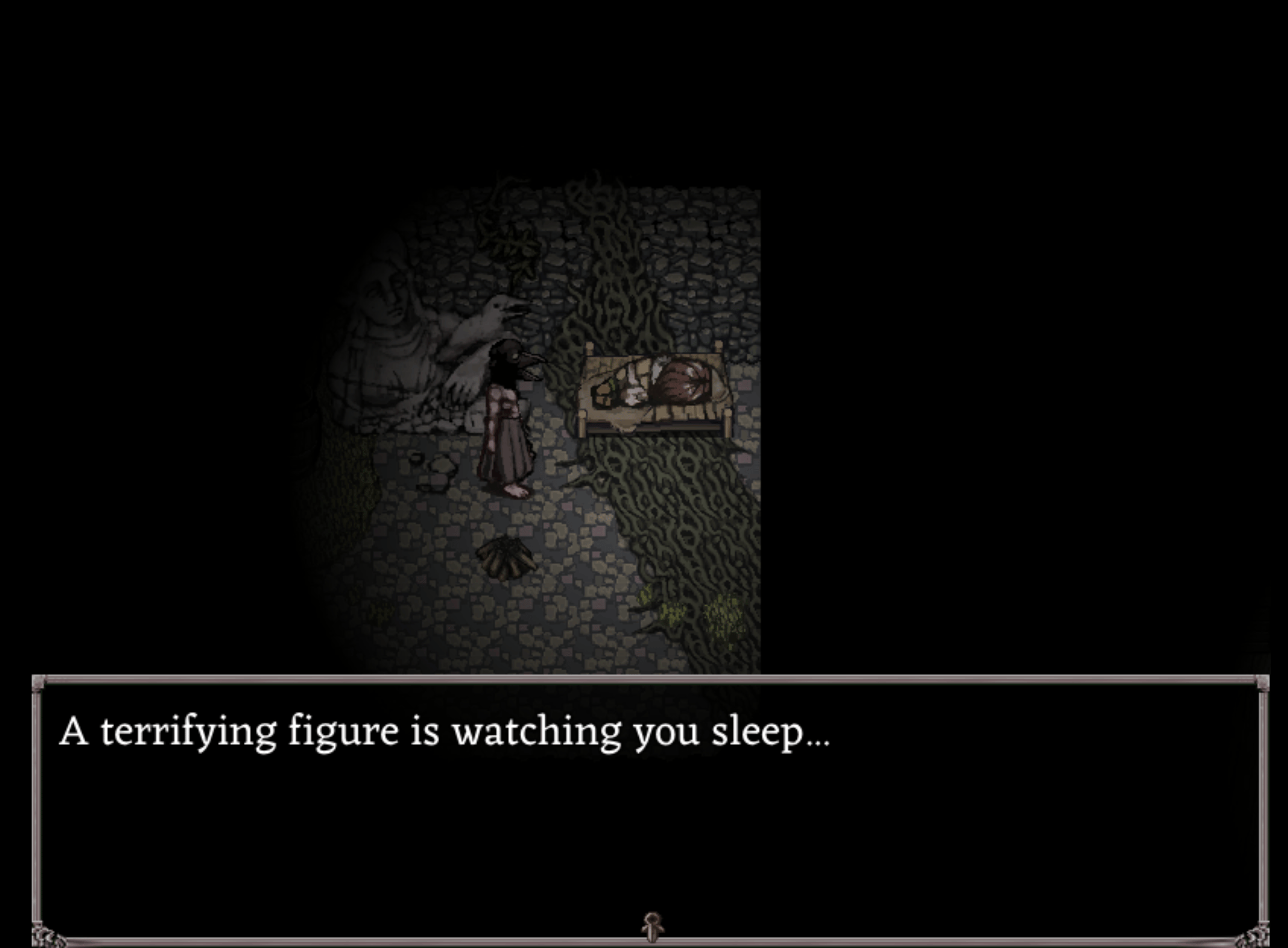
The game’s fascinating lore and dark environments spark all kinds of online discussions, and are a large contributor to why it remains such an important horror game landmark. The game starts innocuously enough, opening up on the miserable vista of the Dungeon of Fear & Hunger to facilitate character creation. Then, it plops you unceremoniously at the gates. There’s a dead horse, an overturned cart, and a few barrels to loot. A yawning open gate invites you into the darkness, while a small dark doorway is an alternative route for those with perceptive eyes. Thinking you might be in for a slow start is rudely disrupted by the barking of rabid dogs in the distance, slowly getting louder and louder. Rushing into the larger gate will almost certainly result in you being caught by a guard, who will proceed to lop your arm off and brutalize you, resulting in your first death.
I, being the highly intellectual video game analyst, went down the smaller door first, and… assumed that every enemy had to be fought, and attacked every slow, tentacle creature down there, and got murdered by sheer, stupid attrition. Fear & Hunger doesn’t care for your attempts to be clever, because it will always find a way to outsmart you – at first. Fear & Hunger’s sheer, bloody-minded refusal to let you win will break a lot of people. Even where some elements of randomness can always screw you over, there’s also always something that you can be doing to better yourself, to get just a little bit further.
The game reaches some pretty dark places. The Dungeon of Fear & Hunger isn’t the end – it’s just the tip of a gut-smeared iceberg. Delving lower and lower comes with greater and greater costs, but as you make it further and further with every attempt, you’re rewarded with truly fascinating, engaging worldbuilding elements. Every little bit of exploration is rewarded, and every combat overcome is a genuine victory.
In a game where almost every standard enemy has the capacity to kill you in just two to three rounds at most, every single action counts. Action economy has rarely been so important. Beating opponents is a puzzle more than a test of strength, though good equipment helps. It makes every enemy properly dangerous, forces you to respect the environment you’re in, and is generally just a fantastic game at disempowering you.
The idea that appeals most to me, beyond the brutal loop that pushes the player to be better, is that the theme behind the game aligns with this idea. Something something ludonarrative harmony. Quite frankly, it is art like Fear & Hunger that keeps me going some days. Games, I think, facilitate control. In particular, horror games allow you to overcome severe odds. Horror games, I think, can be about reclaiming control, even against a hostile and uncaring universe. This isn’t to say that horror games can’t also just be about losing in the face of such odds, but I think, that too is realistic. It is in the trying or the striving that we become better, anyway. I would rather die having stood up and dared to dream rather than sitting in idle boredom, and I think this kind of horror game can simulate that. It can simulate getting to the end of a hard day, and showing that even if you collapse at the end of it, you made it to the end in a very real sense. You achieved something.
Fear & Hunger, I think, is an incredibly important game not because it is cruel, persay, but because it allows you to challenge that cruelty. The game is not arbitrary. Fear & Hunger is something that can be learned and adapted to. It can be challenged. More than that – Fear & Hunger can be beaten. You have to have tremendous patience, courage, and an eye for detail that most other games don’t even care to ask you for, but Fear & Hunger, like the great Pathologic before it, respect you. You are not the center of the universe, but in striving to reach the center of the universe as the player character, you, the person, become better. Fear & Hunger – when it is not busy being terrifying – is kind of comforting. It facilitates introspection. My studies have told me that introspection is – or should be – the ultimate result of each game that we play. Games have this potential, even really high-octane ones, at times. If they give us just a moment to stop and think about our actions, our motivations, or how all the pieces fit together, we can become more than just ourselves. We can recognize, in our striving to become better, that we are just one small part of a larger universe, however powerful we might be in-game.
The previous games I have talked about thus far – Mass Effect 3 and Bloodlines 2 in particular – are about facilitating power fantasies. We have great powers in those games, and go on to do great things. We become the center of the universe. But Fear & Hunger tells us to go a step further and reflect on why we want that power in the first place. Why do games offer a concrete sense of control over our lives? Is it as simple as brain chemistry not stressing itself out and firing over and over again? Is it a way to relax? Escapism isn’t the only reason to play video games, but is obtaining a sense of control over the universe escapism? Is obtaining a stable sense of control from a video game even possible? This is something I’d like to hear from my audience from. What do you think? Why do you – or why would you – play Fear & Hunger? Because I’ve played a lot of Fear & Hunger, and I will play a lot more. Fear & Hunger is a sublime game, almost perfectly crafted. Aside from a lot of bugs. The game does have a lot of bugs.
Still… you should play it. And download Frapollo94’s bugfix mod. That’ll probably help.
 Horrorgameanalysis