
I’m pretty prone to foaming at the mouth about special or interesting video games. If you’ve read from the start, and made it this far through this end-of-year series, you might have recognized that. This last game on the list is, without a doubt, the best game I played this year. I only played through it once. I haven’t gone back to it to 100% complete it. Normally I do that for games I find particularly special, games I want to venerate as my favourites. This game, however, is a different beast. It needed, funnily enough, time.
1) In Stars and Time | insertdisc5 2023
“In this moment, you are loved.”
In Stars and Time took me by surprise. It is not that I thought it would be bad, but the game was a complete impulse buy. It looked interesting, so I took a random chance. That chance turned out to be the best video game purchasing decision I’ve made in quite some time.
In Stars and Time puts you in the shoes of Siffrin, a masc-nonbinary rogue and trap-disarmer, in a world that is black and white. Literally black and white, in that all colour was taken from the world some time ago – everyone forgot how to process colour. It doesn’t really seem to bother anyone all that much though – and it does a great service to the game’s aesthetics. Everything is gorgeously rendered, whether in the fabulous spritework or the more detailed art that pops up during conversations or lengthier dialogue scenes. insertdisc5, otherwise known as Adrienne Bazir, has not just a wonderful art style, but a wonderful sense of humour.
In Stars and Time is permeated with a sense of wonder, joy, and whimsy that basically forces you to lower your guard. You can’t help it! Even when you know that surely nothing will be easy, the characters that you’re surrounded with are just delightful. Mirabelle, the healer, has a bright exterior but very human worries. She is in effect the actual “main character” of the game. The initial premise of the game is that you’re at the very end of an unseen, unplayed traditional RPG campaign. You’re at the gates of the final dungeon, and can pick up quests from the small village in front of that final dungeon. The few people around are all simple, humble, and pretty happy – given the end of the world is encroaching on them. The entire world is about to be frozen in time by the King – who isn’t actually a King, that’s just his name. You and your band of misfit heroes – Isabeau the brawler, Odile the scholar, and Bonnie the… kid, who brought a kid along? – all have hidden depths that makes learning about them a natural reward for playing the game.
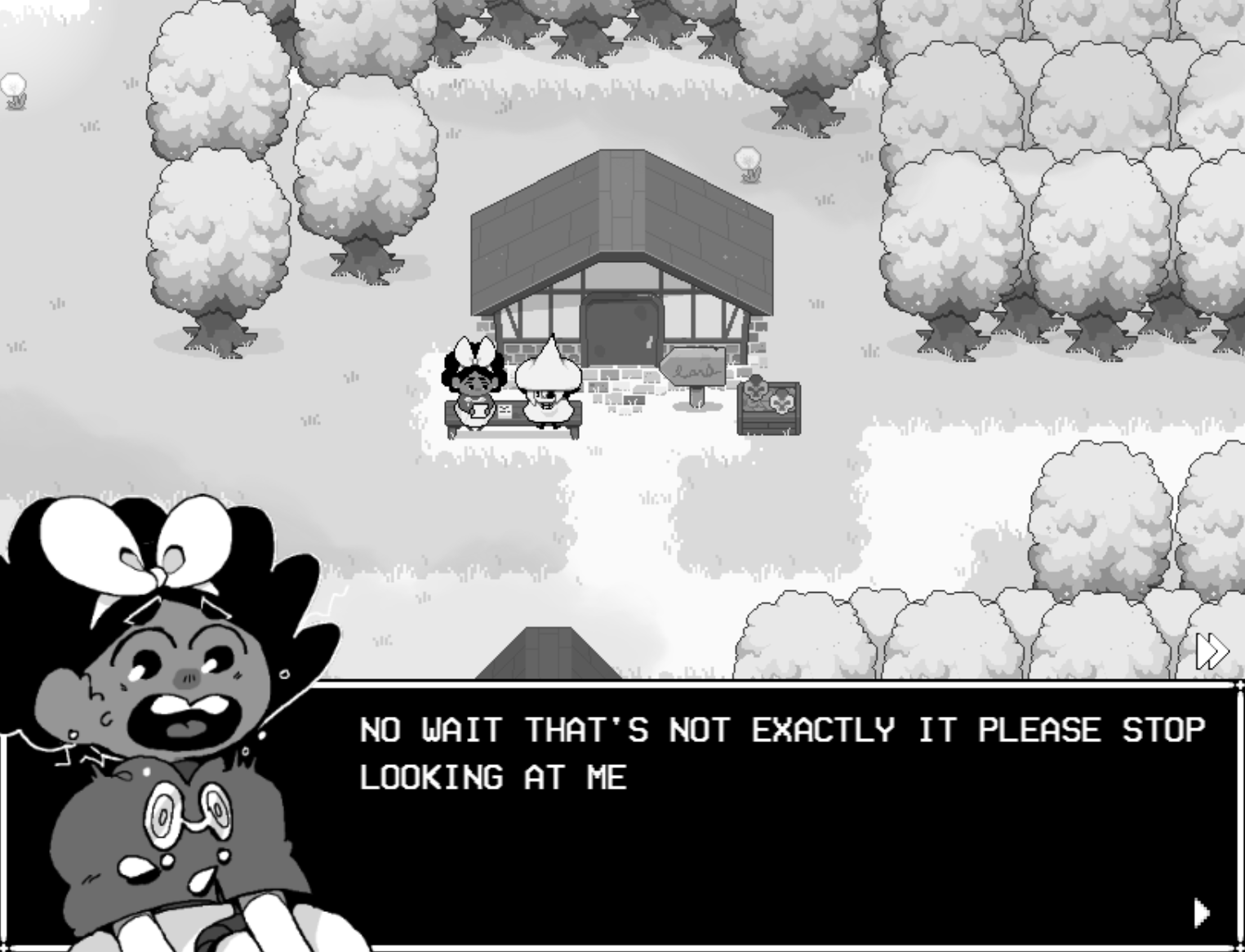
The game is also all about a time loop. When Siffrin is crushed beneath a trap he didn’t see, he suddenly wakes up. This is really only the beginning of the game. You move deeper and deeper into these time loops, and at first, they’re a lot of fun. You see your companions in new lights. You learn things about them, explore their hidden depths, past trauma, or deepest desires. All of this is some of the best in-game queer representation I’ve played fullstop. Asexual and transgender people are treated with respect and a sense of expectedness and normalcy. It made my heart pang for a world like that, and it still does.
You get to grips with the game’s simplistic yet fun combat, a pastiche of Rock-Paper-Scissors transformed into a new setting – the realm of the RPGMaker combat system. Each enemy represents a “type”, and each party member has a variety of attacks that correspond to each type. Enemies get more powerful, but so do you – and in particular, Siffrin gets more and more powerful, as they remember everything from each loop. You begin to wipe out enemies, to gain more and more satisfaction from the combat. Or so it would seem.
At a certain point the repetition gets to you. It’s like the mundanity of playing through Yakuza 5’s Pool requirements but multiplied tenfold. You remember everything. Everything that made you laugh to begin with is now a tired gag you just want to skip. The joy you once felt at uncovering people’s fears and foibles is now frustrating. You just want to get to the end, you want to beat the damn game! And yet there’s more and more obstacles thrown your way. Everything you try to break the loop doesn’t seem to work.
Video games, for me, have been about escape this year. It is not how I normally use video games. Not as pure escape, anyway. I am a scholar who likes to see video games as things that are more than “mere” escapism. I think in a sense I inherently devalue the idea of playing a game just for escapist reasons. I always want to be doing something else with the game, something interesting, to see some higher message.
In Stars and Time showed me, in a raw and unexpected way, my own real, human flaws. My frustration when I don’t get what I want after I try and try and try again. My fear of being misunderstood, misinterpreted, or abandoned. You’re immersed before you really know you’re immersed. Obviously the emotions behind the game won’t land the same for everybody. I think that In Stars and Time, being a game with strong queer representation, brings up those ideas of queer temporality. Ideas about having to start your entire life again when you “come out” as queer. Ideas about being stuck in the same headspace for years and years and years and doing everything you can think of to break free.
In Stars and Time was the game of the year for me for these very personal reasons, it’s true. But it is also the best game I’ve played this year because the gameplay and narrative is honed to a tee. If you a roleplaying game fan, I think you will enjoy it, if just because the structure does something fascinating. I hope (I hope!) one day I can make a video on it. But for now, suffice it to say: you should play In Stars and Time.
 Horrorgameanalysis