
If you’ve followed my work, you’ll know I’m not really a fan of shooters anymore. I used to be! I used to be all over third-person shooters like the Uncharted series, developed by Naughty Dog. While first-person shooters (often U.S. military focused) never quite appealed to me in the same way as the Uncharted series, which were character-driven games that focused on the stories of interesting adventurers, I still enjoyed games like Star Wars: Jedi Knight – Dark Forces II, or one could argue that Mass Effect is a shooter too, I suppose. But as time has worn on, I find that the violence inherent to the medium – and an often uncritical endorsement of the military industrial complex in the case of modern military shooters – has turned me off a large majority of shooters, perhaps unfairly. I tend to judge shooters by their narrative and social context, and a lot of the shooters I see advertised aren’t appealing – I’d love to hear of some other prosocial or interesting shooters! Games that deconstruct these ideas are far more valuable than those that are uncritical of the military-industrial complex, or that remain willfully ignorant about the cyclical nature of violence.
All this prefacing is to say that Metal Gear Solid 3: Snake Eater (Konami 2004) is one of the best shooters I’ve ever played, and it is much smarter than the vast majority of shooters that I remember playing as a younger person. It’s also much stupider, in the best possible ways. Of course, saying Hideo Kojima’s Snake Eater is just a shooter is awfully reductive. It’s famously one of the best stealth games ever made, but its shooting mechanics prompt a deeper appreciation for the world around you.
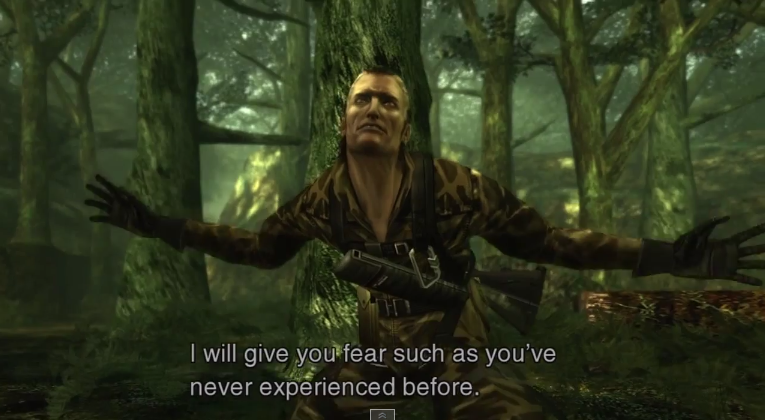
Metal Gear Solid 3 knows exactly when to get silly. It’s the best kind of B-movie – one with real, believable stakes, but with its tongue firmly planted in its cheek. Snake Eater tells the story of Naked Snake, an elite soldier on a top-secret mission to recover a Russian scientist, kidnapped back from the States to work on a superweapon during the height of the Cold War. It’s a story of betrayals, filled with misdirection, and includes tense moments of loss and quiet moments of reflection on the nature of nationalism and what it means to be a soldier. On the other hand, Snake Eater also tells the story of an array of bizarre characters – a man who shoots bees out of his body, a sniper who can pop his eyes almost out of his head to get the best view down his scope, a man who can shoot lightning from his fingers, and Revolver Ocelot. This side of the story is filled with comic moments, wry asides, incredible, impossible stuntwork (like special agent EVA doing a backflip on a motorcycle while hitting a man’s face with her tire) and silly, absurdly on-the-nose lines. Bosses scream their name as they die – “THE PAIIIIIIIN,” wails The Pain. “The Fear!” screams The Fear. All of this is just patently absurd. But yet it works so beautifully because this universe feels hyperreal.
This is a story that is grounded in history. There are documentary-style cutscenes that play, framing characters and their motivations in the past, in nationalism, using real-world footage and photos of tanks and the Cold War to enforce the feeling that what you’re playing is connected to reality. It’s clearly not “real”, but when you’re properly immersed, it can feel pretty close to real. This is thanks to its various attempts to conjure realism through gameplay, even while you’re doing all this to facilitate a meeting with a spy whose masterful seduction tactic is just to unzip her bodysuit and show off her cleavage. Which… I mean… I guess?
The game mainly takes place from a third person perspective, and it’s here that we get the gameplay loop. If you’ve read my previous articles, you might know that I’m a pretty big fan of weird control schemes. Or… well-designed control schemes. Sometimes I wonder what makes a good control scheme (which I think Metal Gear Solid 3 does have). I think it has to be responsive in a way that fits the game. Silent Hill 2 has slow animations and clumsy movement – this works for the game’s mood and atmosphere. Snake in Metal Gear Solid 3 is a little clumsy and hard to control at first, too. The game originally only had the classic overhead view, and each zone is broken up by loading screens. Each area is a stealth puzzle to solve (or at least, it is if you’re interested in solving the game’s challenges by stealth in the first place).
Some people are frustrated by Snake’s slow movement, or his inability to move while crouching. But the entire game is based around his movement. He’s able to move standing at various speeds depending on how hard you push the stick, and he can also crawl on his stomach. There’s no crouch-walking, which by modern third-person standards (including later games in the Metal Gear series) feels dated. But it works perfectly for the requirements of Metal Gear Solid 3. Every tool that you are given is intended, relevant, and carefully presented and considered in the balance of the game. You have to use other tools that you’re given to circumvent Snake’s apparent bad joints or muscle cramps when he’s crouched. Tools like:
- A silenced tranquilizer pistol or tranquilizer sniper rifle
- Lethal weapons, like an AK-47, shotguns, sniper rifles, and so on
- Varying kinds of camouflage you can collect and use in different environments, some with special features (like the Fly camouflage, which makes you stink so terribly you repel enemies from wanting to come close enough to deal melee damage to you)
- Cardboard boxes to hide in
- Pornographic magazines you can deploy as traps for enemies to waste their time
- Explosives you can lay in spots and set off when needed
- Grenades
- A cigar
- Poisoned or spoiled food (which spoils based on how long it has been in your inventory in realtime)
- Binoculars
- Motion detectors, sonars, personnel sensors
- Night vision goggles
- A “fake your own death” pill
- CQC
I’m sure there’s stuff I’ve forgotten – but this is all to illustrate the depth and breadth of the game’s systems. Even when you’re dealing with fairly similar enemy types throughout most of the game, the environment dictates the terms of your engagement. In areas with dense foliage and fallen hollow logs, you’ll be crawling through the mud, wearing dark, earthy or green camo, relying on the motion detector and careful first-person observation of your environment to not alarm everyone in the area. When in an industrial warehouse, you’ll be taking enemies out one-by-one with your tranquilizer pistol, before knocking on walls (there’s something I forgot!) to lure the guard down from the stairs to choke him out from behind. In another instance, you might have been caught by guards, so you fake your death, wait for everyone to leave and report that you were successfully taken out, before ghosting away and then attacking with a sniper rifle from a new position.
Everything the game offers is in service to the ultimate special agent stealth fantasy, which allows for you to master it to the degree you’re comfortable with. As with all games with well-structured pacing and boss fights, each boss tests your familiarity with the game’s systems. The Pain tests your ability to fight in an asymmetrical environment (such as a watery cave where he holds an apparent advantage based on the terrain). The Fear is a test of your ability to switch between third and first-person aiming as he leaps around the trees at rapid speed. The End is my favourite boss fight of the lot, a sniping duel in a gorgeous forest environment that, if you take it seriously, can take up to an hour. It takes lots of careful sneaking around to defeat the oldest sniper in the world, who loves to taunt you just before he shoots you with his tranquilizing darts. It is a test of fortitude, requiring you to constantly be on the lookout for food to eat to keep your energy up so Snake doesn’t pass out. It is a dynamic fight the likes of which doesn’t really exist in any other video game I can think of, which encourages you to immerse yourself in the environment in a really careful, methodical way. The End isn’t just a straight-up fight. It is a battle against time itself, testing everything you know about the game’s stealth and shooting mechanics. It rewards careful play, but it’s also fun to play it gung-ho, chasing the old man around the entire arena with your AK-47 like Rambo from the sequel films.
There’s the oft-overlooked The Fury bossfight, set in a claustrophobic set of industrial corridors, which he floods with fire from his flamethrower if he sees you, which is a test of your patience too, but in a different kind of environment. The fight will prepare you for the intense sneaking in the enclosed environment of the military base you’re infiltrating mere minutes after the battle. Then there’s my other favourite battle, smack-bang at the end of the game, against… well, spoilers ahead from here on out. If what I’ve described is interesting to you and you haven’t played Metal Gear Solid 3, you owe it to yourself to play the damn thing. It’s a beautiful game that transcends some of its stranger or more frustrating design decisions to build to something grandiose, which even made me cry. I know, right? I haven’t even touched on Snake’s team yet, a collection of fantastic characters that I just wanted to spend more time with. Sigint, the weapons specialist who can’t believe the insanity of the other characters he has to deal with. There’s Paramedic, the heart-of-gold medical support who can’t believe that Snake eats snakes with such relish, and who rambles about movies she’s seen recently (so plenty of old films) every time you want to save. You have to call her when you do want to save, which I think is frankly ingenious still, forcing you to grow attached to her. There’s EVA, who I ended up caring for an incredible amount, thanks to her layered spy story and some of the great discussions you end up having with her (the sexual tension Snake mostly can’t engage with is also pretty fun too). And of course, there’s Major Zero, who is just a classic British army officer that loves tea and can’t abide anyone talking poorly of the James Bond films.
Look, frankly, I adore the game in ways that I didn’t end up expecting to. It is as challenging as you want it to be, with characters that are fun to learn about, and villains that end up being tremendous fun to hate. It is melodramatic but heartfelt in its hyperbole, with characters wearing their hearts on their sleeve at all times. Everyone rants whenever they can, baring their souls for the player to see, and there’s something terribly endearing about the whole thing. I’m afraid that it makes Metal Gear Solid 3 sound a little too quaint or something, like I’m being condescending – but it’s a damn clever game, much smarter than it perhaps first appears, with game design that still stands head and shoulders above so many other shooters. Even if the narrative could have been tighter and more focused – particularly in regards to how characters are developed within the narrative rather than just through external or optional sources – it still holds my attention every time I play through it, right to the end. There’s even more I could talk about, like certain boss fights that check how many people you’ve killed, and the symbolism of other moments in the game… but no, this article is long enough already. I want to talk about the final boss, and the idea of what it means to be a soldier.
Okay, now, spoilers. Spoilers for not just this, but later entries in the Metal Gear series, too. And a discussion about what it means to be a soldier in a political world. Serious analysis time.
The confrontation with Snake’s mentor, the world’s greatest soldier known as The Boss, manages to be incredibly affecting despite a relative lack of character interaction between either of them. You go hours before seeing The Boss each time. It feels like a missed opportunity, I think, as I said above, to not have more discussions between the two. And yet the way the game ends, I almost forget every time that The Boss hasn’t been developed properly or even been on screen for about 90% of the game. Yet she hangs over the story like a stormcloud; she is Snake’s mentor, a woman he sees not just as someone akin to his mother but his deepest, most precious friend, a tangled relationship, a woman who means the world to him.
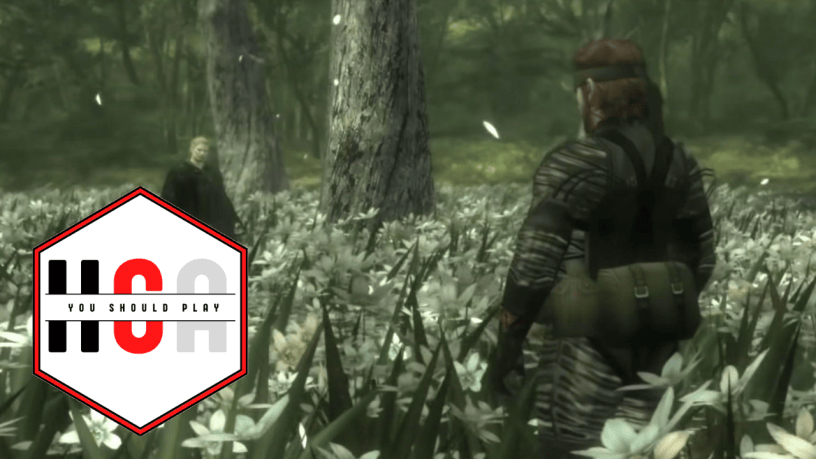
The battle is a battle of equals, framed against a field of white flowers and a few trees. You hide, snipe from afar, try to ambush her, and fight in CQC battles against her. I’m not saying it’s perfect, or that it completely works – the CQC bits aren’t quite as satisfying as they could be, and there are a few pretty cheap ways to take her out – but the battle is often cited as Kojima’s finest moment of symbolism and storytelling, as afterwards, when Snake kills his former mentor, the petals all turn blood red, and his “innocence” about what being a soldier means is destroyed forever.
The final confrontation reveals all that we need to know about The Boss; she, the world’s most tortured soldier with tragic backstory beat after tragic backstory beat, is loyal to the ideal of the soldier. To do whatever is asked of her, even at the cost of her own reputation. It feels like the ultimate indictment of the costs of militarism and nationalism – that this woman, so blinded to the damage being a soldier dealt to her at first, has no choice but to fully commit to being a soldier, a soldier til the end. She betrays America, joining with Russia, at the end of the game’s tutorial mission, but it is later revealed after her death that she was always loyal to America, and became the scapegoat for the events of the game, with her name becoming a black mark on American history – its greatest soldier becoming its greatest traitor. The game ends with Snake not only having killed the most important person in his life, but taking her title, becoming Big Boss, and destroying her reputation for the rest of history to those who did not know her – in essence dooming her to be forever a villain. She does not mind this, and in fact, she sees this as necessary. This “all-or-nothing” philosophy fascinated me, just as the final scene made me cry, completely unexpectedly, as the entire meaning of the story and this central character is turned on its head. Snake salutes a nameless grave and we cut to credits, with both Snake and the player left to dwell on the nature of loyalty.
The game led me down some interesting rabbitholes; it prompted me to interrogate what the word “soldier” actually means, and what the relationship between the military organization and the human being is. There is an abstraction that goes on, I suppose, and one that The Boss directly addresses, wherein the belief of the human individual is subordinate to the demands that being a soldier requires of a person. This, I think, is what contributes to war crimes being committed, where we see horrible deeds being enacted by basically every state on Earth that we could think to name, historical or present-day, but to name a few, states like Israel, Russia, Germany, France, Japan, or the United States. If anyone’s actually reading this article, I can feel myself making friends already. These atrocities are committed by soldiers in the name of the flag, or to speak more accurately, the ideal that the flag represents, whatever that may be. Obviously there’s a lot more to it, and a multitude of other reasons, but I read an interesting interview with Kori Schake, a former U.S. military staff member who worked at high levels in the US Defense and State Departments, and who served as an adviser to John McCain. While I don’t know if she and I could sit down and agree with very much at all politically by the sounds of it, she nonetheless raises some interesting points in this extract here:
“In the American system the military is directly and unquestionably subordinate to civilian control, that is built on the presumption that orders will be legal. We are now really struggling with the unprincipled principal. A lot of people who are worried about democracy in America want to relax the constraints on military subordination. They want the military to be the adjudicator of whether orders are legal. What that would do is actually put the judgment of the military above the judgment of the civilians. And I think they’re not as uncomfortable with that as they ought to be. The main reason I gnash my teeth about Huntington [author of the book “The Soldier and the State”, which Schake feels very negatively about] is that in that door stopper book of his he never really grapples with the problem of praetorianism, of a military that comes to consider itself different and better than the civilians in charge of the government. That has historically been the path to military coups, to the corrosion of democracy. And so where I come down, and it’s not a happy place, I’m not comfortable with it, is that the military can’t save us from the civilians we elect.”
There’s an obvious distaste for the idea of the soldier as a political entity within a lot of the world. In fact, I think quite often the idea of the soldier as autonomous is not really raised. But the idea of praetorianism and the conflict between soldier and state is interesting, and I think it is what the Metal Gear Solid series as a whole really interrogates. To what point can we entrust strongmen with technology and tools for mass warfare and mass murder and say “it’ll all work out fine”? The answer that Kojima clearly endorses is that nobody deserves to have these weapons; Metal Gear Solid V (2015) has a clear anti-nuclear message at its core, which encourages nuclear disarmament. Metal Gear Solid (1998)ends on a warning about the number of nuclear weapons in the world.
The Boss’ worldview is, I think, not just some isolated bit of good character writing in a video game. It is one of the game’s best examples of the hyperreal that I talked about before – about a serious topic being presented in such a serious way that it almost feels absurd. This woman went through an insane amount of trauma for her country – giving birth to her child on the D-Day landings, losing that child, giving her body to her country in a way that Kojima is eager to highlight – and still she gives more. She gives her legacy; she allows for her name to be puppeteered around as a bogeyman. She allows for her government, that she served with undying loyalty, to drag her name through the mud and then blow it up with a nuclear weapon.
Metal Gear Solid 3 asks us to consider what the cost of war is on both the state and the individual. Enemies always change, she tells us, so we must fight whatever enemy is put in front of us at the time and accept that it is right to fight such an enemy, regardless of what happens. She says, directly, bluntly, that “[a] soldier has to follow whatever orders he’s given. It’s not his place to question why. […] A soldier is a political tool, nothing more.” Here, she willingly dehumanizes herself, debases herself before the idea of politics itself, the idea that politics is a means to an end, an entity that has an explicit will that cannot be denied. If we question orders, her argument seems to say if we read between the lines, we can reclaim our humanity. As a soldier, she and Snake could cease to be tools – but the moment we agree to become a weapon for that state, we cannot cross that boundary again. The state has mechanisms it can use to crush ideas of disobedience, ways to enforce the idea that the soldier cannot disobey. Soldiers are political things, part of a larger “army” which is often part of a wider “state”, which has a political apparatus, which often directs that army. As such we can’t help but pity The Boss, and Big Boss too in the immediate term, for the decisions that were made for them, simply by virtue of their career. Yet perhaps we can also look at it in a more critical way, by which I mean we can be more critical of the idea of the soldier as something faceless from a theoretical perspective.
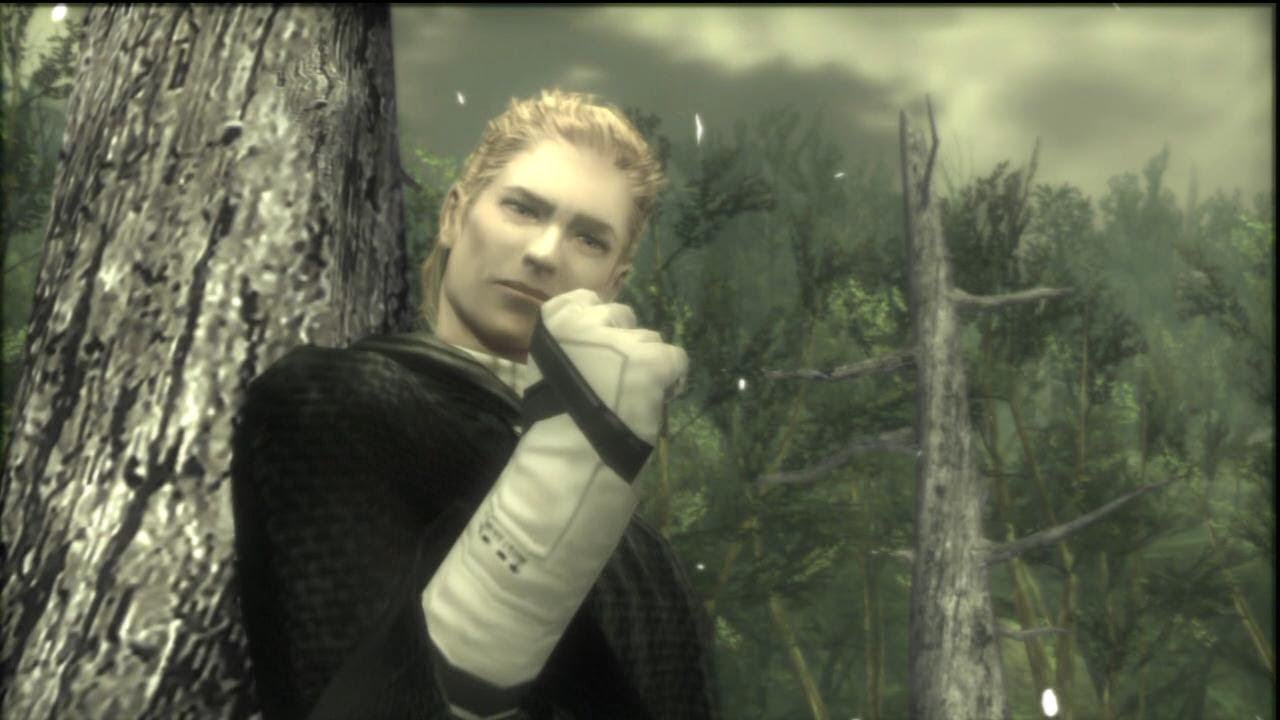
Because in the end, Snake, now Big Boss, becomes a soldier who is haunted by his inability to cross the line again, to be who he was before Operation Snake Eater. In his review of “The Military and Politics”, Baladas Ghoshal writes that, in the case of a weak “civilian” (that is: not military) government, “a strong government may appear to the people as more attractive as it provides a welcome relief from social or political chaos” (1986, 160). The Boss’ philosophy, to me, seems to read as the easy way out. An abdication of responsibility so as to resolve the “chaos” that responsibility entails. She is a soldier for soldier’s sake. Her nickname in battle as member of her COBRA unit, “The Joy”, indicates that she enjoys combat. Big Boss A woman who realizes her own failings and yet sees no way out, no other way to redeem herself than to destroy herself, and in that oblivion find peace. Which is obviously justified in-character but feels pretty awful from a bystander’s perspective. Without my own understanding of soldiering, without understanding what it does to people from a first-hand perspective, I cannot truly cast judgment, merely hypothesize about these characters and the way they link to real-world politics. But I still have found this line of thinking enlightening and fascinating, and particularly of interest to me, who I think is quietly a bit of a politics nerd, having always enjoyed socio-political analysis and history and so on.
All of this is to say that I think the story of Metal Gear Solid 3 – about a loyal soldier losing faith in the institutions that he served so obediently – is more and more relevant today, in a world where more and more people find their trust in old institutions abused by those who lie to them about what the institution is supposed to represent, about those who abuse power, money, people, history, and so many other things. Later in the series, Big Boss becomes a malignant cancer upon the world, believing only in the power of eternal war, that might-makes-right, that being a soldier is a value unto itself. He is a man haunted by his own failures, who, like The Boss, cannot live with himself and in so doing destroys himself and his potential legacy because he can see no other life for himself but as a weapon. And, reading as a potential interpretation of the series as a whole, the idea of the soldier’s body as political, or the state itself as something that the soldier can embody, is Monique Castillo’s 2009 article, “The Soldier’s Collective Body”, which I recommend reading in full. Castillo writes:
“The soldier is a symbolic, exemplary, irreplaceable or difficult to replace figure because utopias as well as conservatisms cannot do without it: combat, fighting, resistance etc. are a constant, even though they change name and region all over the globe. In this instance, the soldier’s body has a specific characteristic which enables it to be a major symbolic determinant in all these combats because the sacrificed life of this body is part of an organic vision of the collective unity to be achieved or restored.
We draw our inspiration from the philosopher Hegel for the idea of embodiment in a political and military sense, embodiment in the sense of realisation of a spirit in a body. […] Hegel explains that if we only apply individual and psychological motivations to major causes, it is impossible to conceive of a State other than as service provider guaranteeing the comfort and prosperity of the individuals. Private interests expect enhanced and guaranteed satisfaction from the State. However, this vision destroys or negates the State’s rationale by reducing it to a mere commercial society. For the State to be an organic (and not just mechanical) unity, the individuals must have no greater freedom than that consisting of uniting into the political whole; they must renounce their freedom as atoms and isolated individuals to merge into a unity of reconciled and no longer antagonistic liberties. This is not an ideal; this is the only reality which, because it is freely collective, creates the very substance of a modern State. This substantiality is not calculated, it is a feeling.
The soldier’s body expresses this organic unity because self-sacrifice is the perfect embodiment of this elevation from “oneself” to “whole”. The expendable body of the soldier can exceed the moral egotism indefinitely reproduced in the incarnation (embodiment) of the Whole in the individual. The Whole of the State, Nation, People, History is achieved in the sacrifice of the part for the Unity, the embodied Unity.”
And here, I think, we have what The Boss is subsumed into; she embodies the soldier as perceived or idealized by the state, a kind of “Utopian soldier” that Snake steps into the shoes of. But, disgusted with this idea, he throws away his loyalty to the United States quietly and works to become his own master, a stateless soldier, a soldier unto himself. He becomes Big Boss, a demonic figure that works to make everyone into the world into this “stateless soldier”, someone that is willing to wage war for war’s sake. This gives rise to the setting’s Private Military organizations (PMCs), which plague the entire series. The Boss sacrificed herself to save Snake’s life and give him his career. It is both a true act of love on The Boss’ part and a terrible act of concession to the state, to the political body which swallows them whole and destroys them. And this is all not taking into consideration the idea that there is an inherent imbalance when the army is contrasted against a civilian population; resisting orders might mean turning weapons on civilian populations, seizing power from a civilian state to form a military autocracy. That is something we have seen many, many times over the last century. So we can’t universally advocate for the army to resist unlawful orders, as that can create its own problems. There is so much nuance to consider, as in all things.
For a game so silly at times, it amazes me that we are here, discussing the nature of soldiering as a political thing as it pertains to real-world situations that continue to unfold at the demands of modern day imperial projects. I still cannot and most certainly do not claim to be an expert on the political nature of the soldier, but the game frankly has opened doors for me, and has exposed to me the potential of the soldier as a political entity. Particularly, it has made me consider how we are made to perceive soldiers as objects, as tools, as things without agency. Soldiers are things to be used by the state; such as in the case of the New Zealand soldiers who returned from Vietnam who were shunned by the government and the civilian populace alike, there is the thorny question of who the ultimate guilt for death, war crimes, or occupation of a foreign country lies with: the soldier who pulled the trigger or the state that put them in the position to do it? It is “the army” or “the state” – the soldier being an extension of those things. And when we play through Metal Gear Solid 3, we are left with the burning question: could I do what The Boss did for her most valued student?
And we hope that we shall never have to find out.
 Horrorgameanalysis