
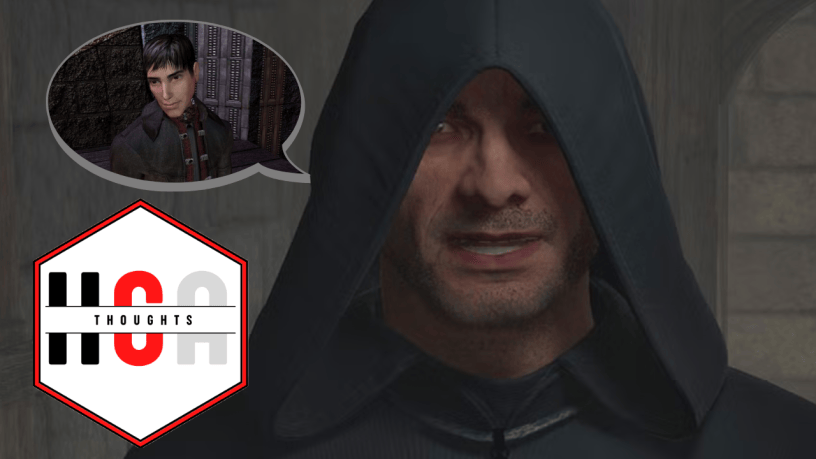
I’ve been replaying Oblivion Remastered, an updated version of a game that I replayed over and over again when I was about ten years old. I’ve written a bit about this game before, espoused how important it is to me. To an older me, Oblivion is an expression of freedom in video game form in terms of space. You can go anywhere at any time. Decide you’ve had enough of your current quest? The game will obligingly wait for you, for however long it takes, in almost every single circumstance I can think of. I know the game inside and out thanks to the one-thousand or more hours I spent in this single roleplaying game. And now that I’m replaying it, I’m realizing that not only is the game’s design no longer for me, but the game in general just doesn’t really support being replayed.
The game is roughly divided into five major questlines. The Main Quest, and four guild / faction questlines: the Fighter’s Guild, the Mage’s Guild, the Thieves Guild, and the Dark Brotherhood. There are other quests that are thematically linked, like the Daedric Quests, quests where you buy and furnish houses, and so on, but basically those five questlines are the meat of the game. There are also the expansion missions – Shivering Isles and Knights of the Nine – but I want to focus just on the base game for the moment, not that this doesn’t apply to those expansions, really. The game’s achievement list supports the theory that those five questlines are the main things you’re intended to engage with – plus it has achievements for the Arena, which doesn’t really have a questline, so much as a set of disconnected fights given framing by the environment you’re in. The most interesting part of the Arena faction – the quest to learn about the Grand Champion’s birth identity – isn’t even required to complete. But HGA, you say, doesn’t that mean the game is worth replaying if you missed something?
And sure, I think my title is a little bit too provocative. Of course you can replay Oblivion. You can do whatever you like with this game. That’s part of the magic. But the magic is fading a little, I think, on seeing the flimsy, shallow design of the quests. The quests occasionally offer choices, it’s true. The Main Quest at one point asks you to hand over a Daedric artefact to be permanently destroyed, or a guard to a cult’s lair asks whether you are going to hand over your items so you can go into the cave. But these are very surface level choices, very immediate, and very easy to resolve. If you’re a character that fights with a blade, you’ll happily do the quest that gives you a big hammer and give that away. So what if it gets destroyed in this playthrough? You’ll never use it. The cult guard will end up dead either way as you are forced to fight your way out of the complex. The infiltration feels like a self-imposed restriction. And anything you generally replay the game for is actually just to see more of the content, not another side of it. You might have missed a quest in Leyawiin, you might have neglected to do all the Mage’s Guild, or see a Daedric Prince out in the wilderness to get their artifact (which is probably pretty situational anyway). But simply there are no narrative decisions to be made.
Every great roleplaying game I’ve played has offered at least one interesting narrative choice, something I’ve done to change the shape of the world in some way or another. Even if games don’t necessarily fulfill the promise, there’s something to be said for even just simple choices. But Oblivion allows you to build your character, customize them aesthetically and mechanically, and then says – follow my orders. Your character becomes the character of the scriptwriter or quest designer, and this isn’t necessarily a bad thing. Or it wouldn’t be, if we’d been more explicitly given a role to play from the beginning, rather than just making a generic avatar.
Way back in 2019, I wrote about Pathologic and choice and consequence. While it’s a terribly written article by my standards now, I bring up Skyrim, Oblivion’s sequel. And I think the article has merit in one extract, where I write: “It’s not so much the limited range of choices as the limited range of repercussions that is the issue. The consequences for your actions in Skyrim are few, and hardly restricting.” Bethesda’s game design philosophy did not become this way in Skyrim – it was, I think, this way from Oblivion on. You can literally do anything in Oblivion and the consequences are almost nonexistent. You can be barred from a few guilds in this game if you commit offenses against its members – a nice touch – but there’s nothing stopping you from joining and leading all the guilds, doing everything in the game in a single playthrough. There’s no sense that a character – who might be the land’s greatest mercenary, leader of the Fighter’s Guild, and head of the more morally reprehensible murderer’s guild, the Dark Brotherhood – is the same person between quests.
I’ve received a few condescending comments over the years when I say things to the effect of “if only game designers had paid attention to Pathologic when it first came out”. The response is “oh but it did, it won awards, people went crazy for it in Russia”, and that may be true, but that’s not really what I’m getting at when I say that. The people who needed to didn’t pay attention to Pathologic’s narrative design in the twenty years it has been out, or the ten years it has been available in English with a good translation. Pathologic’s game design philosophy is to immerse you in a world, to get the game’s systems in place, to get you to understand the role you’re supposed to play. That famous Day 2 shift in the economy – where the prices skyrocket and you had no expectation that would happen – makes the world feel immediately alive. And because you’re playing as a doctor in Pathologic, there’s the expectation that you don’t take people’s money and use it to hoard food for yourself. What if other people need it?
I’m not saying Oblivion needed to simulate exactly this, but there’s very little consequence in gameplay to one’s decisions beside which sword you want to swing, whether you want to be a stealth archer or a heavy armour mage. These decisions shape your immediate decision making, but don’t inform our view of the game world in any significant way. While it’s fun to imagine that prices for items would change as the Oblivion crisis progresses in the game, as big portals to hell open up outside cities, I don’t even really need that.
There’s a moment in the Fighter’s Guild questline where a young Bosmer, Maglir, defaults on his Fighter’s Guild contract. It’s too dangerous, and he can’t do it by himself. He has a family to think about. You then recover the journal he was sent to get, and you can either tell the boss “oh, I did it” or, “oh, Maglir did it”. I remember when I first played the quest, I thought, “oh, this’ll be cool! Maybe one way will let me help Maglir out and… oh. No matter what I do, he defects and then I’m forced to kill him.” The story of Oblivion is not your story. You can shape the moment-to-moment gameplay, but there are no choices to be made beyond just running past people or things you don’t want to interact with. Choosing not to interact with something is a choice, but it’s not a particularly good choice. The quest design feels binary – either you just do it or you don’t – and it’s all just so very disappointing to revisit.
The game’s most famous plotline – the one most well-regarded by players to this day – is the Dark Brotherhood. You undertake some great assassinations, and it is here that the game’s simulation of cities and character schedules really works. Houses and spaces that you exist in actually feel rewarding to sneak through, and you learn the habits of your target in order to pick them off at an opportune time. The little gameplay choices you make in these quests are pretty good, and I think the questline’s first half is remarkably strong, as if you’ve bought into the Dark Brotherhood, you’re pretty happy to kill people for money in creative ways.
The big twist comes when you’re asked to perform the “Rite of Purification” on all the members of the Brotherhood in the chapter you’ve come to know. That means murdering them all. Picking them off is emotionally kind of hollow so many playthroughs in, but I remember it was pretty difficult the first time around, particularly this guy called M’raaj-dar. He spends the entire questline hating you, up until the point where you go to kill him and he says “y’know, sorry, I think we got off on the wrong foot, let’s be friends”. Which worked very well on a little girl playing this game, but it doesn’t work very well on me now. Because there’s nothing I did to bridge the gap with M’raaj-dar specifically. There’s no quest I did that required him, there’s no convincing him, ‘let’s be friends’, not even one proper conversation you have with them. In fact, there’s not really a proper conversation you can have with any of them. You can ask them for advice on contracts, and sometimes that’s useful, but there’s never really a moment I feel I understand them. The only one I understand is the Orc who just likes killing people. But what drives the rest of them? Are they all just murderhappy? I guess they are, because that’s how you’re expected to play your character.
The emotions you’re supposed to feel on murdering your friends slowly transforms into disappointment the longer you consider what you’re actually doing. These are a cast of characters who serve a utilitarian, game-world filling purpose. They are there to walk past, to occasionally hear a line from, and, eventually, the last of their Essential (unkillable) tags are removed and you can kill them when the game says you can. And why can’t we push back on the order that we kill everyone we know, given by Lucien Lachance? Do they actually seem like traitors? Can’t we search for evidence? Who do you suspect specifically? What are all the crimes they have committed? How long have they been doing this? How are they going against the Brotherhood? Is it just one person, or do you actually suspect a big group? These are questions that feel reasonable to ask, but you can’t really get any of the specifics. Who has this assassin actually killed? Why do you think they’re doing this?
Oblivion’s design philosophy expects that the player will accept whatever they are being told in the moment. The conversation winds the player up, the quest marker sets them in the right direction, and the player fulfills the role of a wind-up toy and scurries off to complete whatever task the conversation primed them for. Later in the Dark Brotherhood quest, we now take our orders via Dead Drop. Rather than hearing it from a person, the game introduces a little point of failure in communication, which means that after a few Dead Drop contracts, it is subverted, and, now being given letters with different handwriting and a much more violent, emotional undertone, we’re expected to kill (without knowing) a bunch of members of the Dark Brotherhood elite. So we do, and at no point can we go to Lucien to say “hey what the hell are these orders, I just killed a guy who lived in his basement that was clearly an experienced assassin”. Quest chains simply can’t be broken. You get the reveals the way the designer intended, and no more. This wouldn’t be so bad if the game hadn’t primed us for total player freedom earlier. We can run in any direction we want? We can do anything, then! Well, no. The moment an NPC gets to talking, we have to do what they want, with precious few exceptions. The game is forgiving in letting you do everything, but only the everything you’re allowed to do.
The world of Oblivion is built entirely for player gratification. This is meant to be the heartland of an empire that has lasted for centuries upon centuries. Yet every fort stands abandoned, a ruin inhabited by endless hordes of bandits, marauders, or monsters. There are no garrisons to protect the province. It is you versus the world, defending a population of passive, gormless robots who read their lines and then go back to bed.
For those who have played both games, it might feel odd that I’m comparing Oblivion’s triumphant Radiant AI system against the even stupider Pathologic townsfolk, who don’t have much reactivity at all at times on a simulational level. Oblivion also has so many little things you can do – change clothes, sit down on benches – but Pathologic doesn’t need those things to create a sense of place. It doesn’t need detailed character models, the ability to go into third person, or the ability to pick up and move every object, fully simulated by a physics model. These questions, for me at least, pale in comparison to the narrative immersion that Pathologic provides. Pathologic sets up the stakes, sets up who we’re playing as, gets us to really connect with spaces, and then says “okay now we’re going to start deconstructing all of this and killing everyone”. You see the changes wrought and the impact it has on the world and the characters because the situation actually changes. In Oblivion, people don’t really seem that worried by the Oblivion Crisis, y’know, the threat in the name of the game? Only one city is destroyed (mandatorily before you even arrive at the gates), only one other city is actually attacked (when you initiate the quest), and no-one moves around. No-one tries to escape one city and buy a house in another. No Count tries to bargain with the demons, no guards try to storm the Gates themselves, no citizens buy a ticket on a ship and leave Cyrodiil forever. Everyone exists in a static holding pattern because that’s how the game wants you to be – everything is waiting for the player to engage with it. Oblivion’s day-night cycle and calendar system is useful only for telling when an NPC is going to be in bed or not.
Pathologic’s town falls apart. Infected districts have no people in them beyond guards or flamethrower troopers trying to suppress the infection. Rioters loot other districts the plague has moved on from, and most people hide in their houses. The few people still out and about in safe districts might decide to attack you preemptively if they decide you’ve got the reputation of a looter too. If you’re visibly sick, flamethrower soldiers or molotov cocktail rioters will target you as well. The town – and your relationship to it – changes markedly through the game’s runtime. What changes about my relationship to Anvil over the course of a normal playthrough? Nothing. In every modern version of the game, the chapel attack has always just happened. You never get to meet the NPCs that, in the launch version, once lived their happy little lives in the chapel of Dibella’s walls. Do you know how much more effective it would be if we could still meet them? If there was a little delay to the attack? But no. The game doesn’t want you to miss anything, so it just kills them anyway. When you show up, the desecrated chapel still has a fucking fire burning in it, the corpses strewn about like the murder happened five minutes ago. When the guard outside claims that everything has to be left as it was for the investigation, I’m pretty sure that means you can, y’know, give the bodies some dignity and put out the enormous smoking fire burning in the middle of the room? In Pathologic, fires move around the city as different districts try to purge the infection. In Oblivion, the narrative waits for you to see the fire before it puts it out. Oblivion is a game that purports to have a living world – it is only alive when the player is there to witness it. That illusion breaks fast. You understand that nothing really happens without your input. In Pathologic, so much can happen without you. People can get sick, quests can fail, and your health and food supplies can dwindle if you just decide not to show up someplace. It seems ironic, doesn’t it, that a game about a dying world seems more alive than a game about a living one? Oblivion, however, simply isn’t interested in simulating what happens when the player isn’t there. It is not necessarily a “failure” of Oblivion’s game design, but it now presents a huge gap that I would have to leap back over in order to really enjoy Oblivion.
For those who are still reading this article and are huge fans of Oblivion’s design, and Bethesda’s design more broadly, I think that’s fine. But I think I’ve outgrown Oblivion in a very substantial way. What used to be a game that offered unparalleled freedom really just offers freedom of movement. This has been a sad article to write, beneath what I’m sure reads as pretty scathing criticism. In some ways, Oblivion – this game which even last week I could say ‘I recommend if…’ has become far, far more difficult to advocate for, as I think through what it actually means to me. Bethesda’s games didn’t just become bad and narratively unsatisfying. I hadn’t picked up a Bethesda product in ten years until this remastered edition, mainly out of curiosity (and exhaustion-induced ‘I NEED NOSTALGIA TO BE FED AGGGHHHH’). Taking off the rose-tinted glasses I was apparently still putting on every now and then, Oblivion’s game is probably still good on a first playthrough, experiencing various cool developer-curated plotlines. But the moment you want to express yourself and your character the way you want, you’d better hope you made either a lunatic hungry for blood, or a super nice person who never thinks about themselves, and is happy to be treated like dirt by every new guild you join until you become the leader.
I’m once again wondering how to encourage the critical appraisal of game writing, because Oblivion – which I always remembered fondly and quietly held up as an example of engaging quest writing – doesn’t allow for player expression. We’re not playing an interesting role. We’re the facilitator that allows the script to play out in front of us. And given that Oblivion is being marketed like a modern roleplaying game, I think it is worth having this frank discussion about its shortcomings. Because when I can compare Oblivion, which is twenty years old as of this year, to the original Pathologic, which is twenty-one years old as of this year, and observe that such interesting narrative design and world reactivity has been right in front of our noses all this time, I have to ask – how do we get people (like myself!) to stop trying to replay unreplayable games? I think that’s a question that I’ll try to answer later this year.
 Horrorgameanalysis