
“Traces of the supernatural reveal themselves more often than intelligent and reasonable men would prefer them to. Chimeras worshipped by our ancestors crawl back into the light from ancient times. The directors of our fate rain ashes down on us from the grey heavens.
<…>
They conceal themselves beneath us, above us, and among us, staying hidden until we muster the courage to meet their malevolent gaze. Having been discovered, they appear in the flesh for a mere moment — and then they expire horribly, wreaking havoc on the world that they rightfully see as their toy.”
I will try to avoid spoilers, but if you want to play the game Pathologic completely blind, I wouldn’t read ahead!
Above is one of the opening quotes of Pathologic, a game unlike any other.
For this is a survival game created before the idea of a game based around true survival existed. There’d been resource management games, but never one so in depth as this. And it is this intense resource management that makes the beautiful, yet horrifying, balancing act that Pathologic pulls off so rewarding when you survive yet another day.
I’m up to Day 5 on the second run through of the Bachelor’s story – just one of three characters who have to survive 12 days each in a rapidly decaying town.
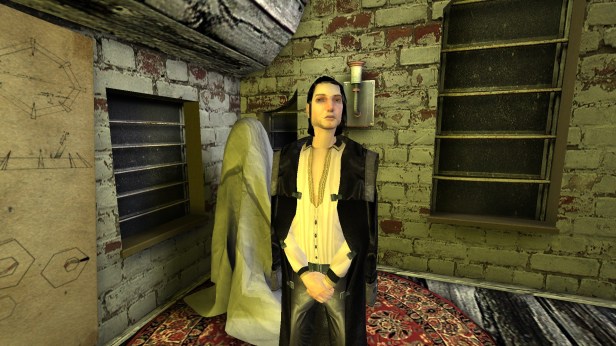
In this town, you meet a number of unique characters whose motivations are all quite believable. There’s no-one wholly good or wholly evil unlike in many games. Take your average RPG town, for instance. Generally, there’s a noble governor trying to root out the scum bandits, dishonorable, faceless thugs who generally won’t even stop to talk to you and would rather shank you to death. What reason do they have for this? They’re generally carrying more gold than you are, and if they’re not, why would they try pick on someone who’s more powerful than them?
The thing about Pathologic is that both you and the other humans are on equal footing. There’s nary a moment when you find yourself taking down robber after robber with powerful weaponry. Instead, I found myself taking my time lining my shot up – after all, I have only a few weapons, my most important being a revolver, now down to 50% durability, and with five bullets left, I had to make every shot count. The enemies are just as deadly as you, even if so far I haven’t encountered anyone with guns, but knives are just as nasty as you’d expect them to be. Getting stabbed in the guts is generally going to be a life-ending experience.
Pathologic never tries to justify that you’re more powerful, or somehow better, than the NPCs because of your unique status as human input into their universe. You play by pretty much the same rules that they do – you get tired, you get hungry, you get sick, you get exhausted. It is the balancing act of the six different stats in this game that makes the experience genuinely terrifying.
Whenever I think modern horror game, there are generally two types – ones with scary atmospheres, and the other with abundant jumpscares which really only serve to irritate the player than legitimately scare them. Cheap thrills aren’t my thing, and considering I don’t play many horror games, I’d always go for the ones with atmosphere more than thrill a minute.
Pathologic doesn’t rely in any way on cheap thrills. Sure, you might jump if you’re as nervy as I am when a black-eyed looter sprints from a room and punches you in the face, but that’s because the game builds it’s atmosphere up so much that a lot is hinging on your every decision.
The town itself is integral to this – take a moment to look at the map of the town below and study the layout of the streets, and more importantly, where the bridges and any fences are.
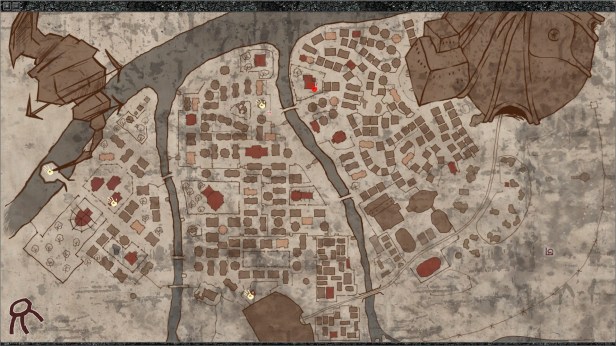
The town is structured naturally around the rivers and it’s tributaries, splitting it into three distinct districts. To complete your tasks each day, you must make your way to a number of different houses, manors and other buildings to talk to the named NPCs and investigate and further the story and side quests.
Walking anywhere increases your exhaustion level, as well as increasing hunger. To reduce these effects, you have to learn your way around town. In any other game, it would be a mild inconvenience. Taking a wrong turn in this game however can begin to cost you a lot – remember that time too is a resource, as if you fail to complete the main task of the day by midnight you lose the game – meaning that learning the layout of the town is important.
When you are exhausted after walking around the town with it’s wonderfully strange and eerie architecture for some time, you can do a few things. Firstly, you can scoff some coffee. This reduces your exhaustion a lot, but it damages your blood vessels, dealing health damage. Now you can see the balancing act beginning to play out.
To restore health, you need either painkillers or bandages. Say for instance you have some painkillers. You could take them, but suddenly your exhaustion skyrockets. You haven’t fixed anything, and you’ve just wasted valuable resources unless you get to bed – but what if you’re already running out of time? That’s why you ate the coffee in the first place.
So you use the bandages instead. You traded some bottles of water to a local drunk for the bandages, and it fixes your wounds for now. But what if you needed those bottles of water to sate your hunger, even for just another hour of precious life?
Pathologic pulls off the balancing act really well. The economy fluctuates more naturally than in any other game I’ve ever seen. Not to say it’s super realistic – almost every shopkeeper adheres to the same pricing scheme every day – but prices do change from day to day, forcing you to trade items you judge are no longer important, which may turn out to be a crucial error.
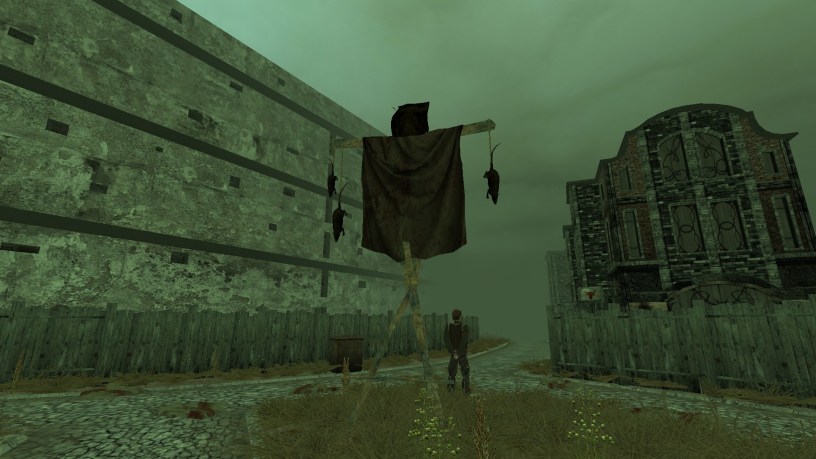
On my first try at playing the game, it fell apart pretty quick. I had no idea what I was doing, and by Day 3, my health was really low after I got into a nasty fight with a robber. I was then asked to plunge into an infected district, marked by these ominous burlap capes strung to poles, with dead rats dangling from the ‘arms’.
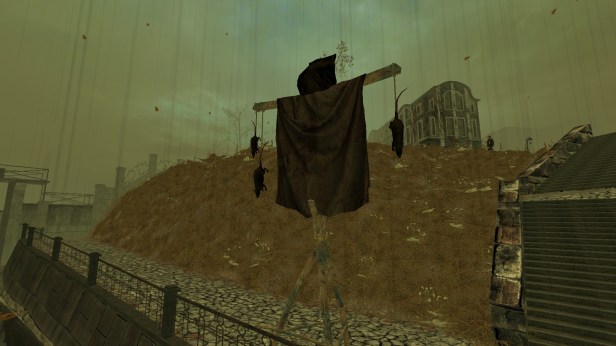
The infected districts is where the game tests your resource management, and where the game pulls out all stops in applying the emotion of fear to the player, which creates an atmospheric marvel.
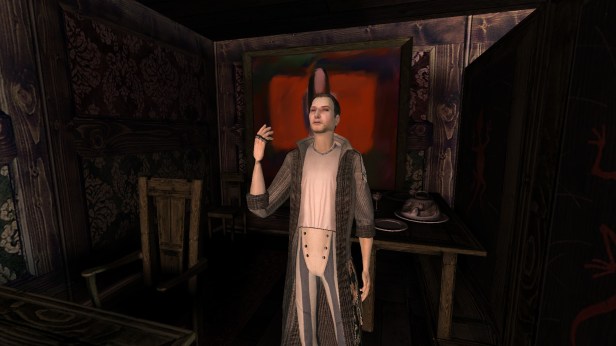
The game in non-infected districts is atmospheric enough. With the drum beats and otherwordly chanting of the soundtrack, as well as the beautiful, strange sights of the town and it’s people, it takes on a surreal, yet grounded feel. The graphics are at just the perfect point – they’re not hideous, but they’re not good-looking either. The people are strange looking, with odd facial expressions, which only adds to the sensation that this town doesn’t like you.
In an infected district, this is subverted almost, because besides the patrolmen who stand guard, ready to beat to death any infected person who tries to escape the district, you see no human faces outside.
The infected are swathed in cloth, walking around almost like zombies. But as the green tint signifying you’ve entered an infected district settles on the screen, you feel a sense of dread approach.
You have five bullets and a scalpel. You have draped a cloth around your shoulders to lessen the chance of infection, and you have a pair of gloves that should do to prevent contamination. Hopefully. But you’re going in to find some other resources that you can use – maybe there’ll be some food in one of the houses, or some antibiotics that you could use if the plague gets you. And it will. I guarantee it.
Stepping into the district, ignoring the warnings of the patrolman, you find yourself in a dream-like place, as maybe an aggressive rat will scuttle to your feet and try to bite you to infect you with the plague, or maybe all you’ll have to dodge are the shambling living, so draped in dirty cloth even as you step over the bloodied cloth that lies strewn in the street. Other people, perhaps?
Suddenly, a cloud forms in front of you. But this is no cloud, no. This is the embodiment of the Sand Plague, a shifting form of human faces, twisted into indistinct expressions of terror.
Your mind attempts to reconcile the two aspects of Pathologic’s world, but finds it cannot, so it creates something more terrifying. Because the world is presented as realistic – you eat, sleep, take medicine, and so forth. Everyone around is human, and you speak to them like a reasonable, confused human being.
So why is there a cloud of screaming faces approaching you from the front, while from behind people draped in cloth try to infect you, the doctor, with the disease?
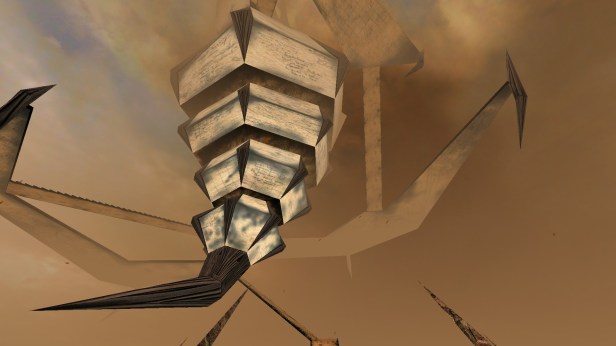
It is the balancing act of resources, combined with the oppressive atmosphere, otherworldly elements juxtaposed onto a world that is realistic otherwise, that create the masterpiece of fear that is Pathologic.
But, if you’re a fan of complex narrative, philosophical plot and interesting characters, or if you just like the sound of a hard but fair system of survival within a horrifying world that will make you depressed as you wonder at the point of it all, then try Pathologic.
Next time I write about it, I’ll have a bit more of a talk about how the characters fit into it all, and why the cycle of walking and talking works in spite of the vitriol around ‘walking simulators’.
 Horrorgameanalysis