
Last time I had a discussion about how fear works in Pathologic. While it was by no means a complete dissection of what it means to be afraid, I made an effort to pick apart the atmosphere and the way resource management functions.
This time round you will be able to see why the game Pathologic works better than many games, because of how it involves the player beyond an expectation that there will be another carrot dangling ahead of you when you reach your destination. I’m in no way discrediting other games by holding up Pathologic as a specific approach, just showing how Pathologic uses the aspects of many different games while using a few interesting turns of it’s own to create a unique game.
In Pathologic, you choose one of three characters. Well, that’s not really true; you can only choose one of two characters to begin with, as you have to finish the game once to play with the Changeling. So, that leaves a first-time player with two choices – the Bachelor or the Haruspex. Having played through the first day on both, I noticed key differences that a lot of RPGs could do with picking up, though it’d be an incredible task to do something like this on a much larger scale, such as one of my other favourite games, The Witcher series.
So, if you choose the Bachelor (which is highly advised, as it eases you far more gently into the game), you enter the town as a well-respected medic, and as such, the way characters talk to you and what information they give you is greatly different from how the second character, the Haruspex, finds things.
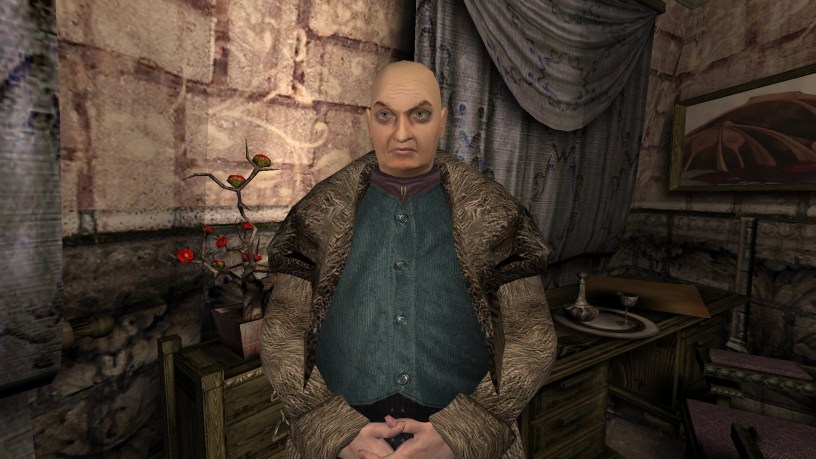
Accused of murder, the Haruspex finds hardly anyone willing to talk with him. And understandably so – why would you want to speak with someone that the entire town has already tried and condemned as a murderer? Only someone who knew you or your good nature would try to speak to you – and this is what a character, Big Vlad, does for you, opening his doors when no-one else will.
Let’s pause for a second and compare what Pathologic does differently to other games where you choose your character.
Let’s take a popular example – Skyrim, from 2011. (By comparison, Pathologic was originally released in 2005). Skyrim gets you to choose from a number of races, each whom, in the lore of the world of Tamriel, have different standings within the universe. There are cat people, lizard people, elves of different colours, as well as your standard human races. Now, not to say that Skyrim needs to go to the trouble of making each playthrough so distinct as to give each race a unique story and reaction from people – though that would be nice – but what Skyrim does is pretty much gloss over any uniqueness that you might gleam from the races themselves. The biggest difference is that a guard might remark on the fact that you’re an Argonian, or that Orcs will let you into their strongholds without you having to do a single fetch quest that the other races have to do.
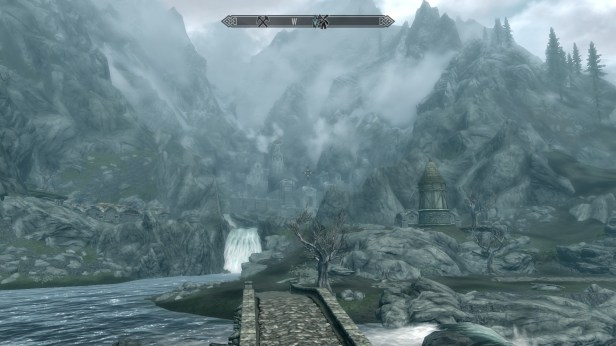
While Skyrim is a fun game, and an important part of my gaming life, it appears to value player choice, but in the end there’s very little difference. Dark Elves aren’t treated really any different in Windhelm, neither are Argonians, (two races who are said to be oppressed by the Nord population) and there’s no real additional acceptance that you see from the Empire’s forces. Sure, there might be one or two less racist remarks, but the fact is that a non-Nord who might hate Skyrim or the Nord race of humans can join the Stormcloaks, the pro-Nord faction, and become their champion. We’re told things, not given evidence of their existence.
Being a Stormcloak hero also doesn’t prevent you from going to join and become the leader of simultaneously the Dark Brotherhood, the guild of infamous murderers, by hacking your targets to death with the axe you got from becoming leader of the Companions, the guild of fighters. The problem is that in Skyrim, your actions carry no weight beyond immediate and unimportant repercussions, and no-one responds to a murderer in any really different fashion than they might to a hunter of animals, or a fearsome warrior. Again, a guard might say that he wants you to teach him the ways of magic if you’re a good mage, but what difference is there? If you pick apart what Skyrim does and doesn’t deliver with it’s promise of choice, it is as they say: the pool is exceedingly wide, but in most places, disappointingly shallow. You inhabit a vast, fun world filled with activities, but none of those activities mean anything to the game. They might mean something to you, the player, in which case it has partially succeeded, but ultimately the game doesn’t really care. If you kill an entire city, you just spend a few weeks in jail and all is forgiven, which is a broken response to something that should have far more serious repercussions.
So, bringing this back to Pathologic, how does this affect choice or consequence? I’m not saying Pathologic utterly nails choice and consequence and is some expansive RPG where you can do literally anything you put your mind to, but within the constraints of the game, Pathologic succeeds far more on the choice/consequence front than Skyrim ever did. It’s this that makes the gameplay loop of ‘walk, talk, walk, loot, talk, walk, catch the disease, oh crap’ so fulfilling in Pathologic. If the talking and the quests ultimately meant nothing – if it didn’t feel like the world was reacting to what you did, then you’d be in far less hurry and would be more eager to shoot things.
But when you choose your character in Pathologic, you agree to enter into one third of a mystery. You see it through the lens of a unique individual, who has their own responses, their own questions, their own ideas about the world, and you can play through this avatar.
The Bachelor is a man of medicine and education – he begins the terrible twelve days within the town as a bit of a cynic towards the stories presented to him of Steppe spirits and plague beasts, but as the plague progresses, his cynicism fades, even just a little, and you are left questioning where his education has left him, and whether it will help him. On Day 5, you can stop and talk to a sick man on the street, who argues that human beings are a burden upon the earth and that the plague is a natural thing, that death is good because it gives the Earth life. As the Bachelor, you can choose to argue against him, or simply cede that, well, he might be right.
The Haruspex is a man who has more traditional knowledge about medicine – he has the capability to mix steppe herbs together and gut other human beings to sell their remains or even use them to make something useful. He begins his twelve days on the run from people who think he is a murderer, and you can either choose to confirm their belief by killing more people or by running. This simple choice would probably not be presented to us in many games – thinking about it from your regular video game’s perspective, you’d imagine that if they’re out to get you, you get them back. But Pathologic gives you a choice, and you might not even be aware it’s a real choice.
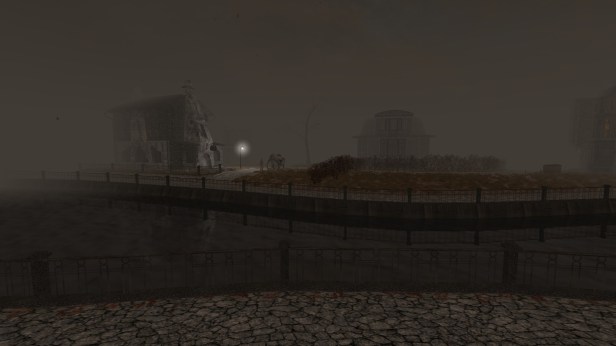
Now, you might think I’m being a little unfair on Skyrim with this comparison. It is, after all, not supposed to be a game like Pathologic. The world was never supposed to react to you in this way – you are just a traveller. But if you’re the traveller who has felled the mightiest dragon who was supposed to end the world and been to see Hermaeus Mora, God of Knowledge, and read his book, then surely the world should fundamentally feel changed. So why doesn’t it? And why does Pathologic pull off this feeling that the world is reacting to you? It’s because Pathologic doesn’t insult the user’s skill or intelligence. The game doesn’t hold your hand at all beyond some occasional quest markers on your map. You teach yourself the keys needed to move around, you teach yourself the location of characters, you teach yourself everything except a few pointers presented by some sort of fourth-wall breaking dramatists at the beginning of the game.
Comparing it once again to Skyrim, if you’ve played it you might recall the opening town. Here, you are bombarded with so much new information about controls and game mechanics, menus and stats, that you do not really have time to process it.
Now, if you’re a video-game veteran, you might think it’s pretty easy to find your way around. But it’s not just that – it’s the dozens of new terms that you are bombarded with. Who, or what, is ‘Talos’? What is the Empire, the Thalmor, the Stormcloaks? Who is Ulfric? Why should I care?
Pathologic instead (for the Bachelor, at least) eases the player into the world by asking players questions – where am I? Who is this person? Why do they want me to do this? What does this mean? By asking questions, rather than answering questions that haven’t been asked, Pathologic invests you in the world, rather than demanding that you invest by telling you why directly as Skyrim, and many other games, are so fond of doing.
Pathologic is like a surreptitious illness, creeping into your system until it’s too late to do anything. I love Skyrim to bits – you might not think it to read the above – but looking back on Skyrim, and comparing it to a game that values player agency and choice, you can see where Skyrim was lacking in crucial areas – remember that this doesn’t make it a bad game by any means, as there’s a reason it won awards and that people are still playing it today – but a game like Pathologic can show us how a world should be unveiled and how a world could really respond to the player.
Pathologic finds the balance in story-telling that can be very difficult to nail – show, don’t tell, but keeping the story interesting enough that the answers are always just around the corner, but with another few questions along the world. The world doesn’t demand you invest, it simply requests.
And things are better when you are polite.

Next time I’ll go more into the actual story of Pathologic and how all the characters work in concert to create a living, breathing, yet dying world that we inhabit in the game.
 Horrorgameanalysis