
Some spoilers for Pathologic follow.
Pathologic, by Ice-Pick Lodge, is, without hesitation, my favourite game of all time. It’s a stunning mix of surrealism, apathy towards the player, and you have to earn it’s respect. It is a wonderful, underrated achievement, and I can’t stop talking about it.
With that out of the way, I’d like to discuss the way that characters are constructed in games, using Pathologic as an example, as well as a few other games.
Take the character of Georgiy Kain, the Judge, who is likely one of the first characters you’ll meet in the original game, if you chose to play the ‘starting’ character, The Bachelor.

His house is richly decorated; paintings of several kinds dot the walls, as well as a particularly hideous fireplace (which somehow has it’s own charm).
From the first sentence that he hurls at you, you can begin to guess at the kind of man that Georgiy might be. He uses long winded phrasing, outdated and antiquated terms of phrase, even, and he speaks in this way in an attempt to deliberately obfuscate his real goals from the player. Eventually, he gets around to telling The Bachelor that his brother, Simon, the man whom the Bachelor has travelled so far to visit, has just died.
And not merely died, no – despite this being remarkable for a man called ‘immortal’ by many – it was murder. Someone had the gall to murder Simon Kain, the most beloved of the Town’s residents, (“Simon had no enemies,” Georgiy tells you) and the Bachelor (ie you) gets the opportunity to not only figure out why, but decide who should investigate, in what order, and whether you have time for everyone.
This conversation with Georgiy could be considered long-winded, laboured even – there’s a lot of discussion around personal philosophies and what crops up a lot is the idea of ‘fate and fatalism’.
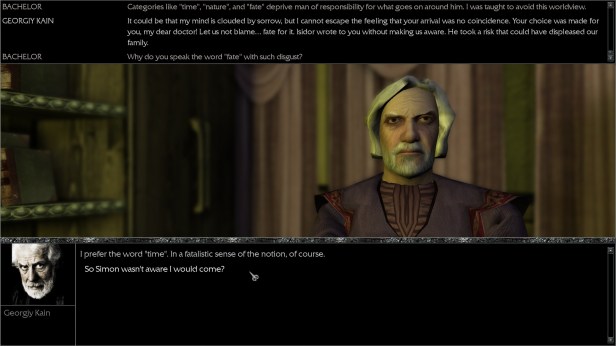
We get from this conversation that Georgiy is a man who is keen to not only debate, but to enter into intellectual conversations, and is a man who has a deep, if slightly strange and skewed, view of the world. This comes through just in the first conversation that you can have with him. During this conversation, you can even refuse the call to arms, and essentially ‘lose the game’ by ignoring the murder mystery for the rest of the day. Not a great outcome, sure; but a consequence of your apathy and negligence.
You can argue with Georgiy as I did, that “Categories like ‘time’, ‘nature’, and ‘fate’ deprive man of responsibility for what goes on around him. I was taught to avoid this worldview.” Not only are you characterizing the Bachelor with your response, and responding to the obvious philosophical leanings of Georgiy, you are, in essence, characterizing yourself.
I’ll take a step back for a second.
Let’s look at more recent games that the company Bethesda Softworks has made – games ostensibly with the label ‘RPG’ attached to them. They allow you to play and inhabit a role in the game, and it can be as broad or as narrow as the game developers like. You do begin to notice something though; the restriction of player freedom to play someone set. There are good ways, and bad ways, to do this.
In The Elder Scrolls V: Skyrim, you always begin the vanilla game in a cart, herded off to your execution, the typical Elder Scrolls “I’m a prisoner” beginning. You get to choose your race, customize your character’s looks, and you’re away, escaping from the jaws of Alduin and the clutches of the Imperials who wanted you dead. You are then set free to explore the world.
In Fallout 4, you begin the game in your house. You have a husband/wife whom you can customize, a house, a robotic butler, and a child. These things are all determined for you. A salesman knocks on your door, and you receive your stats by filling out his survey. Then, the bombs fall, and your spouse is killed irregardless of what you do, and your child is taken.
In Skyrim, you are a ‘blank slate’ of a character. Other characters around you have modicums of personality, and you respond to what they do. It is, in essence, a more watered-down version of a Dungeons and Dragons game, which is what an RPG generally sets out to do. Like Pathologic, Skyrim presents you with a number of things you can say – generally a lot more limited than Pathologic, but they’re different games with different audiences.
It’s not so much the limited range of choices as the limited range of repercussions that is the issue. The consequences for your actions in Skyrim are few, and hardly restricting. In Fallout 4, the issue is even worse. The need to have your players see everything is a design idea that lessens immersion and interest in the game. If your character turns out to be, as the general internet consensus goes, another stealth archer, then what uniqueness do we get from each character? If I can become the head of all the guilds, some of which should surely contradict each other, and if each guild in the end supplies me with the same rewards – a new bed to sleep in and an infinite stream of thankless fetch quests with the same reward(s) every time, then what’s the point in offering choice in the first place?
Fallout 4 has pretty much identical ending slides, irregardless of what faction you chose, and the ending feels hollow. You either blow up the Institute, the Brotherhood airship, or both. There’s no ‘talking them down’ or negotiating – it’s all or nothing. But then again, what repercussions are there to your actions? There’s no new lost Synths wandering the streets, cut from the ties of the Institute, no new quests to rebuild or reforge the wasteland. Just Preston’s endless ‘help these useless idiots and while you do that I’ll find some more useless idiots’ quests. Your actions never feel consequential or weighty. Sure, it’s freeing, not having anyone breathing down your neck and saying ‘since you did that, you can’t do this’ – but it’s also at the same time railroading. If everyone can make all the choices, then no-one has made any real separate choice. Everyone can end up with pretty much the same game state at the end, just with a different guy who tells you to push the big red button at the end.
I did enjoy both Skyrim and to a lesser degree Fallout 4, but they’re not by any means great simulators of choice and consequence. Murder someone in Skyrim, get fined 1000 gold. That’s a pathetic slap on the wrist for what should be a far larger and more consequential action.
Characterization and thus investment in a game is not to do with necessarily well-done or memorable NPCs – Skyrim and Fallout 4 both have plenty of those – but in the way those same characters respond to you.
Murder someone in front of Lydia, and what does she do? “I am sworn to carry your burdens,” She says impassively after the act is complete.
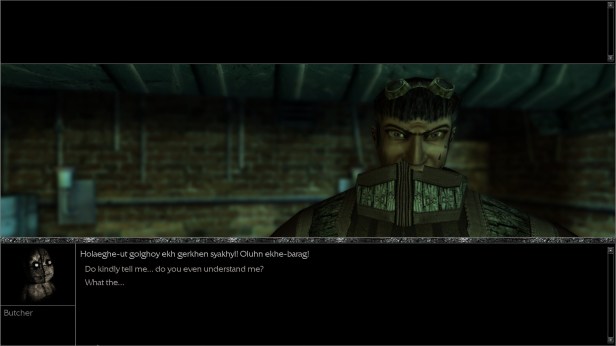
Pathologic’s characters cheat you. Pathologic’s characters lie to you, get offended by what you say, and ridicule you for your ignorance. Some characters demand that you earn their respect. You’re not a hero. You’re not laudable. You’re some doctor who’s shown up and stuck your nose into their affairs. They had plans, and you messed with them. They’re out for blood, perhaps yours.
You kill someone in Pathologic, the Town frowns on you. Kill more, and word spreads. This person is a bloodthirsty murderer, killing people and stripping their bodies of the loot, or even their internal organs. People stop wanting to talk to you. Shops shut their doors on you. Eventually, people realize you’re a threat, and start chasing you, trying to kill you themselves.
Yes, it’s what you do in a game that can define your character and test the characterization of those NPCs the developer has placed around you – do they condone murder? Are they happy to see you flee from the Town as soon as things get remotely difficult or hopeless? Or will they do anything to make you stay? Games need breadth of characterization to make them more immersive, and one way to do that is to have characters respond not as a hive-mind, but as people. Pathologic does this very well, and it’s something that other game developers should be looking at.
Next time, I’ll focus solely on Pathologic and how the characters talk to you, why they talk the way they do, and why they are presented in certain ways.
 Horrorgameanalysis