
So, a long time ago now, I discussed how choice is only useful when we get to see consequence, and how players characterize the world and their own playable character / avatar through the actions they take and the consequences that they reap. Quite frequently, we find that consequences are most effective when we look at the impact they have on the non-player characters in the world. What happens when a character is killed? How do family or friends react? But, perhaps even more interestingly, how can NPCs make you, the player, the vehicle of their desires? They cannot act for themselves, but you can act for them. It is this knowledge that makes Pathologic and its characters so alive.
Some spoilers for the original Pathologic follow.
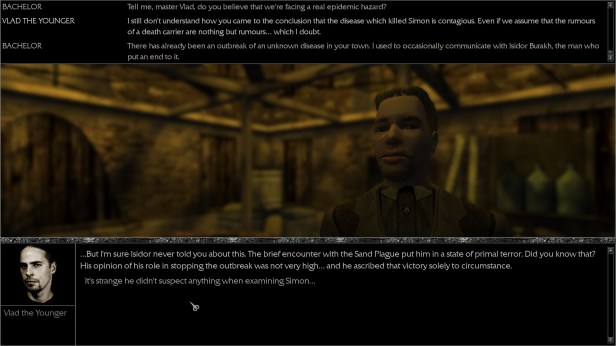
In a conversation with the character Big Vlad, the Bachelor discovers many things about the man, and this in turn makes the player wonder… what else is he hiding, if anything? In a game, it is important that we as players can connect to characters in the world. But all too often, characters within a game world are static or even ‘too helpful’ – both unrealistic. If a game character follows you round and throws themselves headlong into a conflict and dies for you, this should be a big event. But too often, video game NPCs have no sense of self-preservation, one of humanity’s largest priorities it seems – at least on an individual basis.
Pathologic’s NPCs are written in such a way that it seems self-preservation is, at the very least, on their agenda. They recognize that the player, as a new character being controlled by a human being who can make thoughts and decisions of their own, is a force of change, and they use that to their advantage.
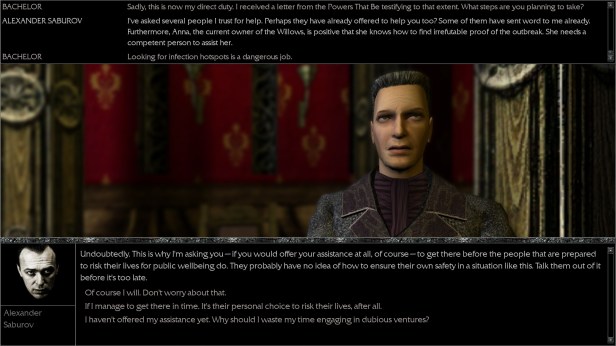
The governor Alexander Saburov is a man who has long been stripped of his power and authority. The other rulers have, in times of peace and relative prosperity, been able to outstrip his house’s powers and circumvent him. But when the threat of plague surfaces, Saburov offers to help the Bachelor gather evidence to convince the other two families. But what Pathologic does so well is make you question motivations. Is Saburov doing this because he genuinely believes in the threat of the plague? Or is he merely doing this out of spite for the way that it’s implied the other rulers have treated him? As the ‘after thought’ ruler, the unnecessary one.
Theoretically, the Bachelor has no choice but to help him, but there is a nagging worry at the back of your mind as you carry out your task, and inform the other family leaders of Saburov’s request – and they accept.
Now, Saburov moves to crush his opponents – perhaps not overtly, but a very real fear is exposed if you make your way through another side quest this day.
Eva Yan, the lovely woman whose house you are staying in, wishes to leave the Town, on hearing the rumours of a deadly disease propagating. A selfish plot hatches in her mind, and she drags more and more people into it – including most first-time players. As the Bachelor, you don’t feel any sense of obligation to the people of the Town. The man you came here for, Simon, is dead, and things are obviously going to hell and just getting worse. So you will more likely than not decide to help her.
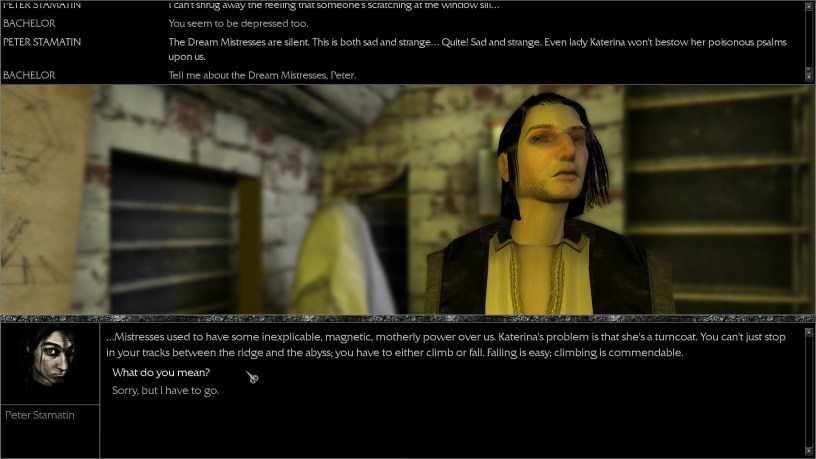
But this quest is interesting, because it can end more than one way. Eva wants to bring Andrey along, so you run over to Andrey’s place. Andrey won’t leave without Peter, so you run to see Peter. Peter refuses to leave, so you need to find someone who will give him permission to go. As it turns out, the only person who he’d accept permission from is Maria Kaina – but Maria Kaina won’t let him leave, as she needs him for her own purposes. So you have to perform a ballet of sorts in conversation; and this often ends in failure, as you aren’t reading between the lines; you are ruthlessly trying to assert yourself as not just a flatterer and a gifted liar, but as an agent of change. Maria sees through this, and cuts you down – unless you say the right words. When you do, you are able to get Peter to leave. A time is arranged, so of course you go. These are your friends, you can’t exactly leave them hanging. But then, it turns out, your friends didn’t show up. You’ve been caught by the Executors, and told – no.
Your actions don’t have consequences here. It’s the game fighting back. It’s your attempts coming to naught. In another game, a more freeform game that lets the player “do whatever they want”, there might be a quaint little “bonus ending” somewhere in there, something that folk would fawn over. “Oh, that’s cool,” they’d say. “You can finish this bleak difficult game really early and still get the credits.” But Ice-Pick Lodge won’t let you snatch control away from them like that.
Somewhat contrary to what I’ve been saying, asserting your role as the one human in a single player game is too often a power-fantasy. Survival horror games are the best at providing the sensation of restriction in a video game. Classics in the now fairly quiet genre know that the best way to make you feel like a character is to limit the player’s mastery over the controls. In a game like Just Cause or Grand Theft Auto, for instance, your character is locked and loaded. Ammo is a button press away, and you can take more hits than your enemies.
But when the Bachelor Daniil Dankovsky is stabbed in the chest by a mugger, his health bar tanks. Why? Because you are just the same as the NPCs. Stab a robber a few times and they’ll fall down, too. A headshot will instantly kill a thug, and springing an ambush on a patrolling guardsman is the best way to earn some free loot without a tough fight. But quite often you are caught by similar techniques.
Pathologic uses and manipulates you because the characters suggest courses of action that seem logical in the current situation. You want to leave town? There are characters who are trying to do exactly that. You want to try find a vaccine? Someone somewhere is trying to accomplish that. What is happening with the local Steppe people? Do they have their own agenda? Yes, undoubtedly they do.
A good game understands that pure liberation is not the path to enjoyment. Pure power fantasies can be fun for a while, but they feel hollow in the absence of restriction and challenge. It is just as if I asked you to write 1000 words about anything you like; you would, more likely than not, struggle to come up with a concept that you wanted to write about. But if I told you the genre or the thing I wanted you to write about, your mind would work to fight the 1000 word restriction, and say everything you needed to say.
It is this way with a good game. In Pathologic, you feel genuinely good when a situation goes right because you planned well, or thought ahead, or fought an unwieldy, slow set of controls to victory. Cheap gratification is just that; cheap. Choice is a luxury, it could be said – why not fight for it?
 Horrorgameanalysis