
Silent Hill feels tangibly like a cultural artefact at this point in time. Konami, the owners to the rights, are merely happy to sell the license to multiplayer horror game developers and milk the name for Pachinko machines, but still, the drought of news relating to the potential of a new game doesn’t exactly have my hopes up. And with the going-down of the PlayStation 3 store, the easiest way to get it without either a) piracy or b) forking out a lot of money is about to go the way of the dodo. If you are interested in picking it up to play and have a PS3, there’s very little time left.
It is worth nothing that there are quite a few new games that seem to be trying to capture the spirit of Silent Hill – games like Visage, Song of Horror, and The Medium – all of which I have yet to play. It is something for the next holiday I get, I think.
Silent Hill itself though sits fairly desolate. The rerelease of Silent Hill 4 : The Room on GOG feels like a step in the right direction – but of course, it’s a barebones port. Konami haven’t even bothered to port Silent Hill 2 or 3 to the platform, even though it would make them boatloads of money. Unless they are waiting to announce a surprise remake version of it for the new generation of consoles (which I do sincerely doubt at this stage), they shouldn’t really have any excuse.
This lamentation comes at this point in the long analysis because Alchemilla Hospital is a reminder as to the power of video game horror at every step, and I do lament the fact that the Resident Evil franchise, while stunningly successful and a franchise I also love, is getting to carry the title of “best survival horror game ever” off into the sunset, because Silent Hill is as much deserving of the title as they are. It just so happens that the relevance of Silent Hill fades more and more each day. Perhaps Konami has gone meta, as they say. Perhaps this longing for a thing we can never have shall be thing that drives each and every fan of the series to insanity, to go and seek our own Silent Hill, and go missing in the strange purgatory that is abandoned suburbia-hell.
But anyway. Enough of my moping. Let’s talk about where the game kicks back into gear after the previous entry.
So the walk across the bridge to the hospital is as formulaic still as it comes. The only threat comes from a few grumpy skinless dogs, which are easily evaded at this stage. Heading inside the hospital, I am still routinely amazed at the camera work on this early-3D game. The camera angles aren’t as frustrating as many other survival horror titles, including the fourth game, which I found to have some truly annoying camera angles. The shots are wide enough that Harry always feels like the focus and you always retain control over him, but also narrow enough that you feel cramped and claustrophobic, like you are being watched through the camera by someone else.
It is remarkable how such a simple mechanic can be used to your advantage and your disadvantage. You feel voyueristic even as you need to rely on these camera angles to actually play the game. It is like something is perched on your shoulder while you play, summoning demons in the game just off screen. The feeling is palpable, and this is part of what makes this old style of horror game work so well. While there is a very strong argument to be made for a first-person or an over-the-shoulder third person horror game, I still think there is an equally strong argument to be made for these fixed camera angles. It just depends what kind of mood you are aiming for while designing the game. Of course, it’s not the only contributor. Resident Evil 7 created a tense mood and genuine scares even while being first-person, which is the traditional vehicle for epic action-shooters like Call of Duty, by restricting the speed, ammunition, and actual field of vision that the avatar has. Team Silent in 1999 has to use different tactics – but still uses them as excellently as Capcom uses their first-person strategy in 2017.
It doesn’t take long in the hospital for the plot to advance in a genuinely meaningful way. It feels to me like the plot has picked up pace after the long gameplay segments familiarizing you with the credos of Silent Hill – that it is a slower burn than most Resident Evil titles, focused on ambient scares and monsters with a psychological bent to them. It is the perfection of that formula that led to Silent Hill 2, my favourite in the series. Many others feel the same.
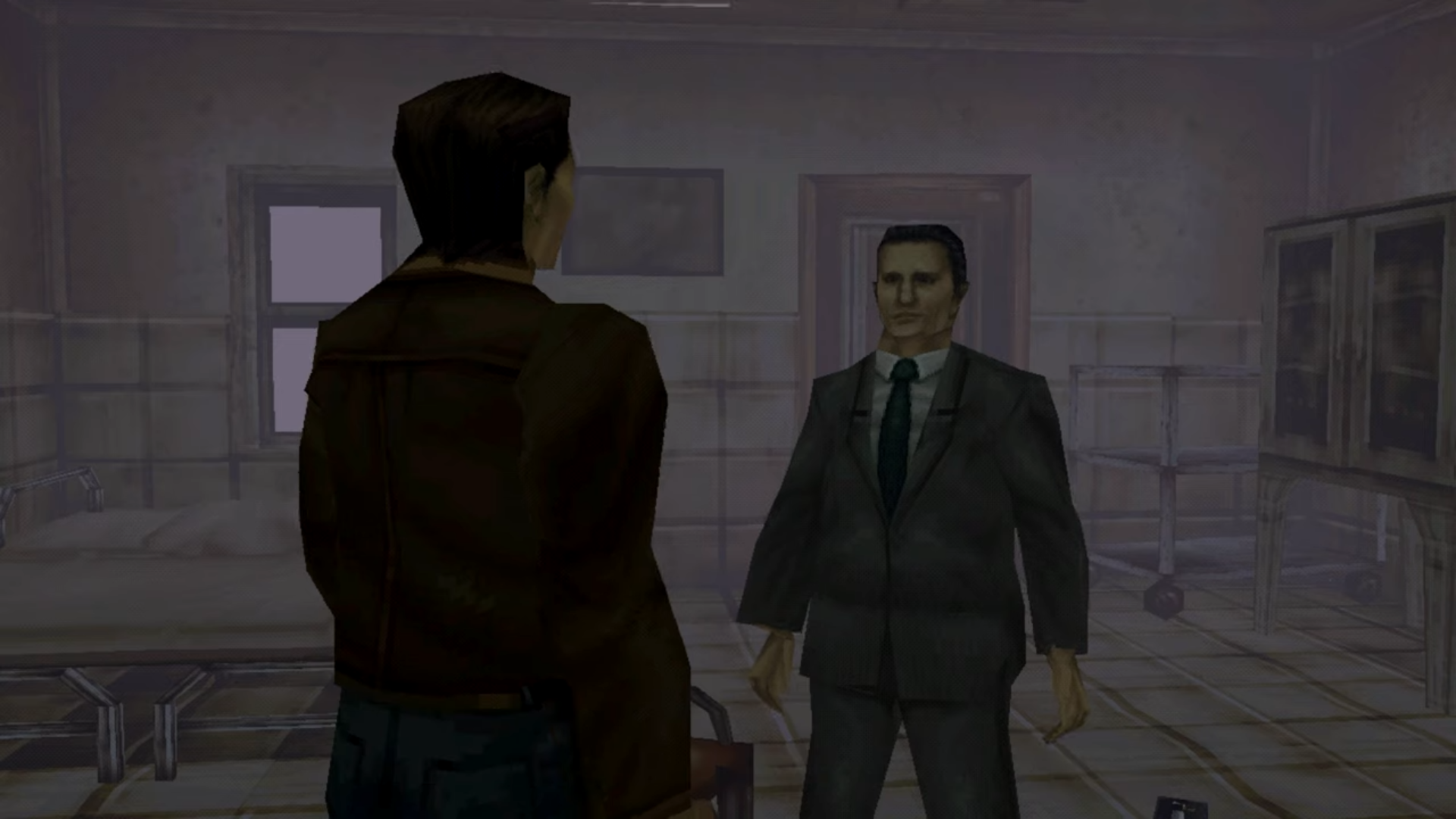
So, we meet a new character, adding to the two others we’ve met so far in town, Cybil and Dahlia. This is Doctor Michael Kaufmann, apparently, and our introduction to him is a slow-panning camera up from his feet – where a dead monster lies in a pool of blood – up to a revolver clutched in steady hands between his legs, to a stern look on his face.
Back in the non-FMV world, Kaufmann is quick to take a potshot at Harry, a warning shot. He seems to think Harry is another monster, just another creature that lurks in the shadows of the foggy town. Harry quickly establishes to him he’s not a threat by just talking to him, and Kaufmann introduces himself. “Thank god, another human being.” Kaufmann says. Harry is quick to explain himself as a “tourist”, and once again asks whether or not Kaufmann has seen his daughter, Cheryl. Kaufmann is less delicate than Cybil, and seems to remark that it’s likely that she is already dead – before catching himself. Kaufmann also explains that he was “taking a nap in the staffroom” and that when he woke up, “it was like this”.
His best line comes when he is stalking about the monsters, and trying to tell Harry that something is seriously wrong here. He says that “You and I both know, monsters like that don’t exist.” Harry can only offer a meek, “Yeah…” in response. It is obvious that Kaufmann has his own ideas on the monsters, but does not feel like elaborating to a person he just met.
Typically for other characters in Silent Hill, Kaufmann quickly makes his exit after discussing Cheryl, leaving Harry once again alone in the town. The exploration of the hospital plays out much the same as other areas in Silent Hill. This time though, unlike the school, I quickly found the map, and used it to familiarize myself. As I come to understand my own style of play more and more, I try to rely less on the map and more on my own memory. Not only does the map make things easier, it makes things less enjoyable, as there’s the slow fade-in/fade-out each time of the map.
I collect everything I can from each of the unlocked rooms, and then proceed to an elevator. Typically, the elevator is locked, since there’s no power to the building. Well, I can sort that out pretty quick by heading down to the basement. I flick on the power, and find what is my favourite melee weapon so far, a large fire hammer. It feels much more immediate and satisfying, and has a large range both forwards and to the side, allowing me to hit several enemies at once if I run out of ammo. Which, for the first time in the game, I do. But after a lot of fighting, anyway. That comes later.
I hop in the elevator, and try both the other floors I haven’t yet tried. The second and third floors merely have lobby rooms that have locked doors, restricting access to the rest of the floors. The haunting feeling ascends to its fullest as you step back into the elevator. Before, there were only four buttons – basement, first floor, second floor, third floor. Now, there is another button.
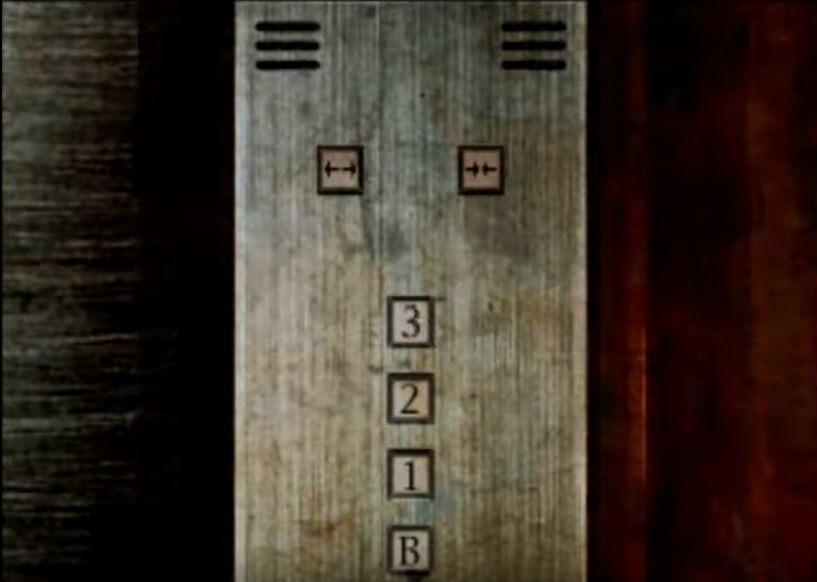
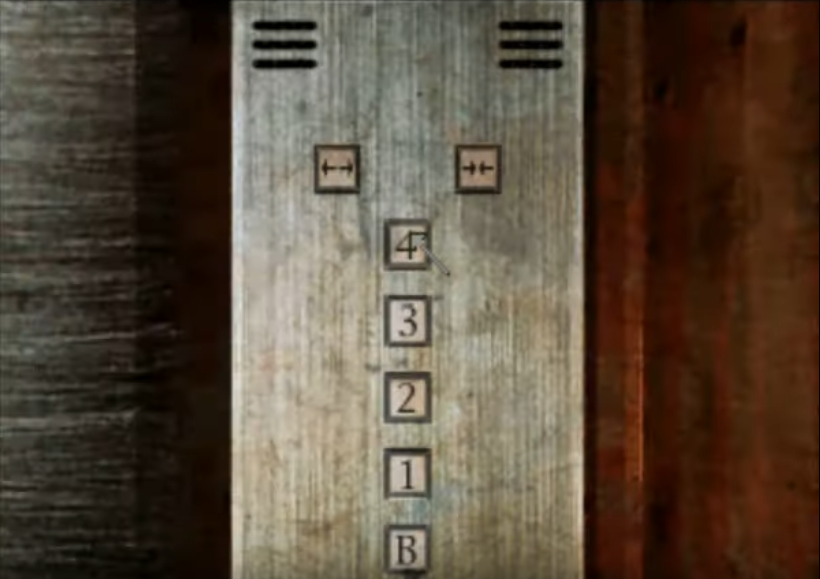
The Japanese fear of the number four – a number that can literally mean death depending on how you pronounce it – echoes here. The fourth floor is, as one might expect from a town as deranged as Silent Hill at this stage, a portal to the rusty, bloody Otherworld. Because of course it is. A short cutscene plays as we enter the fourth floor – someone disappears through a dark door ahead of us – a young woman, by the looks of it. This scene is haunting a way that the original game hadn’t actually yet achieved for me yet. But the foreboding was probably the most heightened feeling of tension and horror that the game had given me. There’s a feeling of inevitability here; the shroud of death hangs heavy over the fourth floor.
As you push through the dark and bloody hallways, you hear strange sounds. If you thought that Midwich Elementary School was an uncomfortable experience, Alchemilla Hospital turns that dial towards its largest extreme. Anything and everything unnerves you here. You find a staircase, which leads you down to the floors that were previously inaccessible. And there, haunting you, the zombified, hunched figure of a nurse, radio static crackling. So it begins all again.
The screams of pain as you shoot the nurses sound disturbingly sexual in nature. Like most Silent Hill games, Team Silent take a special delight in their games when they conflate pleasure with pain. There’s a feeling of taboo, of intense guilt, that comes from defending yourself from these infected nurses. That otherwordliness comes to the forefront even more when the player takes control of James Sunderland in the second game, and the nurses are sexualized to the point of parody almost – but are also twisted and monstrous in a way that makes most players fully repulsed. The effect is more pronounced if you are attracted to women; the repulse-attract of both SH1 and 2’s nurses is just another building block of feeling unnerved, and of being placed entirely out of your comfort zone.
There are a number of puzzles in the hospital. One involves feeding a bag of blood to a tentacle that lashes out at you, so that you can get past it to collect a coloured tile to solve another puzzle, a brilliantly put-together puzzle that requires you to identify the colour of things referenced in a poem, and put the coloured tiles you’ve collected together to get through a large locked door.
Camera angles are used to tense and even cruel effect here, with the large gaping abysses of the Otherworld often holding nothing but infinite darkness, and enemy nurses and doctors popping up as terribly quick bullet-wasters to throw you off your game. Rooms are not even fully covered in floor, instead narrow rusty walkways funnel you through unhelpful but spooky camera angles right to an enemy. Or two!
As I fought basically every enemy in here as I explored thoroughly to find the tiles and anything else I might need, I ran out of ammo for my pistol, the first time that had happened. Instead of relying on my shotgun – which I’m saving for bosses – I pulled out the emergency fire hammer and started to really enjoy melee combat, in a way I hadn’t enjoyed with the other melee weapons I’d found previously. It’s fast and easy to use, and does a good amount of damage.
Eventually, you descend into the basement below the basement, burning away some vines and travelling down what appear to be some kind of mental institution, with big heavy locked doors. Eventually I find a video tape – which I can’t play properly on the hospital’s VCR – and a photo of a young woman in a room that Harry thinks someone has been in recently. I guess because it has a messy bed? The photo comes with an inscription that simply says Alessa. I have to guess that this is a photo of the young woman I saw earlier in the hospital. There’s also a key to the examination room, which I nab.
Heading back upstairs to the first floor, I enter the examination room, and meet yet another character. This is a nurse called Lisa Garland, who has been hiding in here from the monsters ever since she arrived. Crawling out from under the desk, she quickly embraces Harry, who she sees as a saviour of sorts.
She has a similar story to Kaufmann: when she fell unconscious, this time it seems involuntarily, she woke up in another world. Unfortunately for Lisa, however, she seems to have found herself in the Otherworld, not the foggy world. She looks to Harry for answers; alas, Harry is just as much in the dark as she is, though maybe he’s picked up some wider contexts for the event by now. Harry sums it up nicely: “So you don’t know anything either. Great.” Like several times before, Harry thinks that it must be some kind of bad dream still – or at least it feels like one. Kaufmann seemed to have the same idea. The monsters, he reasons, can’t possibly exist. Lisa adds, “A living nightmare.” When Harry grills Lisa about Cheryl and then about the weird mental asylum bit below the basement storeroom, she knows nothing on both fronts, only that she was told not to go down to the storeroom for any reason. The plot thickens.
The writing in Silent Hill is stilted, it’s true – but it gets everything across that it needs to. I don’t recall an instance in which there was something said that didn’t at least add to the intrigue. Certainly we’ve come a long way, though, when looking at a game like Outlast 2, (my favourite horror whipping boy) we still aren’t uniformly advancing the cause of horror texts, and in Outlast 2′s case, we are even regressing.
So just as Harry was about to explain to Lisa what he saw in the storeroom, he groans in pain, then blacks out. And that’s probably where it’s best to finish things for another week. A fantastic stretch of game. Loved this section dearly. I may do a “fuller” breakdown in a video or something.
Enjoyed this article? Consider visiting the virtual tip-jar of Patreon and helping me out. It would mean a lot.
 Horrorgameanalysis