
“If cultural historians of the future were to look back at the early twenty-first century, they would observe that we were unusually obsessed with the end of civilisation as a form of amusement.”
So says Stephen Joyce in his 2018 book, “Transmedia Storytelling and the Apocalypse”. The idea, he argues, is a fairly recent one. The idea of an apocalypse has certainly been around for a long time. But the fear of surviving the apocalypse, of losing all that makes our society a society, is one that has a haunting, and yet consistently attractive, macabre aura to it. What happens if you are one of the few to emerge from the rubble or escape the zombies, etc.? Are you strong enough to survive? Either physically, spiritually or, perhaps most crucially, mentally?
The fear of total destruction – i.e., at the hands of the atomic bomb, was not one that previous generations had to fear. At the beginning of World War II, these kinds of fears came to fruition. As Joyce notes, “[the] rise in post-apocalyptic media is almost always linked with social anxieties”. In other words, post-apocalyptic media has a trend towards an individual’s, or society’s, current fears and preoccupations. In the current age, there is a lot of fear towards our entire species being shaken off the world like fleas on a dog, Mother Earth getting rid of us as we’d get rid of a cold. I think that was a George Carlin idea.
So how to examine the idea of games and apocalypse? The first and most obvious route is to examine them as a test of sorts. How would you deal with being the last person alive?
Project Zomboid, first released in 2013 with development still underway by the team at The Indie Stone, is a game that drills down into the mechanic and simulative elements of such a question. The game world simulates a large open world containing a variety of different sized settlements, collectively called Knox County. You can choose to begin a game in the back water settlements with scattered houses, or drop yourself down in the middle of an infested city. The zombie apocalypse appears to have struck overnight, leaving you (and maybe a few friends) alive to attempt to survive as long as you can.
Zomboid has one element that I would consider quite important from a “post-apocalyptic” standpoint. There is no end to the game. No final goal. In my humble opinion, this both works very well from a nihilistic “there is only death in this world” idea, and yet also serves to put a lot of players off. As I am player who needs a story or a goal to help motivate me to play, large sandboxes (especially with a layer of realism and depth I don’t necessarily want out of my games) often demoralize me, once I have finished engaging with the novelty of their systems.
What Zomboid does very well is retain the idea of mental strength being needed to play. While this may mostly be reflected by the way I approached the game, the idea of being entirely alone and without human contact is one that had a lot of weight and naturally became quite crushing. David Bowie was interviewed about feelings of isolation, and friends said of him that he was always “playing with the idea of self-destruction.” Without human contact, we quite often find ourselves going insane, or entering depressive or otherwise unstable mental states.
The idea regarding apocalypse can only be so effective with other human beings. While I have yet to play with friends, I imagine the game would feel a lot more engaging and rewarding if other people were there to see your success – the forts you build, the large number of zombie corpses that inevitably pile up around your house, the renewable resource systems you cleverly manufactured, and so on. Without the feel of human contact, the game feels tangibly lonely, and the idea of post-apocalypse is stamped indelibly on every inch of the game. Every playthrough ends with death. Whether you elect to make your character swallow cyanide, or whether you make a dumb mistake and bleed out because you gashed yourself on a window escaping some zombies, death is the total, final end. That character ceases to be, their tale of post-apocalypse put to rest.
A game that rejects this idea in its opening moments while still being post-apocalyptic in setting is Fallout: New Vegas. Your character is shot in the opening cutscene and buried in a shallow grave, but you awake to find yourself having been healed by a kindly doctor. Death is not the end of the world – it is the beginning of a new one. You set off to firstly take revenge on the character who shot you, but also to reclaim your identity to some degree.
Identity is an important part of the post-apocalyptic story as well. How do you relate to a world which did not raise you, and how do you make yourself a concrete self when there are no other people to base your personality off, no-one to talk to and receive all important social signals from? The story plays out as a tale of reclaiming and recovering identity on a personal level, but also as the protagonist indelibly stamping your own identity on the land around you. It is your decisions that shape the actions of others, and the future rulers of the region. Perhaps that ruler can even be you.
Picturing yourself as the saviour of the world may bring peace, or it may bring damnation. As you reclaim your identity as you play, you begin to align with the faction(s) who bring you the most ideological comfort. As the world is mostly in ruin, for many of the players, the faction bases are a comfortable echo chamber of sorts that provide a safe space to explore a number of ideas – some of which are arguably nonsensical and founded on lies or mistakes. But, another discussion for another day.
Still carrying on with New Vegas, my personal favourite piece of post-apocalyptic fiction must surely be the first expansion, Dead Money. It is one of the few things I was ever drawn into an impassioned debate about online. I’m not one for flamewars etc; I’m happier to just delete harmful comments and talk in a constructive, rather than destructive fashion. But Dead Money is a divisive work.
The mechanics are harsh and restrictive. They feel grafted onto a far different game, even as they thoroughly reinforce the idea of a place humanity should have long abandoned. It is a place so full of danger and genuine evil that not just the characters but the players reject it
But I find that Dead Money still mechanically suits the linearity of the main game. Players must follow the main story up until a certain point before they are let loose, but even then, the side content basically all feeds into the main story to some degree. The main difference is that Dead Money‘s restrictions are said to be unusually punishing. New Vegas has Cazadors and Deathclaws, both lethal predators that essentially level-gate areas. They have lightning fast attacks and often end player’s lives very quickly, forcing unwanted reloads. Dead Money’s radios, which send explosive signals to your collars, have a decently long warning time. The game forces you to retreat to a certain point out of range over and over again until you have dealt with them.
Where Dead Money seems to fail this idea of freedom is where it seemingly discounts your identity, and where most people struggle to get past in terms of enjoyment. Suddenly objectives cannot be tackled in a way that feels unique to your skills. You have to take a Super Mutant companion called Dog with you in order to surpass enemies that get back up provided their limbs have not been crippled. Players with experience in melee combat will find the experience easier, as ammo is scarce. But as Joyce says, “The post-apocalyptic has innumerable ways of constraining the player’s freedom, whereas other genres often struggle to come up with plausible pretexts.” (112)
It is a slice of a game that captures the essence of post-apocalypse however in what will undoubtedly be the topic of my next article; loneliness. The crushing isolation of the Sierra Madre Casino, coupled with the terrifying ambience of a society long-dead, makes a lot of players bounce off the game; they give up because the game has no enjoyment in it.
What post-apocalyptic fiction can do – and most often does – though is be somewhat unpleasant and unenjoyable. The concept of much of it alone is haunting. A society that has been destroyed, and the characters that remain have to pick through the bones of a dead society. It makes a lot of sense that characters who live in this kind of environment would be mentally scarred in some form or another.
The Super Mutant Dog has been bullied most of his life, and, like many of his kind, suffers from a split-personality disorder which has two distinct personalities that fight each other to retain control of the body. The desire to identify and fit in with people led Dog to obey Father Elijah.
Elijah himself is a product of the apocalypse, a character so fixated on the society that came before his that it leads him to hyperfixate, or hyperfocus. In their 2021 article “Hyperfocus and the ADHD Brain,” Royce Flippin explains: “Hyperfocus refers to an intense fixation on an interest or activity for an extended period of time. People who experience hyperfocus often become so engrossed they block out the world around them.”
Elijah’s hyperfocus takes the fairly obsessive form of wanting to eliminate all that is new from the world and create a world that is utterly silent. Elijah’s psychopathic tendencies – wanting to kill literally everyone who lives in the Mojave – coupled with that hyperfocus makes him a dangerous man, but also one exposed to weakness. You can see the crack in his identity as you lead him into the vault he has sought for years, then seal him in forever.
Dean Domino has a similar issue, except his hyperfocus is stretched over hundreds of years. As a Ghoul, Dean Domino is immune to the poisonous radioactive fog, and he knows the entire layout of the Sierra Madre off by heart by now. He could have left many years ago to pursue a more fulfilling life away from his past. But the fixation on the society long past, and of the last goal he had when he was still a regular human being, captures the essence of what it means to exist in a post-apocalyptic space. Players themselves in these games will often fall into these routines. Restoration of old values and meaningful symbols are fairly important to a lot of players. They see themselves in the game.
It’s a natural inclination to want to live in a place that is more comfortable, surrounded with ideas they agree with. We all do this to a certain degree, live in our own personal echo chambers. The narcissistic Dean Domino is the perfect representation of this idea, as when you prove to him that you are smarter than him with a dialogue skill check (something that you are fairly used to clicking on almost automatically, as they give you better quest outcomes a lot of the time), he will later go on to try and kill you for daring to disagree with him.
As a microcosm for the idea of identity and security in apocalypse, Dean represents a lot of players as they play open-ended games set in the apocalypse. Disagreement in a lawless society means death, especially when given the freedom of knowledge that it is “just a game”.
The comfort of old ideological systems proves very appealing to a lot of people, especially when you look at the Steam achievement stats for the endings of New Vegas. Seven percent of all players who saw the ending chose to align themselves with the NCR, the representation of Old World America, transposed onto the apocalypse. More interestingly however, eleven percent of players found themselves throwing off all shackles and going for the “Independent” ending, an ending that allows you to construct your own web of factions, rejecting the larger ones in favour of a more local rulership – but still containing the ideas you find most valuable. An echo chamber of your own design is still an echo chamber. Again – we all have echo chambers that we live in. It’s just how far out we stray from our own echo chambers that can define us as a person.
In terms of post-apocalyptic fiction, the struggle to identify ourselves with a) a society that no longer exists and b) one or several new societies provides an ideological struggle that defines much of post-apocalyptic fiction, even the kind of fiction aimed at younger audiences. The 2012 Young Adult novel Divergent (Veronica Roth) for instance attempts to define people by particular sub-society. Devoid of any wider purpose in the world, people will attempt to reconstruct the wider world on a micro scale.
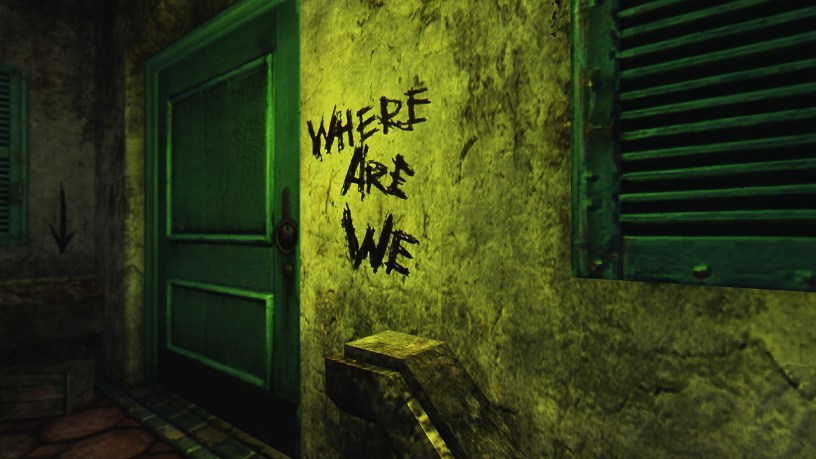
To finish this very long article, I wanted to talk about one final game, still one obsessed with scarcity of resources and identity. This game is Ice-Pick Lodge’s 2008 The Void.
In The Void, death is the primary means through which you interact and engage with the world. Hunger is the primary emotion you will feel as you explore a surreal dreamscape almost devoid of resources. In apocalyptic fiction, material resources – i.e., the things you need for your body to survive – are often in far reduced or even nonexistent quantities. The Void has a primary resource called Colour, which you need to collect in order to keep your heart beating.
The main conflict in the game revolves around your use of colour. Colour is at once your own lifeblood, and your method of interacting with the world. Every time you move somewhere in the Void, you spend colour to move. Every time you defend yourself, you have to essentially draw blood from your own body and conjure magic with it to attack or buff yourself. Imperfect harvesting of Colour from the gardens you can plant, and improper use of the colour in battle, can spell infinite loops of death from which you can never recover. I had to restart the game about five times on my first try because I had no real idea what I was doing.
Ideas of scarcity and fear of how you are going to survive the next day are prevalent in a lot of apocalyptic media – and sadly in places around the world in the modern era. The Void captures modern anxieties of desolation and the idea of being cut off from modern supply chains, supermarkets, and all the rest, and forces you to live first off subsistence – scavenging for scraps of Colour left from a bygone era – and then using those scraps, you must attempt to rebuild a civilization of sorts, at least for yourself. What is most interesting is that The Void takes place in a world that has already undergone apocalypse, but it is about to undergo another apocalypse. I’ll elaborate on that shortly.
The main ideological line in this game is drawn between the Sisters and the Brothers. The Brothers are selfish and hideous creatures who understand the value of preserving life by keeping Colour to oneself. They consider the giving of Colour the worst sin, and they punish this kind of action with death. The beautiful Sisters on the other hand rely on gifts of colour to survive, and are “married” to the grotesque Brothers.
The Sisters might seem more visually appealing (given how often they prance around nude, one might wonder what exactly the intent is behind their nudity. Merely titillating, or something more meaningful?), but their ideology is still potentially troubling. After all, your male avatar is technically a Brother as the story progresses. You are forced to give away precious Colour to Sisters to progress – but as it becomes clear that the Void itself is going through a new and final apocalypse, as Colour itself begins to fade from the world, the Colour that you have harvested can be used to elevate a Sister to the next world, to let her survive. Each Sister represents their own kind of future for the world above.
But if you don’t have enough Colour, you will end up living in the featureless Void forever. This is generally a result of either terrible planning, or subconscious selfishness. For your player character, there is no ending that is denoted as traditionally “good” for the avatar. Instead, you must give up your own life in order to give another individual a chance to live.
In a way, this is a term we could mark as “apocalypse of identity”. You are essentially destroying yourself in order to give the person who most approximates your own idea of a model society a chance to survive and pass on the values you find most important. With resources so low, only one Sister can be saved, and it is up to you as to which one you try to save. I saved Eli, who was my favourite Sister. In the end, I went hungry and died as the Void itself imploded – but I died knowing that at least a part of my identity would go on living.
As to the nature of the Void itself, it is mostly a mystery. Is it the world many millions of years in the future? Is it the afterlife? Is it organic in nature? The structure of itself looks a lot like lymph nodes, or lungs. Is it a fading, dying body? Are you the soul of that body, trying to clutch on to memories, meaning and life?
I wish I could talk longer, but the WordPress Editor is genuinely lagging due to the length of this post. I might write a sequel post, as I still have quite a few thoughts relating to games and the apocalypse, even still regarding some of the games I’ve talked about here already. I hope you enjoyed reading, and if you did, feel free to share the page! I’d love to get some discussion going.
If you really enjoyed this article too, you can support me monetarily on Patreon. Thanks!
 Horrorgameanalysis