
Spoilers for the Assassin’s Creed franchise follow.
When I was a bit younger, I had a quiet worry that games I liked would never receive sequels, that a universe I’d come to treasure would stop existing as a continuing entity, that it would grow to stagnate.
I suppose that’s part of being younger, wanting that youth to continue, for all things to flower indefinitely. And, I note wryly, the trend of that has continued with my desire to see games like Silent Hill, Sly Cooper and Jak & Daxter continue. I don’t see it happening, but there’s still that quiet desire to see it done.
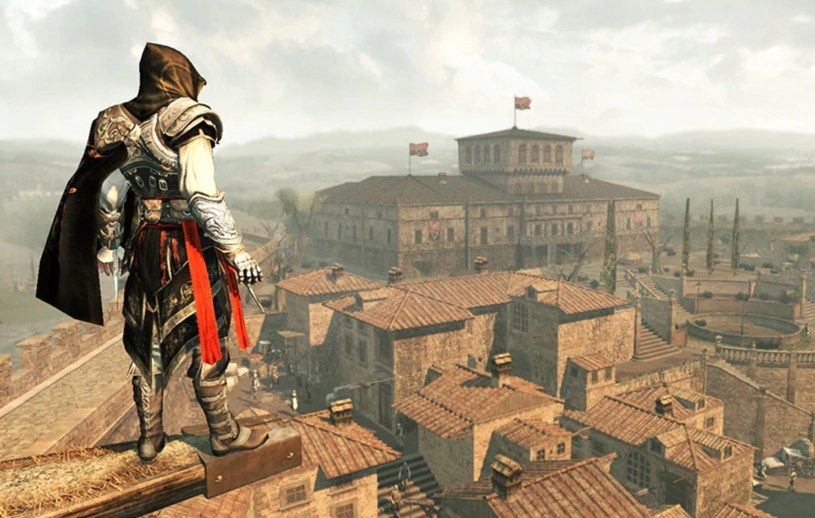
I played through Assassin’s Creed II again recently and was struck by how interesting it could be at times. Ubisoft’s decline to me seems marked, and there is no better way to track this than through the Assassin’s Creed franchise. While often the franchise was quite stale (something it took me a while to work out), there remained a core nugget of intrigue and interesting plot developments that linked the interested fan in, reinforcing with the knowedge that there was something worth picking up the games for, beyond just gameplay adjustments, some of which were merely incremental, while others genuinely meant something.
Having replayed II, I found myself marvelling at the side content called “The Truth”. The objective of this Truth is to solve cryptic puzzles to unlock two truths; first, the truth of the modern world’s manipulation at the hands of the Templars, and second, the sci-fi esque mystery of “Those Who Came Before”. While the Truth may be uncomfortably intertwined with the depressing prevalence of conspiracy theories in our current age, the Truth represents a commitment to telling a continual story in a universe that the developers clearly care about.
I still strongly remember wishing one day I could find out what the heck it meant, and what the resolution to Desmond’s journey would be. Post-AC 3, the desire for “infinite sequels” faded for me, a desire snuffed out by Desmond’s death. Ironically, that desire did not snuff out for Ubisoft themselves. The Assassin’s Creed franchise still goes on today, but what I found most interesting about this continuation is that they don’t care for the breadcrumbs of “the Truth” set up by the earlier titles. Admittedly, I’ve only played Origins and Odyssey, and neither of them could hold my attention for very long. Their gameplay flaws felt to me very blatant, a misunderstanding of both the appeal of an open-world RPG and the original Assassin’s Creed franchise. It removed both the freedom and the power-fantasy – but then, of course, it also did away with the vestiges of a coherent modern day storyline.
I don’t want to pretend like Desmond’s story was particularly well-written or captivating. It’s easily the weakest part of the original game, and remains compelling only in short bursts in the later games, which they did understand. But it provided context and meaning for your actions in the Animus. Without that motivation to grasp a higher mystery or to stop a world-wide threat, I found the entire premise wobblier than ever. Even Assassin’s Creed 4 gestured at some motivation, and linked in the past events to the present scenario with the technician character being revealed to be an important character in the world’s mythos. What confuses me about it most though is that the Truth and Juno’s crazy god-plot to destroy humanity is that they could have easily used that to construct a compelling present-day narrative around.
Ah, but that would smack of allowing a conclusion some day. What Ubisoft have managed to do, almost surreptitiously, is to destroy any and all reasons to end the franchise with a definite stop. I read into it, and I discovered that Juno, the lady who was set up as the big bad for the entire Assassin’s Creediverse or whatever you want to call it, was in fact killed off in a comic tie-in. Which is about as ridiculous and senseless an event as you could imagine. It would be like if in Star Wars, Palpatine was brought back, and it was explained in supplementary material how he came back… oh, bad example. Er, it would be like if Thanos or someone who’d been foreshadowed as a world-killing, universe-shattering threat, was actually disposed of by someone you’d never heard of in a book or something.
It doesn’t make sense from a fan or narrative standpoint. It also doesn’t make sense for new fans of the games, to go back and look at what was happening in the original games, setting up a huge conflict and something at least remotely whiffing of the climactic and conclusive, and then compare it to now, where barely any of that sort of thing exists. At least to my knowledge. I don’t have the time or the patience to grind a thousand sidequests to find out, nor to waste money on microtransactions to skip the game Ubisoft wants you to spend money to buy.
A shift away from coherent narrative and with the eyes on the money restricts the imagination. I have tried very hard to get excited by this year’s big E3 announcements. I guess I’m suffering from sequelitis, and the good old open-world formula which Assassin’s Creed helped to popularize. The clear the symbols off the map til we say you did a good job sort of thing.
At least the new Ratchet & Clank is actually fun to play. You know what, I might go back to playing that.
Infinite Sequels, Assassin’s Creed 2, and the Truth
 Horrorgameanalysis
What a great article! I agree completely – I played the very first AC way back when, on the PS3. It’s the only AC I have ever managed to complete. I tried the second but got bored about half way through, the same with 3. I enjoyed Black Flag’s naval combat, but that was about it. I then didn’t touch the series until Origins…. Which I didn’t like. I’m a big fan of action combat (DMC, Darksiders, etc.) And Origins’ combat was just so… Janky, in comparison.
I played a LOT of Odyssey, but the game was just too long. I’m yet to try Valhalla.
The real world stuff hasn’t interested me since 2, I have absolutely no idea what story Ubisoft are trying to tell there. I think they either need to just drop the real world schtick OR actually put some effort into it. Anyway… Enough of my ranting!
Immortals was fun, though.
LikeLiked by 1 person
Honestly, I loved Immortals. Probably because it’s a Zelda BOTW clone and I love Zelda. Though I will say I think Immortals took the BoTW formula and did it much better. But my thoughts on BoTW are very unpopular in many circles 😅😅😅
But yeah. Ignore Zeus and Prometheus, put Immortals on the highest difficulty and give it a go. Very fun. Though I do have ADHD which I genuinely think contributed to why I liked the game so much. I wrote a little about it on my blog last week.
But anyway!!! Yeah. AC is a mess now, that new prince of Persia looked AWFUL, and Splinter Cell is never coming back. Hoorah! 😭
LikeLike