
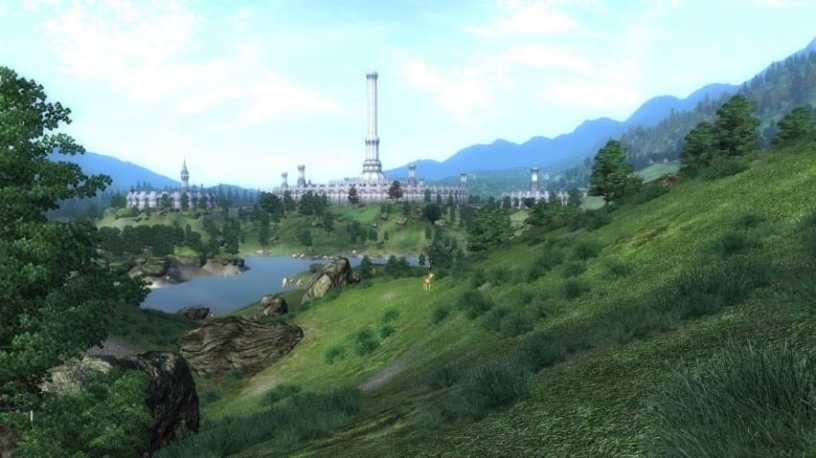
I’ve been recently trying to figure out how to articulate thoughts on video game spaces in a clear and concise way. I haven’t really had much luck. But I have started playing the fourth Elder Scrolls game again.
Oblivion is an odd game, really. To me it feels like the experimental “Skyrim 0.5″, if you are to think about the evolution of the series. It cuts away a lot of what Morrowind did well and right in favour of a different design philosophy, the philosophy which removed a number of weapons, class skills, streamlined armour options, changed the levelling system, made every line of dialogue voiced, added a universal fast travel system, and combat removed Morrowind‘s “it looks like I hit, but I didn’t really”.
As a consequence, Oblivion is the most playable Elder Scrolls for those who entered the series with Skyrim. It feels like a game that is on the way to Skyrim, but is still shedding layers of Morrowind along the way. The thing I’ve been grappling with all these years is whether or not I like the intense number crunching in my Elder Scrolls games. I love me a good cRPG; The Age of Decadence, the first two Fallout games, Tyranny, the games by Spiderweb Software – these are games that emulate the fun of a tabletop RPG with the added assistance of computer calculation and simulations, as well as a prewritten story. I love juggling these stats and trying to figure out what I should sink my next points into.
The point I’m weaving my way towards, is whether or not the Elder Scrolls series is worse off without these traditional RPG trappings? Because RPGs are an odd beast, these days. Their most popular form that I see the most information about is the Dark Souls-alike. An actiony RPG where your stats matter and your gear matters, but often these games don’t have a social aspect to them, unlike your classics like Baldur’s Gate or Planescape: Torment. The Outer Worlds was a recent example of a first-person RPG in the vein of old, but I found that to be unusually stiff and the story not quite as gripping as I was hoping. I have yet to try games like Greedfall, but I’ve heard many good things about them.
It just seems to me that no-one is attempting to do what Bethesda has done with their games. And Oblivion feels like a nexus point to me, the beginning of the streamlining period to the detriment of the RPG aspect.
Daggerfall is an obscenely large thing, some monolith of a game that exists for me as something playable, but never finishable. Morrowind corralled the ideas present in Arena and Daggerfall to create something more deliberately directed and focused. There were still plenty of RPG elements present, but the world wasn’t some ungainly mass – it was an immersive, focused, and curated experience. Everything in Morrowind had a place – good players can find great loot far earlier than other titles would let you, and fast travel was a concept built into the world.
The jump between Morrowind and Oblivion is marked by the addition of two things that completely change the way the game is played; the compass, and the fast travel system. In Morrowind, you had to catch a ride on these large insects called Silt Striders, and pay for those rides. In Oblivion, from the moment you leave the sewers, you have the option to fast travel to any of the main cities. In Morrowind, certain areas were more dangerous than others. In Oblivion, every area is scaled to your level, so you can explore one fort and find just a bunch of scrappy bandits armed with spoons at level 1, where other players would find a demonic bandit chief with the power to electrocute you to death with a few swings of some giant, rare warhammer.
Where in Morrowind the quest givers had to give you directions that you had to pay attention to carefully or even write down, Oblivion couldn’t do that because of the fact that every line was voiced. Voice acting is an expensive thing, and so dialogue has to be short and straight to the point. Expository dialogue is, beyond a few select quest-givers, mostly a thing of the past. A sense of mystery about the world is reduced by the fact that basically everyone is happy to chat to you about anything, at any time, and the fact that you know exactly where to go at basically every moment. As others have pointed out, the presence of the compass reduces finding quest locations and people to a simple case of “follow the arrow”, which is helpful considering the people in Oblivion all have their own routines, and wander all over town, but makes you feel slightly too coddled.
Maps in Morrowind were almost a necessity. You had to know where things were to get things done. In Oblivion, a player can theoretically ignore having to look at and examine the world carefully and can just follow an arrow. And yet, this isn’t what happened to me.
Morrowind is clunky and obtuse. To players who (like me) entered the series on later entries, Morrowind seems a bit antiquated. The combat is a struggle to engage with, and the game is weird. Oblivion is far more approachable. It exists as a bit of a pastiche of fantasy cliche; the Imperial City could have been ripped from any half-rate fantasy novel from the past twenty or thirty years. The port city, the rich wine city, the poor city; the Emperor being assassinated with only one secret heir left alive – Oblivion’s world is not, on the surface, interesting.
But Oblivion’s secret is the immediacy and urgency of the world. The funny thing is, the immediacy which damns it to be not a very good RPG in the classic style of the genre, is the thing that grips and immerses you in the world. That, and the strength of the people in the world. For me, a lot of Morrowind’s characters exist in some kind of blur. There are definitely iconic and memorable characters, but the earnest introductions of Oblivion’s characters do a fantastic job of colouring in these otherwise generic NPCs. The one who loves dogs, the writer, the drunk guy who has a double in another city, the beggars who all speak in fluctuating tones and affectations – Oblivion as a space is rendered charming by the attention to detail in both characters and environments.
Oblivion could have leaned into the weird; the province of Cyrodiil in which it is set was originally meant to be a jungle province, with the Imperial City being some kind of Venice-like place, the heart of opulence and decadence. It turned out to be just a fairly standard Romanesque city, the kind you’d find in any game with similar themes. However, it is again the attention to detail that sets Oblivion‘s cities aside from, say, Two Worlds. Oblivion doesn’t demand attention, but it does reward it. Secret entrances into houses, little hidden quests that you get from poking around dungeons, the thrill of discovering some cool new enchantment or environment (especially in the Shivering Isles) – Oblivion’s world is staid and boring on paper, but utterly immersive when playing. And this is in spite of the fact that the people are all potato-faced.
See, Oblivion subscribes to a design philosophy that puts the player first. There’s no beating about the bush – Oblivion’s central design tenet is that the player should be allowed to do what they want, when they want to do it. It’s that liberation that means you can be the head of the Fighter’s Guild, the Mages Guild, the Thieves Guild, the Dark Brotherhood, and the champion of the Arena, all as the same character. Speaking as the kind of guy who likes his RPGs old-school, tough-as-nails and actually pay attention to your choices, this should be a fairly disappointing decision. And when I reflect upon it some days, it is. But the decision to open up the game in this way is freeing to the vast majority of players playing the game.
Many who I’ve seen play the game, or whom I’ve discussed the game with, cite the fact that it’s quite remarkable you can go anywhere and do anything. It doesn’t rely on Essential characters as much as Skyrim does, which means that characters who you don’t like you can murder, if you really want to. Not that this is a philosophy I condone in reality, but in Oblivion, go for it! Is this something that’s possible in Morrowind? Certainly, to a degree. But Oblivion is the game that remains the most eminently explorable. Every corner of the map is navigable at first level, which is just daunting and amazing at the same time for first-time players. It’s this sense of freedom that was an intoxicating allure to so many players, including myself.
So when Skyrim rolled around, it was, in retrospect, quite obvious that Bethesda would scrap much of Oblivion’s RPG DNA in favour of allowing the player even more opportunity to always play as the character they wanted to play as. No more having to respec your character by starting the game over again; if you decided you didn’t like Destruction magic, you could just pick up a bow and start increasing your skill there with no negative effect towards your overall strength. Oblivion laid the foundations for Skyrim’s “take the RPG out of my RPG” philosophy, which makes it eminently playable at all times, everywhere, for everyone, but reduces its impact when replaying the game. Every character ends up as some kind of homogenized slush in Skyrim, whereas at least the classes allowed some points of difference from character to character. It is up to each individual player as to which they prefer. I sit clearly on the side of the “go heavy on the RPG elements”, since I’m a big fan of RPGs in general from their origins on the tabletop to the classics of the video game genre, but I find myself returning to Oblivion rather than Morrowind more often than not.
Partly this might be nostalgia, but the other part is that it is an RPG that rewards at least some decision-making while being persistently easy to pick up and play. Oblivion is a notable RPG because it is reducing the RPG elements while retaining just enough of that DNA to be compelling and interesting. As the series becomes more and more popular, elements of number-crunching are reduced further and further. I suspect in future, we shall see fewer RPGs in the style of the classics, unless we have some great indie studios lead a resurgence, or if Obsidian’s new game is great – or even if, somehow, Bethesda reverse their current RPG design philosophy. As it stands, Oblivion is an unusual hybrid, that hopefully next time I can drill into a bit deeper.
 Horrorgameanalysis