
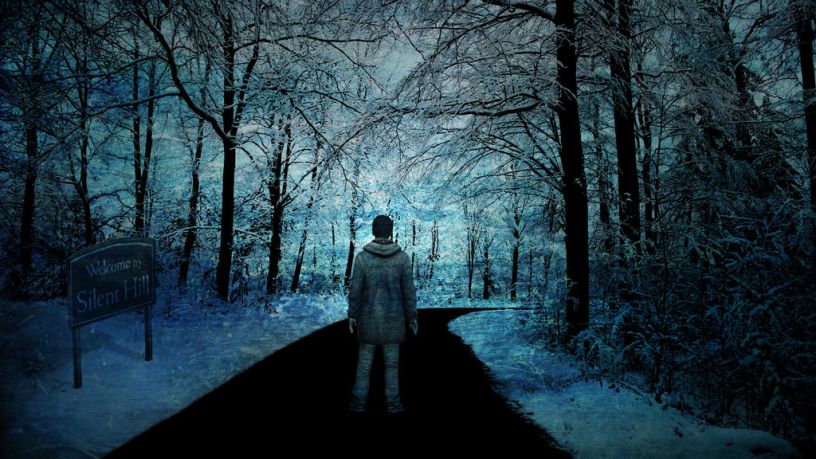
Silent Hill as a game series is a funny thing by now, really. If you’ve read any of my previous posts on the series, you’ll know what I mean. It exists in a sort of mythical limbo. The games’ haunting ambience (courtesy of Akira Yamaoka) exists as a gateway to the games themselves all over the internet, but the games can barely be found. Aside from Silent Hill 4: The Room, their mythical status cannot be easily discovered aside from emulators.
But it’s that mythical status that keeps the fire alive for new games in the series. It’s also why there’s such a desire to understand how, and why, Silent Hill pulls people in and never lets them go. It’s that mythical distance of time, space, and other people’s hyperbole and hype that still gives Silent Hill fresh pull and appeal today. It’s not just hyperbole, of course – it is my sincere belief that Silent Hill is a series of unlimited potential, which gave us a number of the best games games ever made. You just can’t beat the original four Silent Hill games for abject terror and psychological manipulation. Which is why Shattered Memories is so interesting.
Shattered Memories, like Silent Hill 2 in particular, leans into a psychological deconstruction of the main character’s mental state and place in the world. Except the gimmick with Shattered Memories is that it explicitly performs that psychoanalysis on you, the player. From the moment you boot the game, it is upfront about this, which is something that no other Silent Hill game would have bothered with. The other titles are happy to keep you guessing – is the game judging you for this, or for that? Shattered Memories has easily followed paths of consequences and others you can’t wrap your head around until you have not only completed the game, but have played it through several times. It is an intellectually and emotionally engaging experience.
Despite this praise, Shattered Memories is, as a game, imperfect. Speaking personally, I do not enjoy games that have their combat or enemy encounters reduced to just one objective – run away. I especially dislike it when such a game has no map to know which way I’ve been or not when circling these invariably large, dark and repetitive-looking environments. On that mark, Shattered Memories fails. It strays even further beyond the frustration of over-long hide and seek bits in games like Outlast; Shattered Memories sometimes even approaches the dreaded death knell for video games, boredom.
The reasons for this failure could be rectified fairly easily. In Shattered Memories, I found the map basically worthless. You can’t open it and pause the game as you would in other entries in the series. Instead, you have to pull up your phone, which is basically an extra menu – but this does not pause the game. You then have to navigate to map to open your map, which opens a minimap. You can only move very, very slowly while the map is open, and if you want to expand the map from its useless minimap state then that requires an extra couple of button presses, which, again, does not pause the game. You can also not access your phone in general when in hiding spots, which seems like it should be a no-brainer to access there. Without a map, navigating the “Nightmare” Otherworld sequences becomes an exercise in running around in circles, attempting to memorize which paths you’ve already travelled and which you haven’t, since opening your map is just going to get you dog-piled by the enemies.
You also can’t defend yourself, which just makes the whole thing seem worse. If your game doesn’t have a reliable way to defend yourself or avoid enemies, who can kill you very quickly or just inconvenience you a lot, then you have a problem with your gameplay loop. When a game’s challenge can only be circumvented in one way, and that one way is tedious or frustrating, then you have a problem with engagement. The best thing about these sequences is the change of Otherworld type from grimy and bloody to an icy hellscape. It’s a refreshing change, along the lines of Silent Hill 2’s damp, uglier Otherworld – it creates a stand out feeling that encourages a slightly different kind of mood, though still intense melancholy and fear.
Fortunately for Shattered Memories, engagement is retained through two other core pillars – atmosphere and story. The gameplay is divided clearly into two sections; the aforementioned “Nightmare” sections, where the game world freezes over and you have to run for your life from countless enemies, or the regular exploratory sections, where you move around, find clues, and piece together the various mysteries you find yourself caught up in, the main one being – where’s Cheryl? It is worth noting that I got the best ending on the first try, and second worst on the second try – good for me, of course, but I’m less interested in seeing “worse” endings, at least for now. I’d love to return again to get the two endings I didn’t get. It felt easy to get the good ending, but it is compelling to know that the game is reactive. Let’s get stuck into that, shall we?
As Shattered Memories is a retelling of the original game (which, yes, I have yet to finish writing about), it has an intense connection to the characters of that story. Whether or not it is weighed down or enhanced by this generally tends to be a thing of personal taste – I, for one, appreciate when a story is willing to take risks like that, and it seems to be a fairly obvious “non-canon” expansion of an aspect of the original Silent Hill. But canonical standing should not be a meter of enjoyment for anything. A work should stand on its own as a piece of storytelling, one way or another. Shattered Memories stands successfully alone. There’s nothing quite like exploring a Silent Hill game, and this entry in the series acknowledges that. There’s a weight and a poignancy to every single room in the game that is amplified by ghostly memories and shadows that give you voice messages or texts on your phone. It is, in a word, enthralling. It is aided by the fact that the camera isn’t the disembodied, haunting and dehumanizing one that voyeuristically glares at the earlier Silent Hill protagonists. You’re in control, which enables you to get up nice and close to stuff and poke around, spending as much time looking at signs, posters or lingerie models as you like.
Just like Silent Hill 2, Shattered Memories exploits the completionist mindset to drive daggers into your psychological state, or the appearance of the game going forward. The very first building you enter into has a calendar with a woman in a bikini on it, that stands out because of its place on the wall and an added sense of detail. Due to its detail and place, it feels like the main character is going to have something to say about it, so, of course, I went up and had a look at it. I was genuinely stunned when later on the game presented me with a version of police officer Cybil with an unbuttoned shirt and tight looking pants, specifically because I spent five seconds examining something I could just have easily avoided. The Cybil I got was designed to be sexually provocative – but when I checked online after my first playthrough, I saw she could have looked quite formal; either a friendly or an average police officer. It was, genuinely, a shock to realize that this had been tailored to my decision, even if I don’t think it was anywhere near my own personalities or intentions.
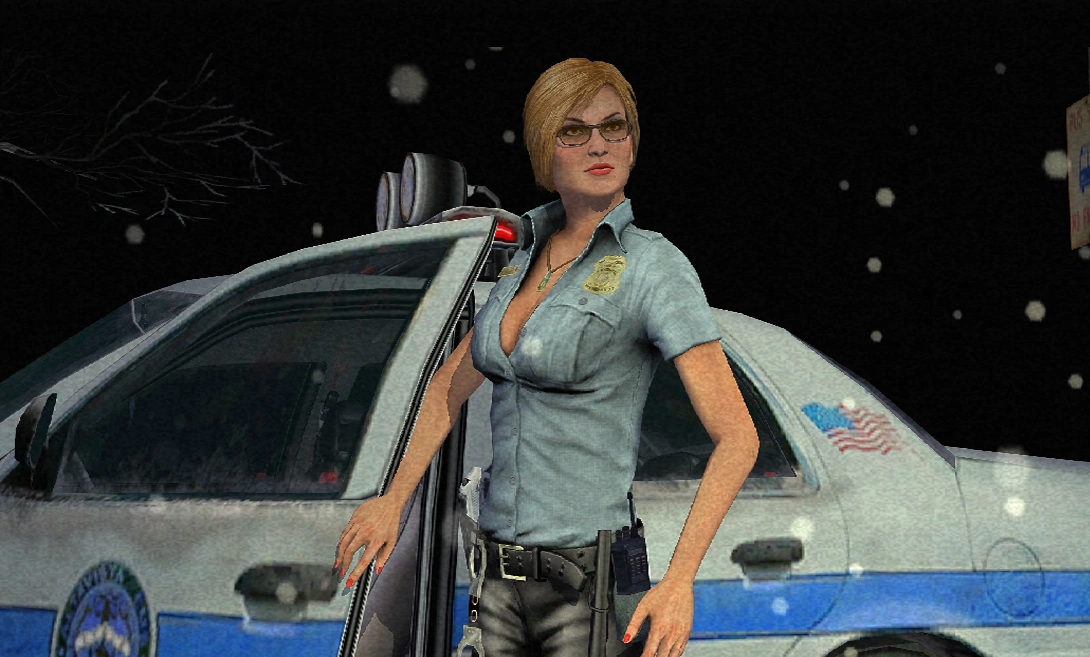
See, Silent Hill dares to do something that few other games try, and, unlike many other games, does it well. I’ve discussed it before, but you know when you do something naughty in Fallout like steal some bread to survive? And the game gives you some bad guy points because of it? That’s the game’s attempt at judging you. It is heavy handed. And you could say that the Cybil I was given was quite heavy-handed as well. But it’s something more subtle than just “you looked at something, here, have a reflection of that thing you did”. It’s the examination of a player’s mindset over an extended period of time through an intelligent and reactive psychoanalytic lens. The game never says “ah, you’re some sexually fixated person” explicitly. I never opened a menu to keep track of my “good guy/ bad guy” meter. The game gives you subtle hints; the colour and type of clothing someone wears, the voice messages they leave, the text messages they send – everything about Shattered Memories is built to exploit that vulnerability. What vulnerability? The assumption that a video game doesn’t know you.
Of course Shattered Memories doesn’t know you. It gives it a pretty damn good shot – the psychological analysis in the credits was hauntingly accurate – but it has a limited set of data to work with. But Shattered Memories is constructed in such a clever way that the very idea that it might know you comes up. It uses so many of its questions and tools and quiet moments to prod and poke the player, to see how they respond. Are they lingerers? Why do they linger, if they are? Are they focused on the story? Are they content to mess around and relax in freezing forests and abandoned cabins? There’s more it could have done, more psychological messing around that could have happened, which, accompanied with a better combat / action sequence structure, would have made the game ten times scarier and just plain better.
But Shattered Memories can’t do that. It’s a game made twelve years ago now. There are no refinements, no updates, no new, quiet twisting of the knife. Silent Hill lies quietly in its own foggy streets somewhere, a recursive, haunting memory. You can’t teach an old dog new tricks. But Shattered Memories can still affect. It is a game that slipped through the cracks, which I hear no-one discussing or reminiscing about in any particular way. But it’s a game deserving of respect. It’s an intellectual and emotional journey that has the guts to look back at the player and to ask, quietly, in a barely audible whisper, who are you?
It is, perhaps, the best kind of question a horror game could ever ask.
 Horrorgameanalysis