
The following piece contains discussion of graphic violence and mention of sexual assault, as well as a few spoilers for Outlast, Silent Hill 2, Until Dawn, and The Medium.
There’s a scene in Outlast‘s DLC, Whistleblower, where can watch other people having their genitals sliced off by a sawblade. The screams can be genuinely traumatizing. There’s a fatality in Mortal Kombat 11 where you can toss someone against a low-table and kick them in the head once, half-severing their head. As their body slumps, you kick them again, and their head comes off and rests on the table – with their spinal column attached. In Pathologic and the original Fallout games, you can shoot and rob children should you so wish. In Until Dawn, a half-naked woman’s jaw can get ripped off her face as she dies in agony. In Silent Hill 2, you can watch a man smother his wife, or watch a masculine-coded monster murder another feminine-coded monster in a very sexually aggressive manner. In Resident Evil, you can find corpses dismembered by the zombies in a variety of horrible ways – or a man jammed on a pipe in Resident Evil 7, his mouth a broken, bloody mess.
But some games I’ve just listed do these genuinely shocking and violent moments in a good way, whereas others include them to do just that – be shocking and violent. What’s the difference, and why does it matter? Shouldn’t I feel rewarded in Mortal Kombat X when I slice a man with a telepathically controlled samurai sword and see his face come off, leaving a graphic view of his brains and other meaty bits before the rest of him is turned into purée? I’m no psychologist, but human beings do seem to love a spot of the old violence as entertainment. And there’s certainly nothing wrong persay with enjoying a bit of fictional Saw-style torture (though that’d never be my cup of tea), provided it’s not actually hurting anyone, or isn’t encouraging the violence to be enacted in real life or anything like that. I wanted to get that disclaimer-y bit out of the way first. Some people just find violence in all forms abhorrent – I’d never hurt anyone in real life, but put me in a video game and I’ll be shooting parasitic nurses and doctors in Silent Hill all day long. But some games just use violence more effectively than others, to tell the story that they want to tell, or give the player the mood they are after.
Shock is the game attempting to get you to feel a sudden emotion. Shock is the game’s way of getting you to sit up and take stock of the situation you’re in. Shock doesn’t have to be negative – it could be a mountain climb giving way to a beautiful vista, or a powerful item being found from nowhere. But in this piece today I’ll be talking about, obviously, the more negative attempts to shock us. The ones that are meant to linger hauntingly in our mind, or be used as popcorn violence, cheap entertainment to while away a few hours.
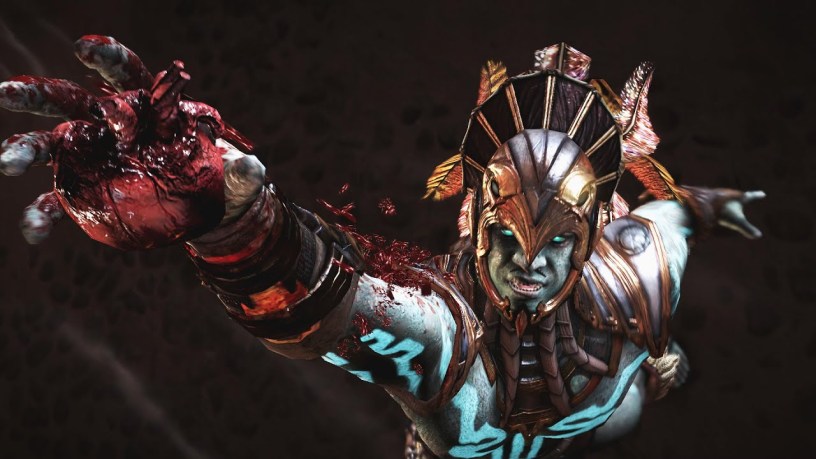
Mortal Kombat is an interesting example, because its entire reputation is constructed on shock violence. Every fight can end with a fatality, their now famous series of button inputs that grant the player a special, brutal denouement to a fight. But for most people, seeing someone’s heart get ripped out or their spinal column readjusted would probably be enough to send them running from the scene of the crime at the very least. So what is that we are supposed to feel? A sense of macabre enjoyment? Rapturous triumph? Repulsion? The game bases its entire reputation around being this ultra-violent experience, so it’s odd that I mostly find them disturbing altars to extreme violence. Now, I don’t want to imply that anyone who really likes Mortal Kombat must be some insane murderer or anything, but after an afternoon worth of playing Mortal Kombat X, I definitely figured out that the violence at the very least does not interest me in the way it might interest others. Mortal Kombat is of course responsible for a lot of video game censorship laws, and the creation of the ESRB, as well as some other games rating boards – so its continued reliance on these shocking elements is almost a requirement – controversy comes with the name Mortal Kombat. I have no particular problem with the game – but it is a benchmark for shock violence that fails to shock. Extreme violence that becomes excessive to the point of parody, or disgust. While some fatalities do happen to hit a magic spot, some have disturbing implications. In X, for example, Jax can fight his daughter Jacqui, and they can both have a right laugh at how much trouble they’re going to be in when they get home and Jacqui’s mother finds out what they’ve been up to. Cut to twenty seconds later, where Jax shoves Jacqui’s arms into her torso, rips the top of her head off, and extinguishes a cigar in the half-stump that is now his daughter’s head. The violence in this context suddenly takes on a more troubling context, which is something that each player should probably grapple with in order to assess Mortal Kombat‘s worth as a shockingly violent game, and whether that shock violence is truly effective in the way the developers were aiming it to be – if I had to guess, in a fun way. It’s ludicrous violence – the audience is supposed to buy in to the fact that the games are violent to the point of absurdity. Who’s going to rip off the top of someone’s head and extinguish their cigar in the stuff that remains? It is, indeed, ludicrous – but at times becomes fairly uncomfortable for me to watch.
Until Dawn’s scantily clad potential murder-victim, Jess, can meet a number of untimely ends. But the game allows her some chance for characterization (however cliched it is), and the game’s epilogue consists of the effects that the deaths of the other characters have on the surviving characters. Plus, the deaths in Until Dawn, while quite violent, are never particularly drawn out or repetitive, as in some other violent games.
Outlast is the other game franchise that relies heavily on extremely shocking content to spin the wheels and keep people engaged. Outlast’s treatment of every character in its universe is basically as a whipping boy. Basically everyone even halfway decent, plus quite a few of the villains, get macabre, horrible deaths, and before those deaths, are subjected to shocking, terrible sights that would probably make the Alien from Alien throw up acid into a bucket somewhere.
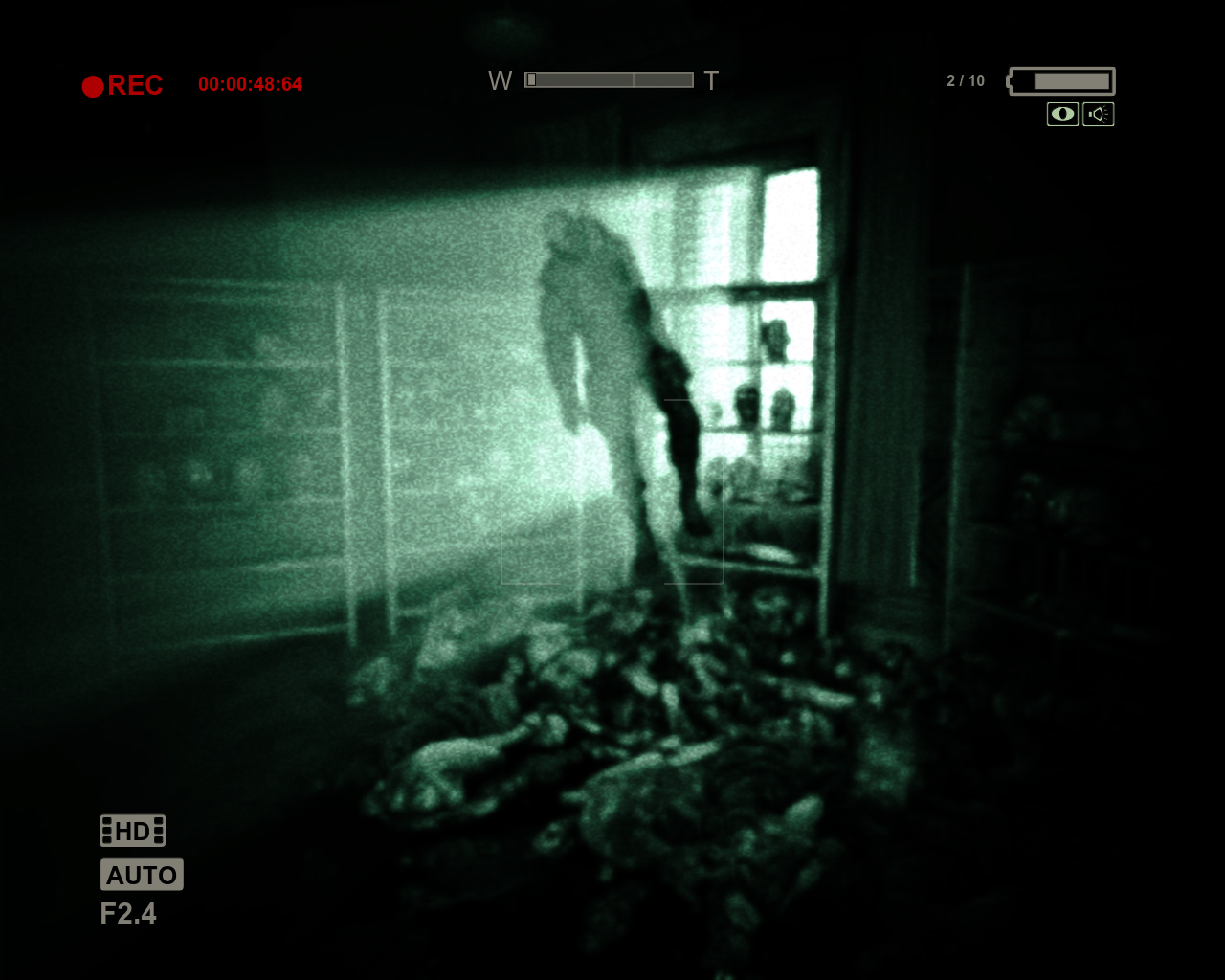
Outlast opens with the pile of corpses above, and never ever lets up its pace from there. There’s copious amounts of naked corpses strewn about Mount Massive Asylum, and a lot of decapitated heads over the course of your stay. You even get your fingers sliced off, and almost get your genitals carved up in Whistleblower. Outlast 2 even has the gall to sexually assault your character in a first-person sequence during the game in a heavy-handed and gross fashion. Is this scary? No – it’s really just gross. Because that moment is not earned or discussed properly afterwards. It’s shoved in the game because they can, but with no thought as to what implications it should have. The original Outlast was much better at this. Despite all the horrible things you see, there’s some attempts at least at justifying it. With Outlast 2, the reasons all come across as flimsy and absurdly violent just because it was the most disgusting thing they could come up with.
Contrast this with The Medium, a game with a massacre mystery and a story of sexual assault at the core of its story. Yet you never see a body for the massacre mystery, just hear the aftermath with “echoes”, which your character, as a medium, can re-experience for herself. These snippets are shocking enough, while bringing across the story for themselves.
At this stage, I want to just define the point of this piece carefully. I am not opposed to games with this kind of extremely violent or graphic content. There are intelligent ways to explore trauma and violence (like Silent Hill), as well as more “fun” ways in the case of shocking violence (like Mortal Kombat). But the point is, you can’t use trauma and violence as both an absurd “video-gamey tool” and try to discuss it seriously later. It’d be like if, after you got ripped in half by Johnny Cage, the game attempted to delve into the mental implications it would have on somebody. Outlast sometimes succeeds with this, and sometimes doesn’t. It’s an extremely tricky line to walk, just like these kinds of topics are for other forms of media. It just so happens that video games allow you to vicariously experience these horrible things. So when a game developer makes a game violent or contains other traumatic content, they need to consider why exactly they are adding these horrible things in. Outlast wants to present its world as realistic and horrific. But it does it to a point of ludicrousness. Balance. That’s my desire from horror games. And that’s hard to do. Maybe I’ll explore these ideas further in a future post. Hopefully this is at least food for thought; a warm up article before I get stuck into some more complex thoughts.
 Horrorgameanalysis