
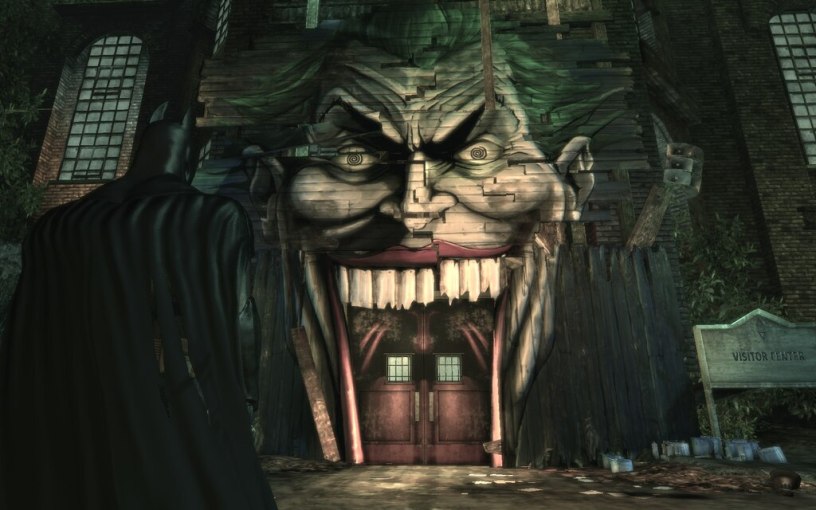
A few minor spoilers follow for Arkham Asylum, the Batman video game from 2008. Boy, I’m getting old.
There’s a lot of baggage that Arkham Asylum brings to the table. It’s a licensed Batman game from a relatively unproven developer, released in 2008 – but, as basically everyone knows by now, it’s a story that ends in success – nay, triumph. Arkham Asylum has, ever since I played it for the first time, been one of my favourite games. It’s a game that understands the central concept of a good Batman story perfectly. There’s no multifaceted conspiracy or crazy, world-spanning plot with Justice League level threats (like aliens or something). There’s just you and the best of Batman’s villains, in a tight and focused campaign with engaging puzzles and exploration elements as side content.
But what impresses me still today about it is how clearly the developers at Rocksteady loved and respected the medium of the video game, using it to its full potential. There’s barely a moment of boredom in Asylum – the Batman power fantasy is imperative to the core structure of gameplay. The developers recognized that the powerlessness of Batman had to be amplified by the subsequent powerlessness of the thugs. It’d take an army of them to take down Batman – and, of course, even that’s not enough. The guns are a useful, equalizing tool. In another game, they’d be just another obstacle. But since Batman is both a mortal man, and a man who abhors guns, guns are a deadly weapon that cannot be turned against the player’s enemies. All of a sudden, you have a worthy threat. Asylum is a game all about power balances and checks. Just like the Metroidvania influence that Asylum adopts, you become more and more powerful as the game goes along, as enemies learn new strategies and get new gadgets of your own. It’s a game about experimentation – can you take out an opponent by throwing a Batarang at the right angle and knocking someone off of a ledge? Ah, you can do that. Can you knock a man down onto an electric floor and dodge roll out of the way so only he gets fried? Yes, you can. Can you string a man up by his legs from the ceiling, then drop him on his unsuspecting friend so you can swoop in for a decisive knockout? Definitely. You can follow that up by placing some explosive gel on the floor and waiting for the last thug to come and investigate, before detonating that too, and swooping right back in for the final KO.
The game is also more than happy to use horror elements to reflect the psychology of Batman. I think anyone who has done any sort of examination into Batman’s psychology would uncover a man who probably is not thinking straight 100% of the time. He’s a billionaire who uses a lot of his money to build expensive suits to fight crime and administer vigilante justice using like a decade of ruthless training. His willpower is the one thing that separates him from the criminals he preys on – and Asylum uses that against him, using the very foundations of the story structure and the medium of video games.
Examine the second Scarecrow sequence for a simple way in which video games can use their very core elements to scare or unsettle the player. As you leave the library area and enter into the hallway of Arkham Manor, the observant player might notice something strange. As you enter into each and every room, there’s a little bit of text that pops up, and says something like West Wing, or Warden’s Office, or something like that. Just something to contextualize the player in the game world a bit more. But when you step into this hallway, the little text that pops up reads Wayne Manor. Huh, that’s strange. So when you round the corner, you see that the hallway stretches on forever. And you’ve lost the ability to run. So you walk slowly through the hallway, watching as elements of it slowly transform into the fabled Crime Alley, where Bruce lost his parents. And as you are travelling along this hallway, all of a sudden, you’re contending with the very core of Batman himself, as he becomes, once again, a frightened little boy – and you become more and more unsettled as the screams of his mother echo through both his and your mind. All this stems from an understanding of what it is to have the very core of the game taken away from you. When the UI is no longer trustworthy; when the basic control inputs no longer respond – then you have a suddenly very scary moment in a game that is otherwise all about empowering the player. Which is perhaps why Arkham Asylum’s Scarecrow bits are just so effective. They come as reminders to the player of Batman’s trauma, his ordinariness, his mortality – and serve to humanize a character who one might imagine it would be hard to empathize with. The core of Batman’s character is human tragedy, the drive for the childhood wrong to be righted, for the world to make sense once again – and that’s what makes him one of the world’s most enduring superheroes.
The more famous Scarecrow mind-screw of course comes later in the game, where all of a sudden, an announcer says “Did anyone see the game last night?” This is a moment that feels reminiscent of the Silent Hill 2 gameshow in the elevator, which is just thrown in to unsettle the player, and throw them off of the expected rhythms of gameplay. It is effective in Silent Hill because it’s an oddly mundane and yet odd thing to happen, and it is exactly the same in Arkham Asylum. And then the game crashes.
That’s a bad feeling, of course. No-one likes losing progress. So when you move out of your seat to restart your game console, or go to hit alt+tab or Ctrl+Alt+Delete, etc, and then see the starting cutscene of the game playing over again, you have to wonder – seriously, what’s wrong? This feels like a massive glitch. But, in fact, it’s Rocksteady’s complete understanding of what makes a video game’s different pieces work. Where once you were feeling in complete control – as in a predator situation, or beating up a room full of thugs – now, you are on the receiving end of the pain. You hear the stoic voice of Batman now reduced to mad, pleading screams. It is even more chilling when you are shot by the Joker in the dream sequence, an unavoidable outcome, and the game’s game over screen pops up with the hint – dodge with the middle stick. What middle stick? I remember looking at my dad and saying something to the effect of “Well maybe we need to try moving both sticks towards the middle of the controller?” And then the game continues. It wasn’t a game over at all – the rabbit hole just keeps growing deeper. So when you finally break out of the final Scarecrow sequence, and Scarecrow sounds afraid – then the player once again feels powerful, but also more in tune with the character of Batman. By psychologically deconstructing the main character, we are given an opportunity to further understand his motives, while also providing some engaging and at times even shocking or frightening gameplay, with this core of emotion that proves that Rocksteady does not just merely understand game design, but also Batman himself.
But while I loved the Scarecrow sequences, nothing affected younger me quite as strongly as entering the Arkham Asylum Visitor Center.
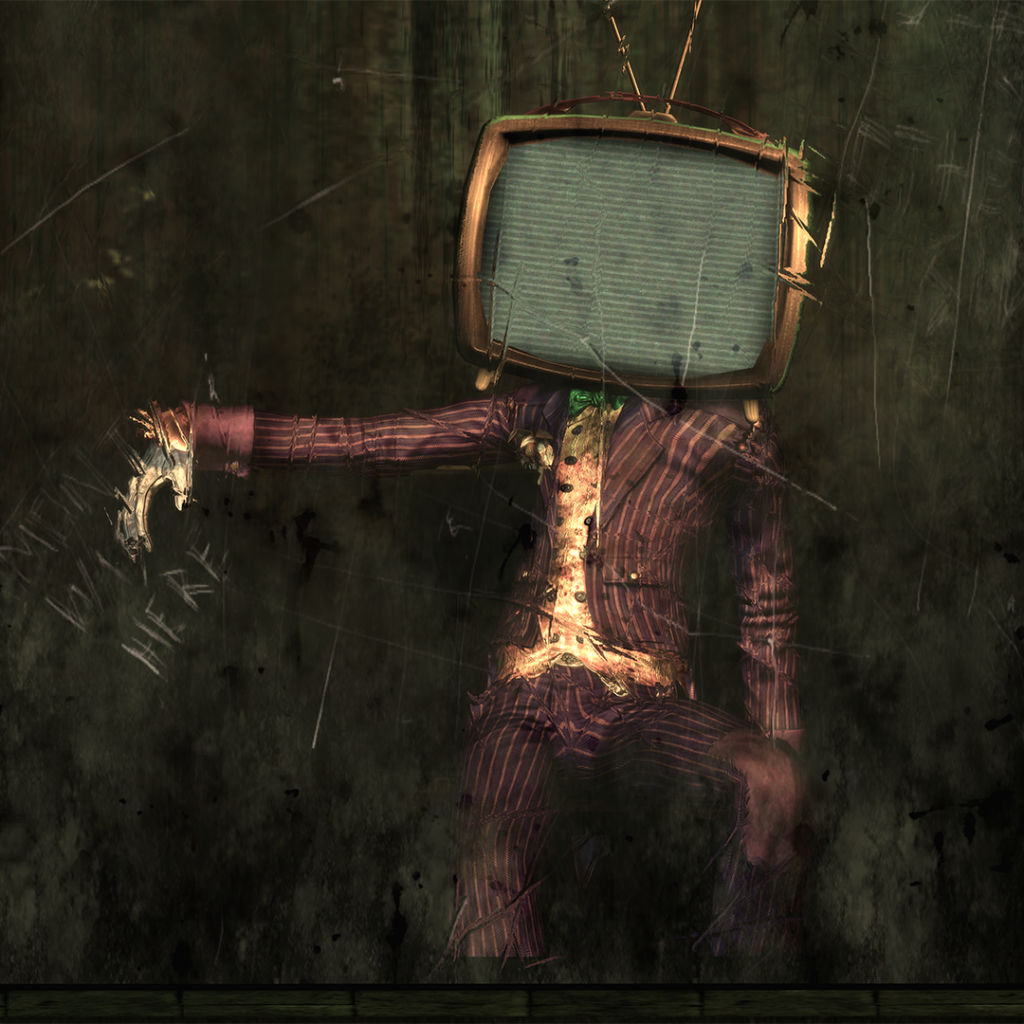
Where before Batman has been a near-constant fixture in the player’s vision, only removed by choice into a first-person perspective that is mostly useless aside from looking for easter eggs, and I think once by the third Scarecrow sequence in that memorable Joker shot sequence, now, you are forced into a first person experience. Joker further tries to psychoanalyze Batman, which, y’know, can either be funny or kind of creepy, but if you return to the Visitor Center too many times, Joker has nothing to say – and there’s a creepy laugh on repeat. Without Batman as something visible for you to control, a reassuring presence on the screen, there’s a confrontational quality in these optional little segments that reduces the power you have further, creating a lonely atmosphere with just Batman and a mannequin of his worst enemy. Batman is completely alone on the island, and now, without Batman on screen, the game becomes profoundly lonely and isolating for the player.
Arkham Asylum uses its Scarecrow sequences and the bits in the Visitor Center to disempower the player, all the while providing satisfactory ways to remain in control and become more powerful as the game goes on. You arrest a number of prominent bad guys, fighting individuals as powerful as Killer Croc or Poison Ivy, and while the game does struggle to bring boss fights to life (the final boss is a bit of a let-down), Arkham Asylum is an experience that remains haunting and engaging today. It’s a tight, focused story centered around a single location that barely has a moment of irrelevant downtime. All throughout, it is satisfying, clever and fun. Enemies that taunt you throughout the game get a chance to be confronted or at least the plot threads surrounding them resolved in a way fitting both the gameplay and the characters involved. It is, all in all, a fantastic game, and is still thoroughly deserving of your time today. I love it.
 Horrorgameanalysis