
The following piece contains vague spoilers for the early hours of Echoes of the Eye.
When should a game be scary?
It’s a question that Outer Wilds grapples with throughout its lengthy, nonlinear runtime. The complexities and dynamics of horror become very different when the story can be approached in a relatively nonlinear fashion. Events that one player might experience early on might be the last set of objectives another player decides to complete in their own playthrough.
Why the Outer Wilds‘ horror elements work, however, is because Mobius Digital has a grasp and understanding of controlled pacing, even while giving the player freedom to tackle objectives in the order that they choose. Sure, there might be things that you don’t know yet, but Mobius understands how to design an area in such a way that players will experience plot threads (as well as spooky things) in the order that Mobius wants them too.
Echoes of the Eye, the singular DLC for Outer Wilds, is, admittedly, something I have not yet finished, having just acquired it today. But I wanted to celebrate what I have played so far. There’s a delicious restraint to the horror and the ambience that would-be horror developers can learn a lot from. Indie titles often try too hard, creating aggressively disgusting monsters or playing screeching loud noises all the time. Relentlessness is in fact the enemy of getting players like me to keep playing your game. Horror needs space. But space can also be too easily fumbled, turned into boring, methodical stomps around darkened corridors as you look for the next item to progress the story, while nothing remotely dangerous or interesting happens.
Outer Wilds circumvents this by making the game world a rare joy to explore. Exploration is a way to get me enjoying your game, provided the tools are engaging. For Outer Wilds, the simple jump button being a press and hold to jump makes your character feel bouncy, fun to move, as well as responsive. Moving across the environment itself is a reward. But in doing so, Outer Wilds achieves immersion. The controls are fluid and responsive, and the mechanics are a joy to play with, and push against. Boundaries in Outer Wilds are made to be broken.
With the very core of the gameplay, exploration, being fun and immersive, players will poke and prod at everything in the game world, naturally drawing themselves deeper and deeper into the variety of mysteries present in the game’s solar system. In Echoes of the Eye, moments of tedium are, so far at least, non-existent. A new rafting mechanic transforms the game further, creating an effortlessly fun and frenzied white-water ride through the new location. Elements of horror are naturally present and occurring. Space is a big, deadly, unknowable thing. It’s the absence of life – which is doubly punctuated whenever you find something that indicated life once existed here, but is no longer there now – that makes the game mysterious, and horrifying. A player is naturally drawn to the points of interest in the game world, which are naturally kinda spooky, since they are clearly abandoned – but were definitely once lived in. And then the mystery unfolds further, and you find… a space, shall we say, tucked away in a few different places in the map, and the horror becomes profound and magnificent.
Horror in video games really rests heavily on audio design. I don’t know, maybe you disagree, but try booting up a horror game and playing with sound for five minutes, then without sound for five minutes. I think you’ll find that the game becomes far less scary. So when a horror game has above average audio, I take notice, and automatically become more immersed. When a horror game has great audio, that’s when a horror game turns from good to fantastic. Audio does so much of the heavy lifting – animation is a long and lengthy process, and sound is easier to create and generate (technically), and sounds do a lot of the setting of the mood. For an additional audio experiment, play the Benny Hill theme while playing a horror game, and see just how easy it is to break immersion and fear. Once you understand how profoundly easy it is to be jolted out of the flow state of immersion, you will understand just why the craftsmanship behind a good horror game works.
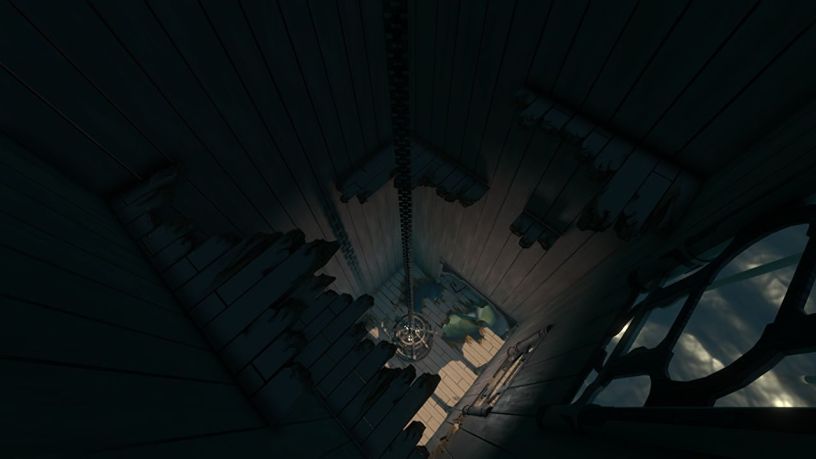
Outer Wilds is a mundane horror game for most of it, about the horrors of space going hand in hand with the joys of unbridled exploration. Echoes of the Eye hones in on more deliberate horror elements, going for flickering lights, shadowy figures, and a great use of darkness, sound, and speed of movement. Both paths work for the game’s atmosphere and mood, because both keep the same tenet of immersion in mind. The marvelous work done by Andrew Prahlow on the sound design creates moodscapes, snapshots of parts of the game world in your memory, and sucks you into each area the sound goes with.
Flow. Like the water at the center of the DLC, Echoes of the Eye puts the player’s comfort and immersion first, creating an enveloping world that you just can’t tear yourself away from. But when should it be scary? When the player becomes immersed, truly and completely. When the player’s drive to solve a mystery becomes greater than apprehension. That’s when the game ramps the reason for apprehension more, creating tension and terror.
An imaginative, gorgeous joy, Outer Wilds, already one of my favourite games, becomes even greater for stepping into horror so bravely. As always, play without distraction, play with headphones, kick back, and enjoy one of the smoothest non-horror game horror experiences in modern video games.
A Sense of Horror in Outer Wilds – Echoes of the Eye
 Horrorgameanalysis