
A low fog drifts over a delicate mountainside courtyard, patrolled by samurai warriors. In the distance, the pinnacle of mountains and an awe-inspiring castletop view create the sensation that you are in a world far bigger than you. This haunting suspicion is entirely confirmed when an enormous man on a similarly enormous horse ride out through a gate onto a macabre battlefield, dotted with the corpses of fallen champions. You exhale, and ready your tiny blade against the enormous spear that rushes towards you –
It was the moment with the giant snake that convinced me that Sekiro was one of the most awe-inspiring video games I’ve ever played. It was a moment of fascinating clarity because of its stillness, then the sudden jolt as the snake strikes, knocking you from the cliff into the abyss below. The snake feels like the perfect representation of the dangerous sublime. But what is the sublime, and how do we grapple with it in today’s modern artworks?
The sublime is a feeling of awe. Through this article, I’ll be specifically referring to Edmund Burke’s sublime, who believed that there were essentially two natural qualities: beauty and the sublime. Beauty was something that was well formed and pleasing, whereas the sublime was something that could both compel and destroy. A mixture of awe and fear; terror and excitement. So awe, despite how often we use the word awesome, is actually quite hard to achieve. Awe is something magnificent, or something unexpected. A game like Silent Hill 2 can utilize the sublime (especially the Burkean idea of the sublime) in its sprawling, rotting corridors in the Labyrinth area, creating a feeling of fear utilizing the sublime. Each soggy footstep gives way to another piece of unknowable architecture, a feeling that something is groping around inside your brain, and messing with traditional notions of scale and direction. But games have to tread a fine line when they engage horror in the sublime. Matthew Spokes in regards to System Shock 2 found himself overwhelmed by the horror of the situation, saying that “[m]y immediate response to the visceral horror of these distorted occupants and their plaintive cries was to stop engaging.” It is that fine line between awe and fear that can be so hard to achieve, that both Silent Hill 2 and Sekiro do so very well.
Sekiro can utilize fear in its sublime, but obviously not as intensely as a purely horror-based title like Silent Hill aims to achieve. Still though, I’ll always remember that first Headless cave. What often surprises me about Sekiro is its openness in the environments. The sweeping vistas, the trees you can grapple to and fro, the sheer verticality of some of its locations fascinates and stuns me. So when the Headless cave forces you into this tight, dark area (which will probably be peppered with online warnings that basically boil down to: are you sure you want to do this?), the suddenness of the game’s sublime qualities become more stark. Awe is generated first by the sweeping environments, then by the way in which we are funneled and made to fear the cramped constraints of smaller battlefields, and the deadly enemies that tend to lurk in such places. The Headless are disturbing enemies too, playing on traditional ideas of the human body and creating something grotesque from it, a traditional play on body horror that further enhances the sublime; the excitement of coming up against a novel enemy balanced against the horror of the reality of that enemy. The threat exists implicitly – this thing has a human body. You also have a human body. Is that what will happen to you?
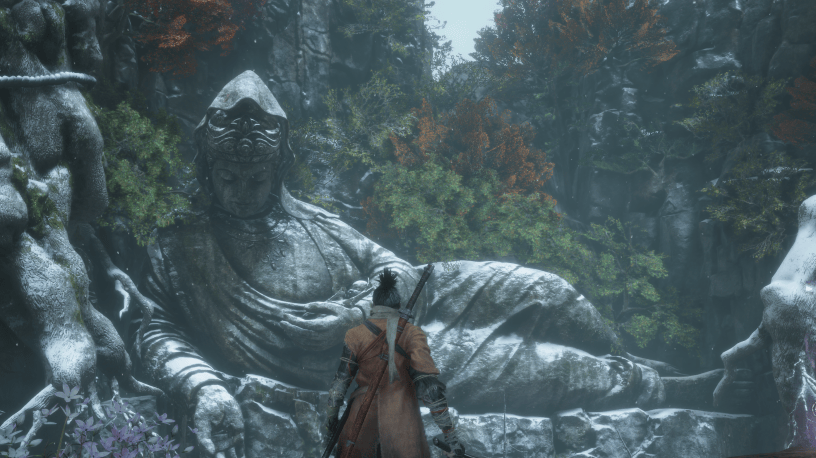
More often than not, the sublime is used to create a pure feeling of respect in Sekiro. The natural world in Sekiro is a very, very dangerous place, inhabited by giant, angry birds, ravenous monkeys, and any number of human enemies, who have forged these mighty palaces and walls that you will be clambering all over throughout the game’s experience. I think I will always remember that moment you meet the Guardian Ape, this colossal beast who moves fast and has a number of deadly and dangerous attacks. It is a memorable locale, too, dwarfed by the shadows of Buddhist Bodhisattva statues. This, of course, is thematically relevant to the game’s story, as a Bodhisattva is an enlightened being who has put off entering paradise in order to help others attain enlightenment. It is very welcome to have the statues be both awe-inspiring and not just there for the “rule of cool” or something similar.
But the quieter duels also stand as ways to emphasize awe. At all times, Sekiro encourages this feeling of humility, of being a man who is merely surviving while making his way through the world, rather than the world bending to accommodate his wishes. Genichiro Ashina is the hill players climb throughout the entire game. At first, he is a boss that appears at the beginning of the game to set the game’s events in motion. Then, he appears as the game’s first truly major roadblock (which always comes as a shock to players who, like myself, were already finding things quite tough), and he shows no mercy. Hence why beating him that time is one of the most satisfying boss experiences in video games, at least for me.
There is nothing but you and him atop the castle in the mountains. A duel between two truly great warriors, a feeling of quiet awe and focus radiating from the whole fight. There is, famously, no trick to beating Genichiro Ashina. He has good long ranged attacks and, should he hit you with his sword moves, you will be severely hurt. Sure, you can go and collect health upgrades and healing gourds, but in the end, there is nothing to do but beat him. Through this process, you will die, no doubt, many times. But death is as much a part of the sublime in video games as the environment. As Matthew Spokes explains in his book on Gaming and the Virtual Sublime, failure in video games has the potential to unlock new avenues of play and how we approach it. Where failure in video games was once performative and very public in arcades, failure in video games can now be quite private, giving each player an individual experience of competition with the game itself.
Jesper Juul, a noted video game scholar, examines video game difficulty as being core to our enjoyment of them. A game, being too easy, becomes trivial and perhaps boring. A game being too hard on the other hand creates feelings of frustration, especially when a player knows what to do, but the game seemingly just won’t let them because of its difficulty. Juul’s suggestion, then, is that “failing, and feeling responsible for failing, make players enjoy a game more, not less’ (p. 238).” So fighting Genichiro Ashina provides pain for a period of time, before it provides pleasure. Burke’s sublime rests heavily on this idea – this pleasure/pain divide helps create the compelling nature, even as it destroys the person experiencing the art in question.
Spokes himself deals with Sekiro – a fact I had in fact forgotten until I had begun re-reading his book to write the article. In it, he argues that the fights in Sekiro are “obscenely hard” (speaking of the battle against the Sword Saint) – that the very magnitude of the task, set against our own skills, becomes in itself awe-inspiring. We are dwarfed by the insanity of such a task; consumed by the complexity and difficulty of some of the boss fights. I would argue that the sublime does indeed come from this, but for me, the magnitude of the task became even greater set against the fact I’d have to do it over and over again. It wasn’t just that the task was difficult – it was that the task was difficult and I had to attempt it over and over again. Repetition engenders the sublime too – the pleasure/pain cycle continues, and each retry pulls you closer towards pleasure, away from pain. The moment of pure adrenaline that follows a boss’s defeat can just as easily be sucked away again – probably the most famous example of this is the Guardian Ape’s resurrection after death. A tough fight won becomes suddenly transformed into another, perhaps even tougher fight. The novelty of the fight becomes sublime, even while constantly throwing oneself against the same boss becomes sublime too. In all elements, Sekiro seems to be a game built to emphasize the Burkean sublime – seductive, impossible to put down, and very much capable of destroying the player. I consider it a masterclass in video game design, and a game well worth experiencing for yourself. Because it’s one thing to experience vicariously on YouTube how someone else reacts to the game’s sublime; it is another thing entirely to face up to Genichiro Ashina and emerge triumphant, to have felt pain, but ultimately to be gifted pleasure for it. It is something very much worth engaging with – a true testament to the power of video games.
The Sublime in Sekiro: Shadows Die Twice
 Horrorgameanalysis