
“What some of the early horror genre masters knew, and what I know, is that the audience are perverts, but in the best possible way.”
Fede Alvarez
You know when you play a horror game and you feel decidedly un-afraid? That tends to be a result of either ratcheting up the gore and horror so high that it bends around and becomes cheesy, or when it speeds past horrific moments so fast that no-one gives a damn. Silent Hill 4 is one of the rare games I’ve played that has an atmosphere of oppressive horror that doesn’t grow stale, predictable or boring, while also almost never overextending itself and trying to lean too far into the horror that it comes shlocky or cheap.
Horror is such a hard genre to get right, or even to define at times. Silent Hill 4, like the rest of the Silent Hill series, falls into surreal horror, a genre definable by its detachment from reality to at least some degree, and a reliance on metaphor and symbolism to carry the scares. Rather than always being literal interpretations of horrific things, surreal horror is often more cerebral, requiring the viewer to dissect what they see in relation to other context the story should provide. This makes each and every piece of imagery something that your brain has to work over to try and define – which makes it much scarier, since it comes back to haunt you later.
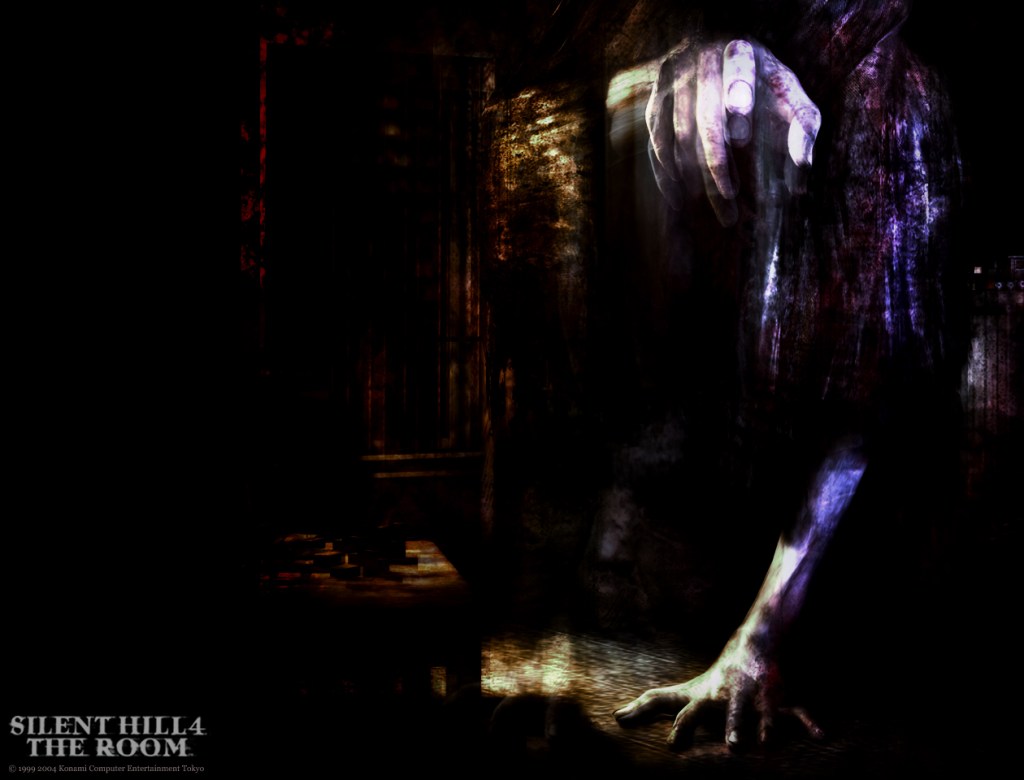
Silent Hill 4 is mostly freed from any particular reliance on reality, placing a clever emphasis on only one “real” section, which itself is victim to a decay in reality, becoming more and more surreal and awful as you play on. To begin with, however, the titular Room is your safe haven.
It is where both you and protagonist Henry Townshend protect yourselves from the horrors you see elsewhere by allowing rest and recuperation here. The Room is one of my favourite video game hub spaces. It serves as a reflection into the main character’s life while providing a space that builds upon the core themes of the game, that of oppression, isolation and voyeurism.
Silent Hill, as with a lot of classic survival horror games, are voyeuristic. They achieve this through the detached camera angles that serve to provide, as Bernard Perron says in his book on Silent Hill, a perspective that no normal human could look at the events from. They are alienating and confronting. The camera angles serve several purposes. First, they allow the player to actually play the game. Second, they give the player themselves a feeling of distance from the character they are controlling, as well as providing that all-important feeling that the world itself is hostile to you. Finally, they make the player culpable in voyeurism, making us a horror movie director of sorts, culpable to all the terrible things that are going to occur to the poor character(s) in front of us.
Silent Hill 4 takes this one step further with their first-person perspective, which places us directly in the shoes of a player character and thus gives us a sense of ownership over the character, as well as an incredibly personal relationship to the story. No longer are we distanced from the character; so therefore we expect the sense of alienation to be gone. But, as it turns out, the Room isolates both you and Henry together. Your interaction with other people while in the Room is reduced to only the act of watching and listening. It is a completely one-sided interaction, and you are on the side of the spy, the pervert and the lonely man in the apartment with a telescope or the camera. It’s the horror of being unheard, forgotten and unrecognized. Peering through the peephole shows you some people fussing in the corridor, and bloody handprints on the wall. Those who play and enjoy horror games, or enjoy any kind of horror media, have some culpability in this feeling of being “perverts in the best possible way”. It is a genre in which we want and expect to see others hurt or traumatized in some way, whether that be physically, emotionally, psychologically, etc. for our amusement. The thing that makes it alright is the understanding that it’s not real – but in order for it to be effective, it has to has elements that are close to reality. That is the fine line a horror designer must walk.
It is important to note that I don’t say that those who enjoy horror are perverts in a good way to be edgy or for any kind of shock value. The simple truth is that we as humans are wired to enjoy that sort of spectacle on some level or another. It is just part of the human condition. Horror is a universal genre, not one that just a few special people can get and understand. I think everyone has the capacity to like some kind of horror; not necessarily everyone does, of course, but liking horror is a thing lots of people do. Horror is fantastic, I love it, it’s my favourite genre; but that does not make me (or anyone who feels the same way) special or better than anyone else.
In Alexander R. Galloway’s book, “Gaming: Essays on Algorithmic Culture”, he discusses the origins of the first person perspective. The first person perspective came from cinema, wherein, as Galloway says, “the collection of visible evidence is often crucial in films, and the POV shot is commonly used to present to the audience evidence necessary to the film’s narrative.” Silent Hill 4 puts us into a first person perspective to collect evidence and get closer to the character. Another academic, J.P. Telotte, describes the 1947 film “Lady in the Lake”, saying, “that enigmatic detachment, of course, as we both act and see ourselves in action, again typifies the dream experience”. And this seems to summarize how Silent Hill 4 works, especially in a late game scene, where we peer through the peephole in the door and see a bloodied Henry Townshend staring back at us. The third person perspective provides detachment, while the first person perspective allows us to act directly as Henry.
What should interest us most however in the realm of the visual is what Galloway calls “the first-person subjective shot, which is used to show what Carol Clover calls “predatory ”or “assaultive” vision, that is, a sadistic way of seeing characterized by aggressive action, forward movement, and onscreen violence.” Henry Townshend might not be violently aggressive towards other human beings, but the voyeuristic element can be tied to this subjective shot which is tied to assaultive vision. Henry’s only way of interacting with the outside world is an outwardly hostile way – which is almost justified by the way the game is set up, with whenever you peer out your window, you can see other people staring up at you sometimes. However, Galloway himself rebuts this by saying that in games, the first person perspective is active rather than participatory, “What was predatory vision in the cinema is now simply “active” vision. As far as identification is concerned, film failed with the subjective shot, but where film failed, games succeed. Where film uses the subjective shot to represent a problem with identification, games use the subjective shot to create identification.”
We have the opportunity to identify with Henry Townshend, but at the same time, we are culpable in whatever actions he takes. Electing to spy on Eileen, your beautiful neighbour, takes on a particularly sinister quality considering you are the one in control, electing to see what she’s up to. The tiny peephole scratched through the wall also often prevents you from seeing Eileen’s face, reducing her to just a body for half the game in these sequences. Of course, it’s the amount of culpability you feel as you attempt to scratch elements of truth and knowledge from the game’s story by doing whatever you can to find stuff out and obtain evidence. Your isolation and loneliness increase alongside Henry’s, but any chance to get any closer to him is destroyed by the third-person camera perspective. Together you are alone; apart you are isolated. You are always the voyeur; the sinister element of the visual is that you are always an intrusion, no matter what sequence of the game you are playing. This makes you a horror element too, while increasing the disturbing atmosphere of the game for every second you are playing, until the disturbing elements of the game feel stuck to the inside of your brain.
Akira Yamaoka himself says that, in his opinion, “the first person is better … What I wanted to do this time is the closest thing to [reality] … after all, becoming a first person game, you can draw things from the player’s perspective”. Interestingly, Yamoka said “next time I want to see something that’s from neither the first nor third person perspective” – which I find fascinating. I see Silent Hill as the perfect setting for standalone horror games, each connected by setting and general idea, but themes, scares and experimental game design being used in each one. It is a shame that Silent Hill 4 spelled the end of Team Silent’s time at Konami, as I can only imagine the fiendish experiments that would have been cooked up had the games not been handed off to other, more inexperienced developers in the West. Experimentation, revulsion and subversion, as well as a general feeling that you are disturbed, are all key to Silent Hill – and as the general tropes of survival horror became more and more explored, experimentation is key to finding the new thing that works. A shame that in commercially owned creative industries that experimentation is so often frowned upon. The money that is required to make an experimental horror game like the Silent Hill series is nowhere to be found. As Dario Argento says regarding horror films, “We had many good directors – John Carpenter, Brian De Palma – but things have become polluted by business, money and bad relationships. The success of the horror genre has led to its downfall.” At least Resident Evil is currently really very good, and some indie horror developers continue to carry the torch.
Yamaoka continues, saying “first person is the player’s perspective, and third person is the player is an objective camera.” The visual design, Yamaoka says, comes from “picturing scary things and violence with your mind, and scraping them from there”. Which explains the often-times surreal nature of the game, as the scares are collected from a variety of people, and “scraped” from the mind, a verb I quite like in this instance. It implies that the process of getting them was difficult, and perhaps the designs didn’t emerge whole – which makes them more frightening.
The feeling of reality while existing in the Room was something that the design team wanted to emphasise. The game designer, Tsuboyama, said that their goal “in designing the room was to give it a sense of reality – like you were really living there during the time you were playing the game. He thinks that even in everyday life, there are many things you encounter throughout the day that can give you a sense of fear, but in the Silent Hill series, it’s a matter of how much of a sense of everyday life and reality we can make the player really feel.” In my opinion, the blending of the mundane with horror is much more effective than absurdist horror elements, like the over-the-top horror I found present in a game like The Evil Within. The Room allows the player to breathe, while keeping them just on edge enough to keep the horror mood and feeling, reinforcing the game’s themes. I find I’m much more afraid when the horror is applied to a real-world setting. I’m never (heaven forbid) going to be chased around by a lunatic with a chainsaw who wears human skin, but I am going to need to get out of bed, go to the fridge, do my laundry, etcetera. When the dryer splatters blood on the wall, when the fan on the ceiling goes haywire, when everyone in my life ignores me; that’s the kind of horror that more games should play on.
The director and scenario writer of Silent Hill 4, Suguru Murakoshi, explains this principle when it comes to designing the game; “this has been present throughout the series, but there’s a “fear of the abnormal.” In this game, it’s how ordinary things are just a little off somehow, and that’s where you find the fear that’s unique to Silent Hill, I think. Also, the foremost concept we had for the plot was “terror,” but we wanted to make sure that it didn’t stop at simple scariness. We didn’t want the game to merely frighten you; we wanted to deliver shocks that lingered in your heart – to incorporate something that went beyond fear.” This is precisely what such games should aim for, and it is precisely the kind of experience I love.
Now, it’s not that there’s anything wrong with zombies persay; they just happen to generally remove any sense of reality from the proceedings when they are overused. Most games present them in a fairly ludicrous way, at least to me. The original Resident Evil is one of the few games I’ve played that makes zombies scary, because their threat level isn’t the size of a city. Individual or pairs of zombies in tight spaces are more frightening than a dozen zombies on an open city street, mainly because “zombie disaster film” is definitely overused, in its base form at least.
Silent Hill 4 does realism and immersion very well, soaking the player in more realistic horror in the Room before spitting you out into more surreal and aggressive areas as you crawl through the hole, a literal portal to a different form and approach to the horror.
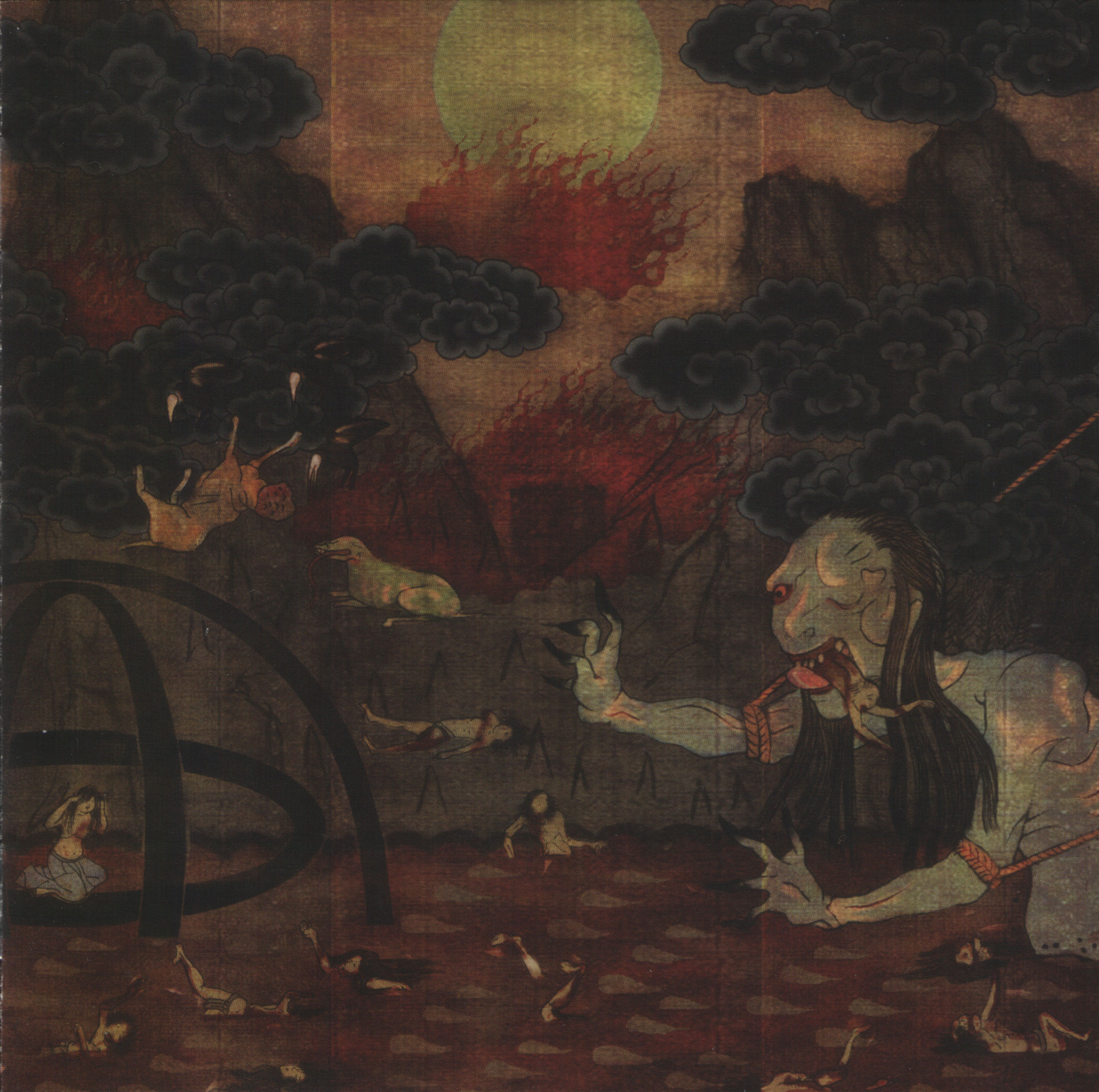
Even still images for the game and artwork are frightening and evocative. The cover for the soundtrack is some horrifying hellscape with people suffering in the lava, and a giant monster reaching out to grab people. If I could frame it on my wall, I would. It’s marvelous.
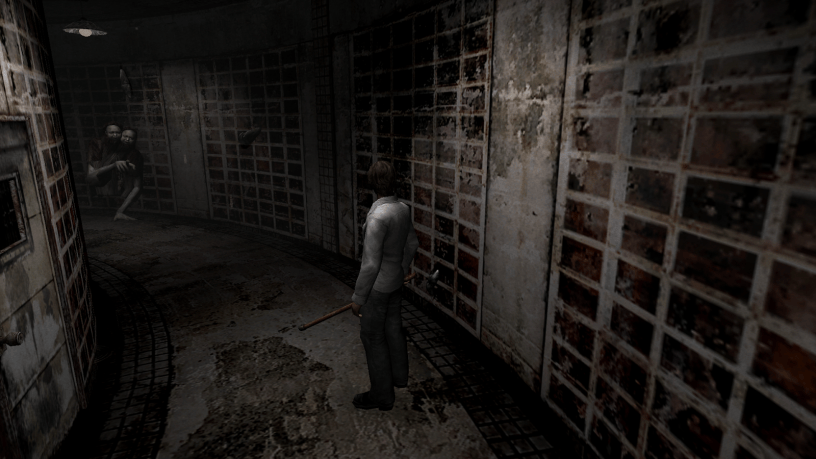
I also wanted to talk about the disturbing visual design of the game, in particular what I consider to be the game’s best alternate world, The Water Prison. The Water Prison is, in my opinion, a marvel of horror level design. You awake in a small, cramped hallway, and the prison itself is built circularly. There is no beginning or end to the hallway, and there is always a corner that you cannot see around. The entire place is visually decrepit, dilapidated and claustrophobic. The only open spaces in the area are either filled with bat insects known as Hummers, or are a grey, misty vista out onto endless, melancholy seas. The latter space (the outside of the tower) is particularly effective, because the feeling of open space is rarely available in this game, which makes entering the circular halls even worse. The design feels based on the sinister prison / social experiment known as the Panopticon.
What is most effective about the Water Prison is the experience you have on the third floor. Giant leeches slither over the grimy walls, and each of the cells is markedly eerie in their own visual design, with particularly claustrophobic camera angles. I’ll be talking about these cells more in the audio section of this video, but the most effective visual horror moment in this whole game for me is the fairly organic one, when you see one of the Twin Victims, the baby-faced ghosts who stand on one hand and just stand there. Menacingly pointing at you, the Twin Victims are haunting renditions of some of the main villain’s victims, but what works best about them is their movement. The fact that they walk on their hands and are fairly large enemies belies their uncanny speed. The first time they moved, I genuinely jumped. I was expecting a slow, sluggish enemy, but instead got a murderously fast monstrosity, running circles around me. They aren’t particularly difficult enemies to fight either, but it’s their visual design that makes them horrifying. I prefer not to deal with them wherever possible; flight is always my first option, preferring not to tangle with them for any longer than is necessary, because I find them just that effective. It’s a stroke of horror genius, this third floor – and I love it.
Hopefully I can transform this article into a larger video on Silent Hill 4 – and that the discussion can continue while I play the game on stream in a few weeks time! If you liked this article, your support on Patreon would be greatly appreciated!
 Horrorgameanalysis