
I play a lot of horror games. And I play a lot of those horror games for comfort. Not comfort-comfort, obviously; not total relaxation. A horror game should be unsettling, provocative, daring. Actual, complete relaxation in horror only comes with predictable or poor horror games, or horror I’ve played through before. But most of the time, I find myself coming to horror games for fun, some comfort, and the confidence-building that comes through confronting the next creature that lurks in the shadows. I love horror.
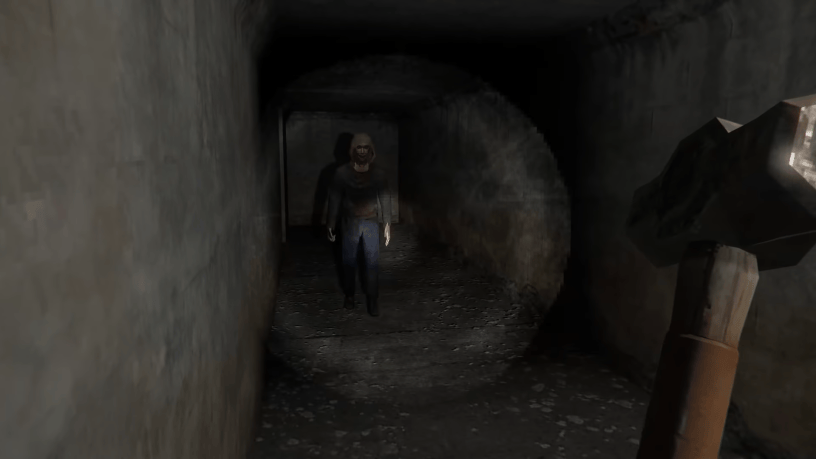
So, with this framing in mind, let me put it to you that Lost in Vivo is one of the most successfully unsettling games I’ve ever played. The pacing is immaculate; almost every scare calibrated to catch you off-guard. The tight and claustrophobic corridors of subway tunnels and sewer pipes exude genuine menace. With every step forward, you know that you are taking yourself further and further into the depths of a place that, by rights, should not exist.
This is not to say the game does not stumble at times, when particular sections outstay their welcome for a fraction too long, or you might begin to adjust slightly to the game’s psychologically-daunting attitude. Some sections lack the fear factor of others, and the pacing can dip a bit. It’s not scary one-hundred percent of the time. But there’s something marvelous about it, the way in which the game works, in which every new section and every new enemy provides a fantastic, and frightening, challenge. Courage is tested in Lost in Vivo, a game rich with symbolism and hidden meanings. Directly inspired by Silent Hill, it is no wonder that I love it so. At points the game is legitimately hypnotic in a horrific way. I consider it a tremendous shame I let this one sit in my library for so long untouched. It’s great.
Moments from the game come rushing by me as I think of how to write about it. But it is that first and harrowing hour to be honest that stands for me as a shining example of how to open a horror game. A slow, brooding opening sets up the objective clearly (your poor dog gets washed down a sewer drain, you have to save her!) and you are given a set of tools – a flashlight, a sledgehammer, and a whistle. And you whistle for the dog, at the same time activating your compass, showing you where to go. And then the moment – the moment when something whistles back. You suddenly don’t feel like going any further. I could say more, but I fear to spoil it for those who want to play it themselves.
Lost in Vivo is one of the best indie horror games I’ve played for a multitude of reasons. But it understands the tropes of ludic horror and builds on them. It exploits foreshadowing, building on other games’ sometimes clumsy attempts to construct a world through written notes. In this game, notes can supply you with inaccurate information, but information that always, always builds towards a larger purpose – even if that’s just to make you feel dread, to make you want to put the game down and say “enough’s enough”. Traditional video game objectives like “restart breakers” suddenly transform as you realize that by turning off breakers you are ceding control of an area to the monster. Maps you find are outdated and sometimes inaccurate, forcing you to find your own way forwards. Lost in Vivo is not perfect. It can be a bit frustrating at times – but it’s scary. It’s dark and dank and claustrophobic, suffocating the player every chance it gets, making them feel unbalanced, never-safe. It is a wonderful, wonderful game. I almost never played it again after the first time I booted it up, so effective was it. It is dread. It is marvelous. If the game had a stronger plot, I think the game would be one of my favourite games full-stop. As it stands, it is one of my favourite horror titles, and one whose gameplay never quite got old – though survival horror is one of my favourites.
When I have more energy & time, I will write up a full analysis with spoilers included. I think it is superb.
You can buy Lost in Vivo from Steam.
You Should Play: Lost in Vivo
 Horrorgameanalysis