
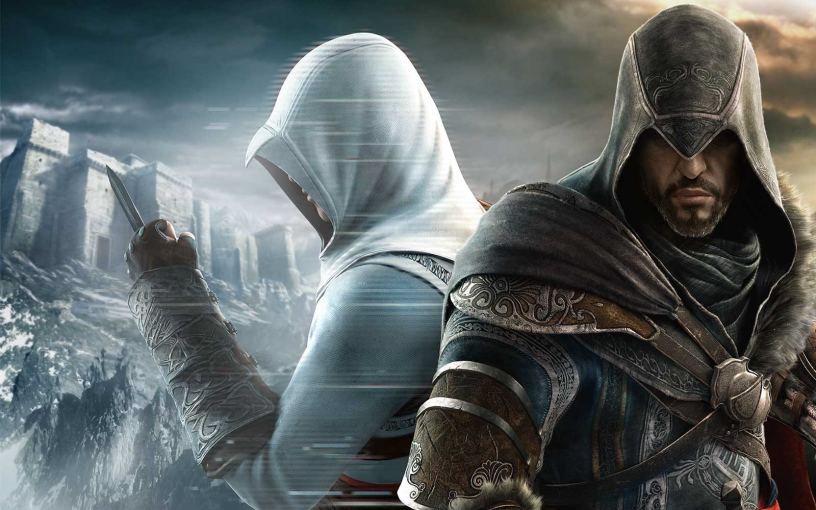
The following contains spoilers for Assassin’s Creed Revelations, the 2011 finale to the Ezio Trilogy.
Assassin’s Creed Revelations has been a bit of a blind spot in my nostalgia wing mirror. When I bought the Ezio Collection a few years back and replayed the games I loved so dearly when I was younger, I saw the design faults as clear as day. They were almost painful to witness – for a series that I had once held so close to my heart, I couldn’t quite believe that even the best games in the series were beholden to some truly awful padding, lazy character writing and weird pacing. Still, the atmosphere and the earnestness of the story (and the likeability of some characters) meant that Assassin’s Creed II & Brotherhood, while no longer games I would consider my “favourites”, still had some merit. But, exhausted after the grotesque bloat after Brotherhood, I never bothered to replay Revelations, which in turn preserved the best parts of it in my mind, and shielded me from its shortcomings.
Recently I took it upon myself to clear that from my backlog, and in doing so, I discovered that Revelations is not just prone to a few shortcomings – I found that it was a game I could recommend to almost noone in this day and age. Provided that a player has already played Assassin’s Creed II and Brotherhood, this particular era of the series has nothing more to offer but meaningless experiments and more busy work.
The game is not all bad. There is a reason people remember the trailer and the beginning of the game in general. An escape from blizzard-wracked Masyaf as Ezio, in a land once owned by Assassins and now dominated by Templars, complete with a carriage chase that feels inspired by Uncharted, is a fantastic way to mix it up. After two games feeling like the hunters, now Revelations seems to promise an experience as the hunted, as the faction on the backfoot. Alas, Revelations quickly pitches that idea headfirst into the garbage as Constantinople’s Assassin faction is revealed to have sided with the Ottoman Empire as they expand into local people’s freedoms. Worse, the Assassins train openly in the streets, hang their banners from large towers, and seem to flaunt the rules established in previous games. It’s a wonder people in this universe didn’t include the Turkish Assassins in history books.
Another positive, before I get stuck into the negative, is that generally Altair’s memories (which end every in-game “chapter”, called a Sequence in Assassin’s Creed lingo) are well-written and engaging, probably because they don’t overstay their welcome, unlike the rest of the game. Altair’s struggle is filled with pathos and tragic moments. Certain things should have been expanded upon a little more, such as the reason why Abbas hated Altair (something not learned until you have killed Abbas), but the final moment with Altair, as the game objective becomes “rest a moment”, is genuinely one of the most moving moments in the series, as you trudge towards the place where Ezio has just found Altair’s body. It is a moment that feels clever, with the inevitability of death mixing perfectly with the banality of a video game objective pop up. As you direct Altair to his death, the genuine pathos of the moment still gets to me, and as he closes his eyes, Revelations finally manages to summon some emotion. Then it craps all over that emotion when it segues back into a sequel hook for Assassin’s Creed 3.
I think the game’s largest problem is that the protagonist of this game shouldn’t have been Ezio – or if it had to be Ezio, some explanation as to his motives would have been helpful. He just shows up, wants to get into Altair’s library, and finds himself dabbling in local Assassin affairs for no real reason beyond he wants the keys to said library. Along the way Ezio establishes himself to not care one whit for human life any more, which I found personally quite disappointing upon replaying it. He blows up the Great Chain to leave Constantinople, and proceeds to use a Greek flamethrower to burn down every ship in the harbour, killing who knows how many people. When in Cappadocia, a huge underground city, he sets fire to the gunpowder stocks and floods the city with smoke, killing countless people just to flush out one man (who is never really established as particularly evil – we just kind of assume that since Ezio wants to kill him, he must be a bad guy).
All this could work if the game was interested in telling a story about Ezio’s moral decline, wherein he always believes the ends justify the means or something similar, but the game never wavers from presenting Ezio as a hero. Even when he assassinates the wrong man on the orders of someone he has had about three interactions with, the story just kind of shrugs and says “whoops”. This is particularly blatant when Ezio scolds a trainee Assassin in one of the extra side missions (The Vizier Pt. 1) when she kills the wrong target. I just had to shake my head that the game seems to miss the opportunity to tell a character-driven story about Ezio the Mentor assassin who has come to a foreign land, far out of his depth, and believes he can do no wrong since he saved Italy. The closest the game comes to telling Ezio off is when Yusuf, the Master Assassin of Constantinople, says “maybe you shouldn’t deliberately rile up the crowd to break through the Arsenal gates” because that would, understandably, kill a heck of a lot of people. Ezio, again, just kind of shrugs and walks towards the camera because he’s the protagonist, and what is this but a power fantasy (apparently?!).
If we’d had a new Turkish Assassin, someone struggling with their loyalties to the Ottoman Empire or their hatred for the Byzantines, or a Byzantine / Greek Assassin who was learning to adjust to life under the new regime, then maybe these story beats we could have accepted as a reckless Assassin trying their best (but failing hard). But with Ezio, it’s harder to accept, because the game always frames him as the good guy (“The Mentor”, in fact), and we are given zero reason to really contest that.
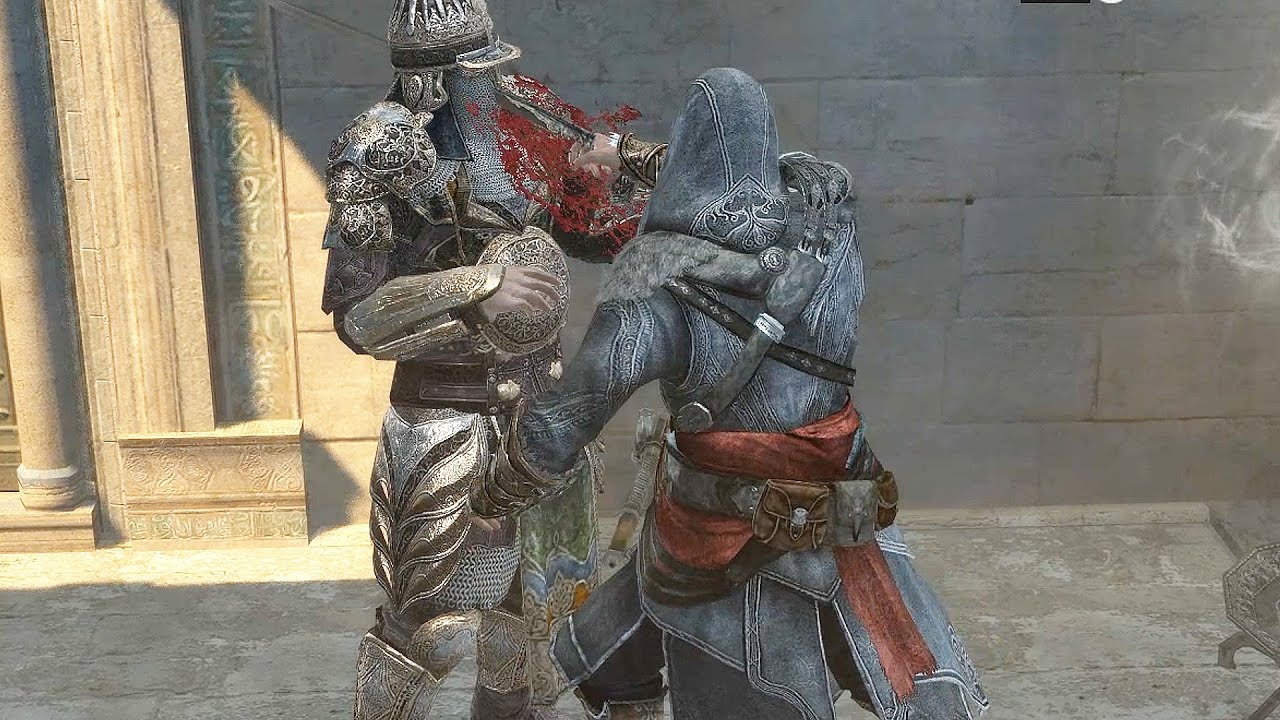
I consider myself to have a higher tolerance to gore than I used to after many horror games, but many years of thinking critically about media have given me a new appreciation for the general overuse of violence across media. Violence (and action) is a cheap way to get the audience’s attention – but ill-thought-out violence can in fact sabotage the themes of the story or the personality of the character who we are following. Ezio’s new ruthlessness comes across even in a few of his killing animations when he counters or kill-streaks an enemy. While previous games in the series didn’t shy away from some truly nasty kills, Revelations makes Ezio appear particularly bloodthirsty. In what must be one of the most shocking kills in the series (that you can perform on any generic guard), Ezio thrusts his sword straight through their face, then, as if that wasn’t enough, spins their head around on their neck using the sword as a lever. With their neck snapped, Ezio withdraws his sword and lets their body crumple lifelessly to the ground. Another one involves Ezio stepping in close through the enemy’s defence and thrusting his sword viscerally through their chin once, then, as it gets stuck for a split second, he thrusts again, the sword bursting out through the top of their head as he triumphantly lifts them into the air.
People often pick on Uncharted as a series that suffers from some ludonarrative dissonance, where the nice guy Nathan Drake, the guy we are meant to be rooting for, comes off as a bit of a psychopath as he murders hundreds of mercenaries. But Revelations must surely top these lists, as Ezio comes across as a remorseless, relatively apathetic monster, who doesn’t care about anything but opening a library. He doesn’t even know what’s in the library, and doesn’t even have any real personal motivation to kill those in opposition to him, other than the fact that they are Templars. While I personally always found the philosophy of the Assassins to be far more compelling and in line with my own personal beliefs, in this game I struggled to see where they were coming from.
The game’s real villain, who reveals himself as the villain right after you kill the guy you burned down a city to get to in a scene worthy of some of the worst blockbusters, initially seems pretty compelling. Despite a contrived first appearance, he gives a good speech when Ezio catches up to him, and also uses Sofia (a character who I will get to later) as leverage. Prince Ahmet is a bit of a philosopher, who believes the Templars and Assassins to just be two sides of the same coin, with himself and Ezio just being people who could have been friends, if they weren’t fighting over keys to a library. He immediately shoots himself in the foot when he elects to have Sofia killed immediately after getting what he wants from Ezio, driving Ezio to immediately pursue and kill him. What a waste of a character who could have been a proper threat, someone who could have, in the right hands, have driven Ezio to have some kind of moral dilemma – you know, the kind I was talking about just before. Instead, Ahmet acts like a lazy movie villain because Ezio is the good guy and we can’t have the player questioning Ezio at the end of the trilogy!
In a better game, we would have had a longer, better-paced story that didn’t flit all over the place. The game’s Sequences have an uneven rhythm, the only factor grounding them being the Altair memories (again, probably the best part of the game). In one mission, we are infiltrating the Sultan’s palace to stop the Templars killing Suleiman. In the next, we are running errands for Sofia Sartor, sneaking into a dock to get her papers.
Sofia Sartor is a good character, but absent from the game’s main beats for the most part. It is true that she has what seems like a strong moral core, and an interest in books and learning that goes painfully underexplored, but for the romantic lead for Ezio (a character we have invested a lot of time in by this point), she just does not get enough screentime. She seems like she should play nicely off of Ezio (and she does), but there is so little time to get invested in her. The game whirls around madly, using its truncated development time to jam as much poorly written story into as little time as possible. Where some Assassin’s Creed stories overstay their welcome, Revelations gives it no time to breathe, instead missing out what feels like whole chunks of context that are sorely needed to make us care.
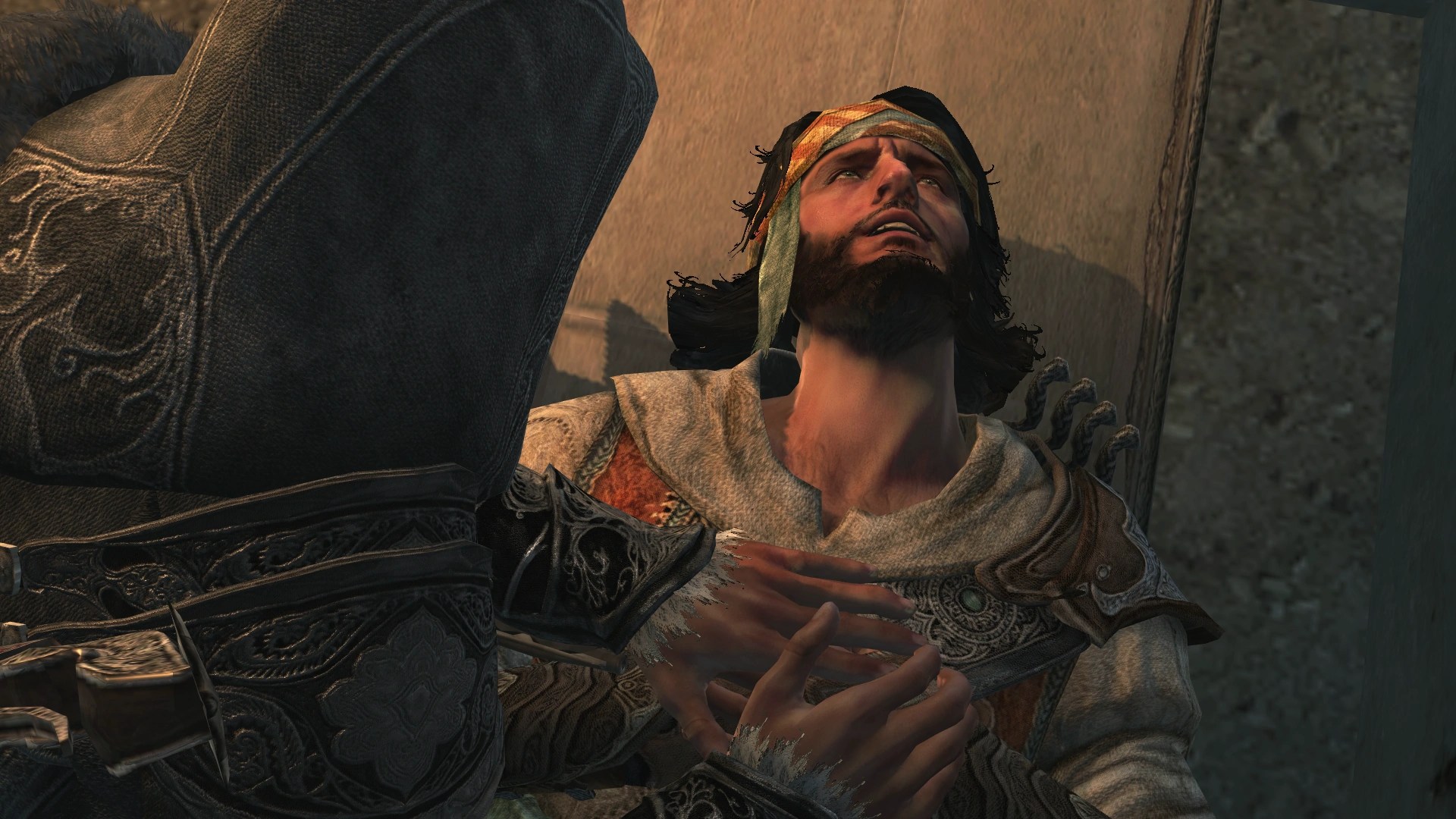
Revelations fumbles the ball hard when it comes to a coherent story; we should have had a game that actually challenged the morality of the Assassins in a confident way, especially seeing as the game seems to set that line of questioning up. But nope, Ahmet does bad guy things, gets thrown off of a cliff like Cesare Borgia (but by someone else other than Ezio this time), and Ezio rides off into the sunset with the girl and retires from the Assassin life. This ending would feel more satisfying if it was earned – if Ezio had realized that he had become a bit of a monster, or that he’d been acting cruelly or without regard for innocent lives because he felt his Creed empowered him. But he never wavers, and noone except Yusuf (who dies off-screen to make Ahmet seem like an even bigger jerk) ever questions him. Even Yusuf just goes along with Ezio’s plan to weaponize the people of the marketplace to get him what he wants.
In a better world, we would have had a game that dented the hero power fantasy that Ezio had been living out for the last two games, and provided deeper ideological conflict beyond “freedom for everyone” and “yeah enslaving the world with a big satellite is cool”. I’m breaking it down too far perhaps, but there was real potential for a proper ideological struggle in Revelations that fleshed the conflict out even more than in previous games. Instead, it dumbs it down if anything. And that’s a right shame.
Next time: An assessment of the new gameplay additions, and why they’re frankly a little… unnecessary?
 Horrorgameanalysis
I’ve had pretty much the same feelings towards this series as a whole, and the part that bothers me the most is how much I’d probably still love these games if they were just a simulation of specific locations in history and nothing else. Even worse is the fact that we still don’t have anything (to my knowledge at least) that scratches quite that same itch of just being able to run around with your mouth wide open, immersed in a beautifully sculpted world that you can explore to your heart’s content.
I don’t actually remember much of the details anymore since I played this game years ago, so I’m wondering how you felt about the simulation of its locations specifically? Part of me wants to dive in again just to be able to revisit this game’s exploration, but I’m just a little worried I might be setting myself up for disappointment. I figure this game entry might be a good place to start since it looks like it takes place during an incredibly interesting period in history (which I didn’t remember at all until I checked the Wikipedia article for the game. I guess I was too busy throwing smoke bombs at peasants for fun to notice back when I was younger!) when it reversed the trend of the Islamic world’s empires and traditional institutions crumbling after it managed to finally conquer both the (Eastern) Romans and its rival beyliks despite also having to defend itself from a coalition of Christian states that invaded the Ottomans amidst the Pope’s launch of a crusade against them, and only a few years before the Ottomans established the fourth and final Caliphate (an institution which had been left vacant for nearly three centuries at that point) and became known as the guardians of Islam and its holy sites after conquering all of the Levant and Egypt, alongside the holy sites of Medina and Mecca…
…but something tells me none of that made it into the game.
LikeLike
I do think that is probably the most value people can get out of the Assassin’s Creed games these days – as well-sculpted historical sandboxes that allow for you to scale famous landmarks and inhabit a time and place you could otherwise never go to. It is hard indeed to find a game that brings something similar to the table – I suppose Bethesda’s Elder Scrolls games are a similarly mainstream explorative game about that same feeling of immersion, just in a fantasy world instead.
I plan to write another three or four entries in this miniseries, and one of them will be about the simulation of its locations – but to address it a bit now, I think they do a fine job with Constantinople as a place to run around in. Climbing in and around Hagia Sophia and Topkapi Palace remains just as engaging as you think it would – but Constantinople, after doing the sightseeing, is not as interesting to run around as say Venice. The city (as presented in game) is just various shades of beige, and the Golden Horn that divides the two parts of the city must be traversed by loading-screen boat, lest you want to swim for five minutes. The difference between districts feels quite negligible, aside from the northernmost district. That’s why I think I was such a fan of that early Masyaf section in the snow, because it sticks out more in my mind from the beige blur. This is a huge shame I think as Istanbul could have been really something special. At least traversal is fun thanks to a new toolset or two – but it doesn’t live up to the reputation established by Jerusalem, Damascus, Florence, Rome, and Venice in previous games as a place where your jaw can still drop after many hours.
The game is set during the period before Selim the I came to power, which means at that time they had not become the defender of Islam that they would be very shortly after his brief reign (as I understand it anyway). The main conflict is ostensibly between Byzantines and Ottomans, but the Byzantines are presented as ineffectual villains and the Ottomans as just the kind of default “guys in power”. The actual interesting historical conflicts are skipped over in this game in favour of telling this weird Ezio story that I picked apart in this post. Ezio meets Ahmet, Suleiman, Manuel Paleologos, Piri Reis, and Selim, but they are more like Easter Egg historical appearances, ineffectual guest cameos, rather than using them to tell a story about actual historical conflict. It’s not even really used as set dressing, and it’s never explained for anyone who isn’t interested in Byzantine / Ottoman history. It’s just “Byzantines are Templars, Ottomans are (mostly) neutral but Assassins support ’em anyway, aside from the few who are Templars, in which case, kill ’em”. And it’s a big shame because there could have been a morally gray story to mine from there too, something that actually challenged Ezio – but Ezio gets to make his judgement calls and he doesn’t have to live with any negative consequences. A big shame.
LikeLike