
There are some things that act as pivot points in one’s imagination. Works of art that contain particular elements of a culture or a society, perhaps, that you hadn’t considered before. Those works become foundational texts in one’s own mind – part of a literary canon, so to speak. For me, Blasphemous is one of those games.
I played this back in 2020, and have been recently revisiting it for the sake of completionism, since I actually enjoyed it so much. Yes, I recently wrote that post on backlogs and how problematic mine is – yes, this isn’t really helping. But let that in itself be an endorsement of Blasphemous’ quality.
The game is a metroidvania style, explorative grimdark platformer / Soulslike with a unique religious bent. The game’s theming is what rooted it so firmly in my mind – the religious horror was an angle that I hadn’t seen explored very much in video games, and if the game wasn’t called Blasphemous, they probably could have just called it Religious Horror: The Game.
Taking inspiration from the intense, fervent history of Catholic Spain, Game Kitchen conjured up a rich and fascinating world. While you could argue that it leans very much into the indie Soulslike stereotype – you playing as one of the last “sane” (arguable) people in a world that is now inhabited by monstrosities – the particular angle Blasphemous takes allows for the monsters to be approached not just as mutations, but all as particular tragedies.
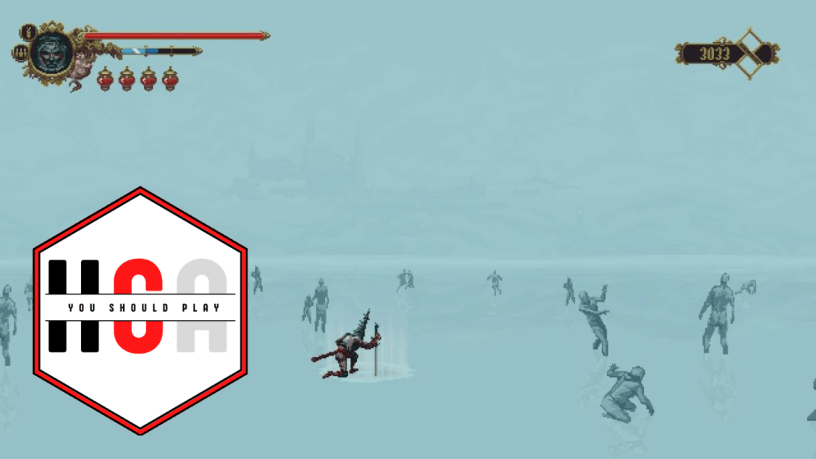
The Grievous Miracle, some kind of spiteful deity or even just a terrifying force of nature, is the root cause of the world of Cvstodia’s ills. Punishing whatever it sees as sinful and demanding a life of constant pain and penance for perceived sins, the Grievous Miracle rewards even those who are incredibly devout with lives of suffering. The world, as a result, is falling to pieces. Rich pixel art brings to life all manner of crumbling and desolate regions – from the Wasteland of the Buried Churches (a fantastically evocative sunkissed realm with what looks like stormwracked churches sitting skeletally in the background) to the deep bells of Jondo, a bell built upside down into the earth so that the world may hear the mourning of the thing that lives at the bottom, all the way to the depths of a forbidden library, Blasphemous is a constantly riveting game of exploration. I can’t recall a single environment I was displeased about discovering – the joy of exploration is so important in Metroidvanias, and the delightful art and music characterizes each place with its own unique mood and feel.
The enemies that inhabit these places also linger in the mind, though for more terrifying reasons. A man, almost sawn in half aside from a sliver of skin in the lower belly and groin, tosses a large cross at you like a boomerang. Ghostly prelates hover, affixed to their chairs, and thrust their long, judgemental spears at you as you pass by. A saintly woman who burned her face off because she was being venerated for beauty leers at you in the darkness, gold dripping from her exposed brain. I could go on, but there is a joy to discovery here, too. A joy to discovering the dark depths of the world of Cvstodia; a joy to seeing how the Grievous Miracle has wreaked its terrible judgement on the world. Whatever it is – for it is never ever explained – the Miracle (by which I mean the artists and designers at Game Kitchen) has done a fantastic job rendering a complex and apocalyptic world.
Aside from the presentation, which really sells the game, the gameplay itself is a delightful side-scrolling Soulslike with tight controls. You have a sword swing, a parry move, and a spell slot which can eradicate weaker enemies and maybe buy you some breathing room with a few of the bosses. You can upgrade your weapon, as well as slot in all kinds of subtle modifiers that change the way the protagonist, the Penitent One, moves around.
Like all the best Soulslikes, Blasphemous knows that the rhythm of a fight is important. Each and every screen has a different set of obstacles to maneuver your way past, and with each hit you take you fear the next screen, and you await desperately for the Prie Dieu (this game’s equivalent of a Souls Bonfire). The magic, then, is in the combination of the joy of exploration and the joy of the fight. Every enemy has a different set of moves to figure out, and it becomes even more delightfully intricate when several enemies of different types begin to make their moves to try to take you down. The satisfaction comes from besting another room of enemies, and living to fight another day (or another minute).
The game is not quite perfect, even still. While the bosses are mostly genuine magic – Our Lady of the Charred Visage, Quirce, Unkempt of the Flames, and Crisanta of the Wrapped Agony being my favourites – there are one or two outliers that have a few cheap or relatively unpredictable moves. Those moves only stick out in a game that has such otherwise considered and thoughtful combat. The platforming can be a little bit of a sore spot, given that spike pits are instant kills and there are some tricky bits here and there – though with a bit of practice, they’re definitely possible, just potentially a little bit frustrating. Overall however I found the platforming and movement to be a great joy. The story also falls sometimes into that Soulslike trap of being too vague and obscure. While this personally doesn’t turn me away from the game, I understand that people can prefer a more lucid plot, rather than one you have to scrutinize carefully. But the game still stands tall and bloody, radiant in the glow of victory, satisfied at having beaten death away again.
Blasphemous, then, is a pastiche of genres and influences that converges successfully onto a unique and novel horizon. The sound of Spanish guitars playing as you fight off sewer demons, or the Gregorian chants as you fight back holy(?) spawn are the icing on the cake. It is a vibrant and diverse world to explore, punctuated with fine challenges of all kinds. Bullet hell bosses can be followed up by giant bruisers, then you can get strangely intimate duels where every move you make, no matter how small, matters. When you learn how each move works, how every flick of the stick or press of the keyboard moves you, then you fill the Penitent Ones shoes – and he fills your mind. That is the real miracle – that one can become so attached to a game that you become an extension of it, or vice versa. Blasphemous is a well-balanced, moreish meal that demands your respect – and after exploring even just a little bit of the lusciously rendered and realized Cvstodia, and fighting just a few enemies, it will likely have it.
You Should Play: Blasphemous
 Horrorgameanalysis