
The Age of Decadence has long been one of my favourite cRPGs. It is intelligently written, with an emphasis on playing a specific role. No multiclassing here, no playing as a “jack of all trades” – unless you want to end up dead and penniless on the side of the road, blood spilling from your ruptured intestines. If you trawl all the way back to my 2017 – August archive, you’ll find one of my first attempts to write publicly about video games – and, funnily enough, it was about The Age of Decadence. I have played and replayed it time and time again; it is another one of those games that feels awfully foundational. Like every aspect of it has coloured some part of how I approach writing, and what I understand good video game writing. If it wasn’t for Pathologic, it would be my go-to example of “good choice-based video game writing”, and it is certainly one of the finest RPGs ever made, providing you want a really honed, difficult experience. I think I might have to rewrite a fresh piece or do a video singing the praises of the game; it really is, for me, a miracle. I understand not everyone feels the same way, but it has long been a good game
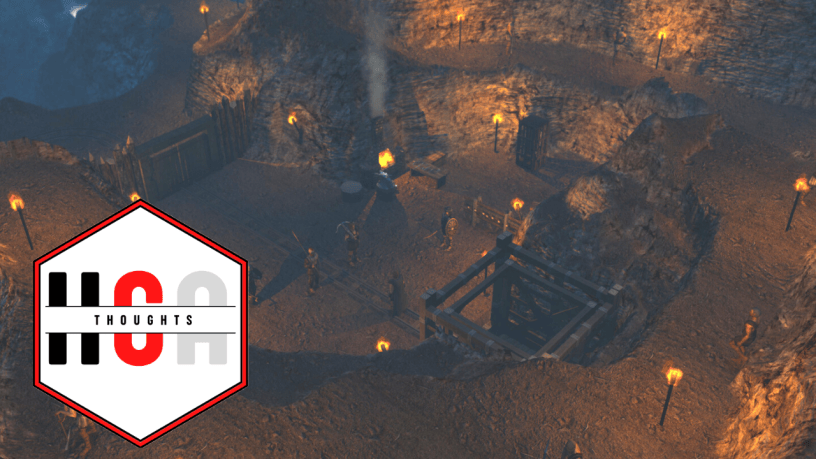
So it is with some consternation that I complain about the game’s immediate follow-up, Dungeons Rats. But it is with gentle understanding that the game is not supposed to be like The Age of Decadence. It is meant to be a combat-heavy game that uses The Age of Decadence‘s brutal combat system and creates a party-based combat system out of it. But I think in creating an emphasis on combat, the game loses itself somehow.
Where The Age of Decadence succeeded with an emphasis on “combat as a last resort”, or as something that was brutal and likely to result in your character’s death, Dungeon Rats, by necessity, puts the combat front and center. It is a game meant to emphasize the combat engine, but the combat engine simply isn’t strong enough (for me) to stand on its own. It was something that felt messy and brutal in The Age of Decadence, but the UI change made it feel coldly utilitarian for some reason – and without a real break from the combat, everything blurs together for me.
Again, maybe this is simply a problem that I have regarding tactics games. I have actually been finding in recent years that isometric cRPG combat (something I used to love) is really quite dull and boring for the most part. I have been trying to play Pathfinder: Wrath of the Righteous and find I just want to do the talking bits rather than the fighting bits (for the most part), because I think what I have discovered is that the appeal for RPGs for me these days is to engage in interesting, human-driven dialogue.
I love combat (and roleplaying!) in a tabletop setting, but there’s something quite sterile about the combat for the most part. A game like Divinity, for instance, is probably the best that we can come to the versatility of tabletop RPG combat on the computer. Creativity is something that is legitimately hard to code into games – options for verisimilitude are tricky to get right. And somehow, I don’t see AI-generated prompts as being able to assist with that. “More options” I think is also besides the point – what I want are ways to combine and use already-existing items in conjunction with one another, or see interesting uses of terrain. And don’t get me wrong – Dungeon Rats does these things. A whole bevy of interesting weapons, a glut of different battle-maps and a variety of enemies. In theory, it does everything right.
Dungeon Rats loses what made AoD so interesting, because in AoD electing to engage in combat was a choice. Either that, or you failed a skill check and the enemies decided your honeyed words weren’t good enough to get you out of a particular jam. There was something fascinating in that game about watching my merchant character fail at a simple persuasion check and be killed at the hands of a bunch of common street thugs. Because it emphasized the danger of the world. RPG worlds these days often emphasize “big choices”, because small, granular choices are too hard to program into the enormous triple-A RPG titles that are being produced today. We want simple choices that lead back into bottlenecks – things that appear to split, but eventually wind up back at the start. Because The Age of Decadence was so deliberately designed, your character was automatically restricted from engaging in certain questlines, and was doomed to failure in certain instances. A mercenary generally can’t smooth talk, for instance – and if she can, that’s because she elected not to train with her trident instead, and that’s why she ends up dead in the second big skirmish of the game, for instance.
I think the difficult thing to accept is that Dungeon Rats is just an uninteresting game for me. But The Age of Decadence remains replayable. Its short length and lack of a party system means that a single playthrough can be singularly engrossing. I am quite tired of having to juggle a dozen different party members’ stats and min/max them to get past certain difficult combat scenarios – something I actually used to enjoy doing, say, in Knights of the Old Republic. I suppose my years-long inability to engage with Dungeon Rats is a result of that long, slow decline of my free time – but it’s more complex than that. I think I am also wrangling with my desire to see games that do more interesting things with dialogue than with combat.
This is all to say that if a tactics-based game set in a post-apocalyptic low-fantasy world sounds interesting, Dungeon Rats is a spectacular choice. But it’s just not for me. However, perhaps I’ll do a couple of playthroughs of The Age of Decadence on stream…
Why Can’t I Play Dungeon Rats?
 Horrorgameanalysis