
I’m not very good at writing about music, but here goes: Theodor Bastard’s 2012 album Oikoumene is a remarkable work of art. I hesitate to simply slot it into a genre; folk music feels terribly reductive, because they incorporate ideas of trip hop and ambient genres, among others, into their music. Also, what is the term “world” or “folk” music even meant to imply? It has the same intrinsic self-other relationship that antagonizes one side while patting the other on the back. “World” is ‘less-advanced’, or something similar – that seemed to me to always be the connotation. That always disturbed me a little, too.
The temptation to again use the words “primal” or “elemental” again filters into my mind, my vocabulary. But Oikoumene should surely defy ideas of Stone Age universalism, some untapped great unconsciousness that we all engage with. Because Oikoumene can mean many things to many people. I listen to quite a few bands or artists whose language I do not speak, because the music itself can still speak to me in some way or another.
Oikoumene travels places, and maybe I do have to say that it taps into at least my unconsciousness. I am fascinated with the wild, even as I know that I would probably be a hopeless survivalist (at least at this current stage of life). Because the wild, again, is part of the self-other binary that defines so much of human discourse. “Wild” implies “uncivilized”, which implies “nonhuman”. And I think that is almost where Oikoumene takes me to. A state of wildness. It is not that the music is unfocused, or bad. It is rather that of the mindset that the music takes me into, using just rhythm and pitch – and just emotion behind spoken words that I can’t understand.
It is an album of introspective adventure, where you travel across the plains of your own mind on some remarkable journey. Along the way, I think Theodor Bastard encourages you to sit and rest with traditional melodies, but the sounds and words always inevitably drive me on. “Takaya Mija” is probably the best-known track from the album because it is the most danceable. It feels like the kind of music that you might put on in a tavern or something similar – it is, for lack of another phrase, hypnotic and seductive. It is, in fact, the music I chose to use when I ran Pathologic Tabletop campaign back in 2018 sometimes in favour of “Andrei Kabak”, the game’s traditional bar theme.
Then of course you reach some of the stranger songs on the album, after being eased into it with “Takaya Mija”. I am sure those of you who speak Russian or understand the intent of the album more implicitly will be able to take me to task for the actual intent and meaning behind the songs, but “Farias” feels downright antagonistic or malicious. A male singer seems almost mocking about something that he seems to have, and the song climbs in the background around him to a kind of fever pitch at the instrumental bridge sections.
Much of the rest of the album, including the title track “Oikoumene” utilizes naturalistic sounds to evoke that much-sought-after wild, the mythic wild that I desire to not just preserve, but expand. The rewilding of urban environments is a fixture in much of my imagination regarding space, as well as a more hopeful expression regarding how we could coexist with nature rather than creating this oppositional, harmful binary. We internalize human-built things and externalise the animal; what Oikoumene does for me is build a bridge between the two worlds, connect them together in my mind. It is a rare joy to lose oneself in an entire album. “Oikoumene” and “Tapachula”, which sit in the center of the album at tracks number six and seven respectively, form in my mind a duology with each other. They are the tracks I used again to transport my players particularly into the mood of not just Pathologic, but certain wild societies in my own tabletop games, or as backing to parts of stories or analyses I write regarding nature or the wild.
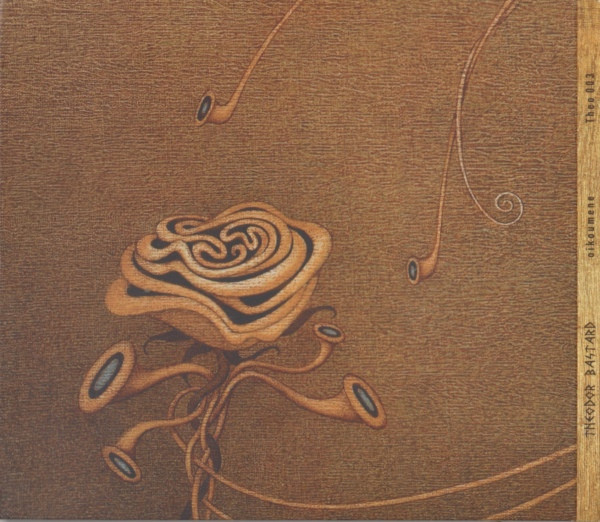
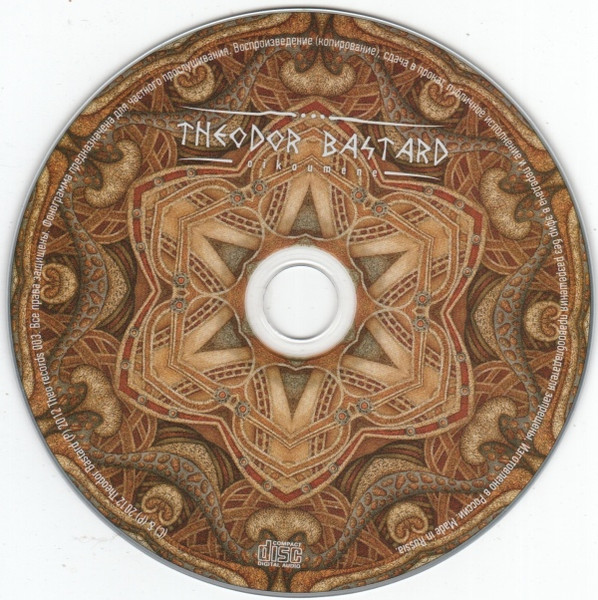
I of course cannot miss mentioning the remarkable art that accompanies the album. It is complex and darkly addictive, the kind of thing that sears on one’s imagination – much like the music on the album, of course. My CD copy is one of my most treasured albums on the shelf, not just for its relative rarity outside of Russia, but because of that art. Even the art on the CD is hypnotic – I somehow wish my CD player was clear just to see it spinning around.
The album actually reminds me of a particular time I spent playing games, not up to very much, kind of just whiling away useless hours, and it was this music that I chose to accompany mindless exploration and grinding in games like Kingdom Come: Deliverance, and it has also been this music that shook me out of dull stretches of my life where I couldn’t summon the energy to write. If this year has taught me anything so far, it is to write. Whatever I choose to write is not necessarily important – but it is the very act of writing that can define and construct me as a person, a mirror of interlocking texts I can hold up to my own face as a comparator, as an internal-vs-external binary, exploding into something fruitful and new. Exploding into re-reading. Every time I re-“read” Oikoumene, I find something new to love. I hope you do too.
 Horrorgameanalysis