
“Many great people think to claim this realm as their own.”
He paused for a moment, looked you over. His eyes were burrowed deep in recesses of his hood, so that all you could see of his face was his skeletal chin, and furrowed lips.
“But you, of course, know that this realm has only one master. Don’t you?”
[[Yes, of course. Lord Ethal’s will is my own.]]
[[I… don’t. Not always.]]
[[Turn to face the window and gaze out at the city below.]]
—
The world of “The Isle of Ethal” is one that is, and always was, intended to be relatively self contained.
Developing a world from scratch is never as easy as it can initially appear. Sometimes you think “I’ll just plonk some elves here, some vampires there, and it’ll all sort itself out.” Sometimes that can definitely be a good way to start. It’s kind of how I start some projects.
The Isle was always more considered than that, at least when it started. I knew I wanted this world to have a beating heart, something that pumped solidly and around which this entire civilization rotated. The City of Thanderon was that city. It was very much inspired by the Imperial City from Oblivion in its role in the tabletop campaign I was devising.
But, as I was conceptualizing this game, I knew I wanted to shift away from Thanderon, despite there being much more detail written out for that than any other location in the game. Perhaps because of that past baggage. I wanted something that felt fresh, some part of this little world I made that I hadn’t explored. So I went north.
The game’s setting is roughly early 1300s equivalent. A relatively classic medieval fantasy setting on the surface – before that particular period was thrown into abject chaos by the Black Death – contains influence from other periods of time as well, as well as cultures beyond just that of Medieval England, as happens to be the main focus of many fantasy works and games.
Moorish culture and fashion is something I am researching for the game a bit, to help make the culture of the Isle of Ethal stand out more from other fantasy works. The game’s architecture, at least at first draft, often appears to me as I visualize it to be slate-gray medieval European buildings. But the inhabitants of the buildings are steeped in the art and fashion of the Moors, for the most part.
There are also the barbarians camped outside the city walls. The barbarians are definitely inspired primarily by the Roman-reported aesthetics of Germanic tribes. I hope that with this unique blend of aesthetics and cultural influences that something new
The Inquisitorial Order – the order to which you, the blank slate of the player character, belong – is the order that defines much of the country’s law enforcement. They are checks and balances, getting rid of criminals that defy the natural order. That natural order, is, of course, centered around Lord Ethal remaining in power indefinitely.
The immortal ruler Ethal spends most of his time situated in Thanderon. Thus, the Inquisitorial Order function as the classic extensions of his will. Magic is not really a part of this world – instead, magic is performed through material things. Alchemists are powerful here, as are enchanters, those who can imbue things with the magical power evident in the air. As an Inquisitor, you have access to one of those magical items. This item will have a definite impact on the gameplay, and will allow you to influence conversations and the events of the game in ways that aren’t just mundane.
—
“What do you think Chaos looks like?”
[[I see Thanderon, punctured from underneath, like a piece of parchment that a knife has stabbed through. From that wound emerges darkness, pouring upwards into the sky, changing it from blue to black. It’s like blood in water.]]
[[A broken chain, lying in a bonfire.]]
[[Nothing.]]
So we have a Medieval world, with the classic immortal ruler trope keeping the world “static”, at least, as static as he can manage it. But the world aesthetically differentiates itself (I hope), and also doesn’t rely on many of the fantasy species and magic (which I do still love to bits). I wanted to create something that, as I think I said last time, is flexible and immersive. The world therefore is rooted in these material ideas. Magic is material. Flesh and blood is fallible – except for that of Lord Ethal, whose flesh and blood has not failed him for centuries.
I have taken great care with what I’ve written so far to have careful descriptions about temperature and texture. Mood comes through in those things more than in overly elaborate descriptions of your surroundings. Of course that too is important, but I want the player to feel the cold of the streets just by reading my descriptions.
The world is separated generally by class (how typical, I know). Nobility are handpicked by Ethal himself, sometimes with family bloodlines chosen generations ago, often for shows of competence or support. But all bloodlines, no matter how glorious in the past, eventually collapse under their own failings.
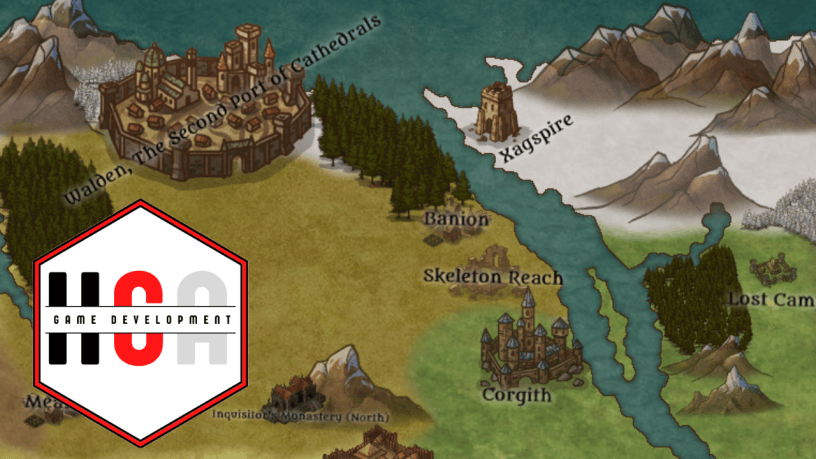
As you might have seen from the banner image, I had a go at reconstructing a map of the north from old notes I had. The map is certainly not perfect, and there are bits to the west and a sliver to the south I had to crop for the sake of the banner, but essentially this is the northeastern part of Ethal’s realm. If I was to expand the world further in future projects, I would likely remain with what you see on that map to some degree. But I’m getting ahead of myself.
The city of Walden has been ruled by one family for generations. It is staunchly religious, affirming the belief in the deity-figure of Ethal throughout all of its citizens. But something has happened, and that foundational belief has been shaken to its very core. With no other Inquisitors available to investigate, it falls to you, a relatively new “graduate” of the Order’s rigorous training program, to deal with the outburst of Chaos that has happened in Walden.
I hope you like what you have heard about the world and the game thus far. Please let me know if you have questions, because those questions will indicate what people might be most interested in about the world, and thus what I should answer within the bounds of the game too.
 Horrorgameanalysis
Really awesome stuff! That second snippet of dialogue is especially impressive – really an evocative description. As far as questions go, the thing that I want to know most about is Lord Ethal himself. Who is he? Where did he come from (at least supposedly)? Is his presence in Walden keenly felt, or is he painfully/mercifully distant? Does Lord Ethal possess the conventional trappings of a good, benevolent king (whether or not that’s true)? If the current religion is centred around him, what did religion look like before him – and are those older beliefs still practiced? How harshly are they suppressed, and indeed just how dystopic is the Isle?
I’m also very interested in Chaos, especially considering the inherent tension between it and the seemingly absolute Law of Lord Ethal (though I suspect to dig too deep into that would be to reveal plot details). Also the mythology, the role of magic, the history of the Isle and what lies beyond it, etc.
I know this is too many questions to reasonably answer all at once, but hopefully it shows that I’m very interested in what you’ve shared so far. Also, don’t think the elements I haven’t mentioned are any less interesting – but this comment could be several paragraphs longer, and if it was you’d likely be wishing it wasn’t! 🙂
LikeLiked by 1 person
Thanks for all this! These are some great ideas for expanding out the world, in ways that, as I alluded to, I don’t necessarily consider (as I take many things for granted about my own worlds).
Ethal has a bit of a narrative behind his rise to power. Essentially his is the story of rising from the very bottom to secure the land – maybe an Oliver Cromwell kind of figure. He’s definitely a stickler for order and an authoritarian. His presence in Walden is keenly felt mainly because of the fanatical loyalty of the ruling class towards him (as he put them in power in the first place). But with recent troubles, people are at the very least grumbling about the fact that Ethal is so far away – but perhaps saying, and doing, worse.
Religion is sort of divided between the barbarian religions and the religion of Ethal. There are cults for those barbarian gods that still exist within cities, but they are definitely undercurrents compared to the visible power of Lord Ethal. There’ll be more to come on religion I think in the game, but I haven’t explored it enough conceptually to say anything more interesting!
Besides the looming threat of Chaos and monsters, Ethal is pretty happy to keep things turning as a regular medieval feudal society. Dystopic in a sense, but still livable – at least for those who agree to kowtow to the rules.
Thanks as always for your interest. More to come later 🙂
LikeLiked by 1 person
This really has me excited to learn more! I really liked how imaginative the writing you used was, and the way this article manages to paint a picture that rivals the provided picture itself. In other words, I can’t imagine that your relative inexperience with visual art (this part is a reply to your last article on the subject) would be a problem; your writing is more than skilled enough to leave me confident that I’m seeing the same mental image of this world that you are.
Also, I was wondering about what Lord Ethal’s (blessed be His name) government looks like. To be more specific, I was curious about how powerful his government is, and, by extension, how developed the state’s bureaucracy is. I know that this is the most boring possible question someone could’ve asked, but is His government relatively centralized compared to real-life historical examples of the time?
The reason I ask is that most historical states of the time would’ve had direct control over only a very small portion of their country and would’ve needed to delegate the right to rule the rest of the realm onto their elites. Of course, the specifics of such an arrangement varied greatly, and there were exceptions to this such as China and Korea which boasted extremely powerful and well-developed bureaucracies compared to most of the rest of the world, which is what Lord Ethal’s (blessed be His name) government reminds me of, from the sound of it.
At the same time, the way you describe the Inquisitional Order makes me wonder if it’s a situation similar to Europe, where the Catholic Church could be considered a near-untouchable powerhouse by virtue of owning extensive holdings across every Catholic country and having rights such as exemption from taxation and the ability to collect taxes from Catholic populations directly, without interference from the crown. If this were the case, maybe the nobles hold little actual power compared to the Order, and Lord Ethal (blessed be His name) would consider the Order to be his biggest competitors as far as power goes? Then again, the fact that this religion is centered around Lord Ethal (blessed be His name) could mean that the local religious authorities truly wish to serve Him, and use their power to assist His divine rule wherever possible?
Sorry if this looks rambly, there’s just so many possibilities here and I’m pretty excited to learn about the history here. After all, someone needs to find out enough lore to write all those wiki pages!
LikeLiked by 2 people