
Defending a maligned, misunderstood monster.
The following contains spoilers for Silent Hill 2 (2001) and Silent Hill: Downpour (2013).
It’s hard to remember exactly when, or how, I fell in love with Silent Hill. But it was described wonderfully by some random internet commenter, somewhere, when they described it as being “a place you can put your sadness in, for a little while”. A way to lighten the load, as it were.
Silent Hill: Downpour, the eight main installment in the series, is, I think, a misunderstood game. Not that it’s “underrated” or anything – it’s a perfectly serviceable game. Over-hated but not under-loved, if that makes sense. But there’s a lot about it that shines, even despite the fact that it was the first mainline Silent Hill that did not have Akira Yamaoka attached as composer. Korn, somewhat infamously, filled the void. But Downpour is able to also conjure moments of the sublime, and moments of awe. Being pursued down Escherian corridors and staircases by the absence, by a black hole that warps reality and pulls at Murphy’s flesh and encourages his terrified, pained screams, is much more effective than anyone really ever gave it credit for. Sometimes Downpour is even beautiful, just like the earlier titles in the series.
The town of Downpour is the only really open-world Silent Hill. It begins to grate if you are going for one-hundred percent completion. The town is made to be luxuriated in, certainly, but not to be picked over, certainly not to be completed. To define all of its mysteries, resolve all of its stories, feels almost criminal. Which is why my position as an analyst and as a habitual completionist often defeats the purpose of the horror I love so much. But sometimes you come across a concept or an aspect of a horror work that means a lot to you yourself, something you can imprint on personally – and when that happens, it never really becomes explainable. Or at least, the well never dries up. I always return to the fear that made me realize just how vulnerable I truly am – and it’s that vulnerability that I cherish.
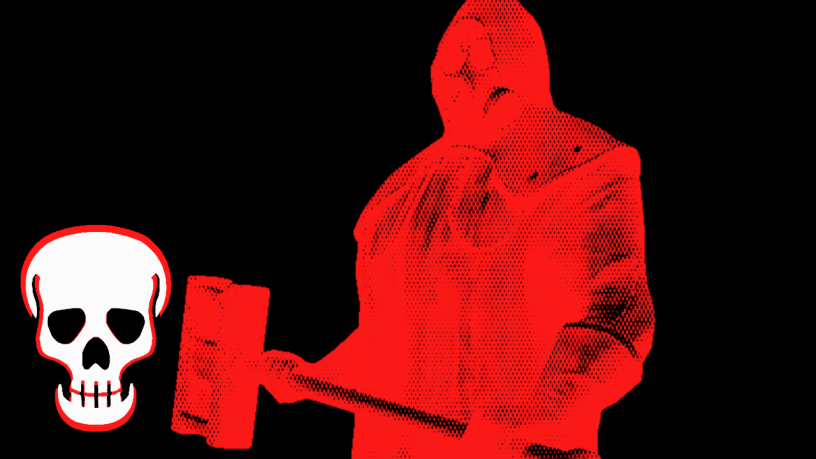
The Bogeyman is one of my favourite aspects of Downpour.
Monsters are funny things, because they mean different things to different people. Sometimes, they can even mean different things to one person. Humans are strange, like that. We are capable of holding more than one view at a time, and those views are frequently contradictory and even flippant towards one another.
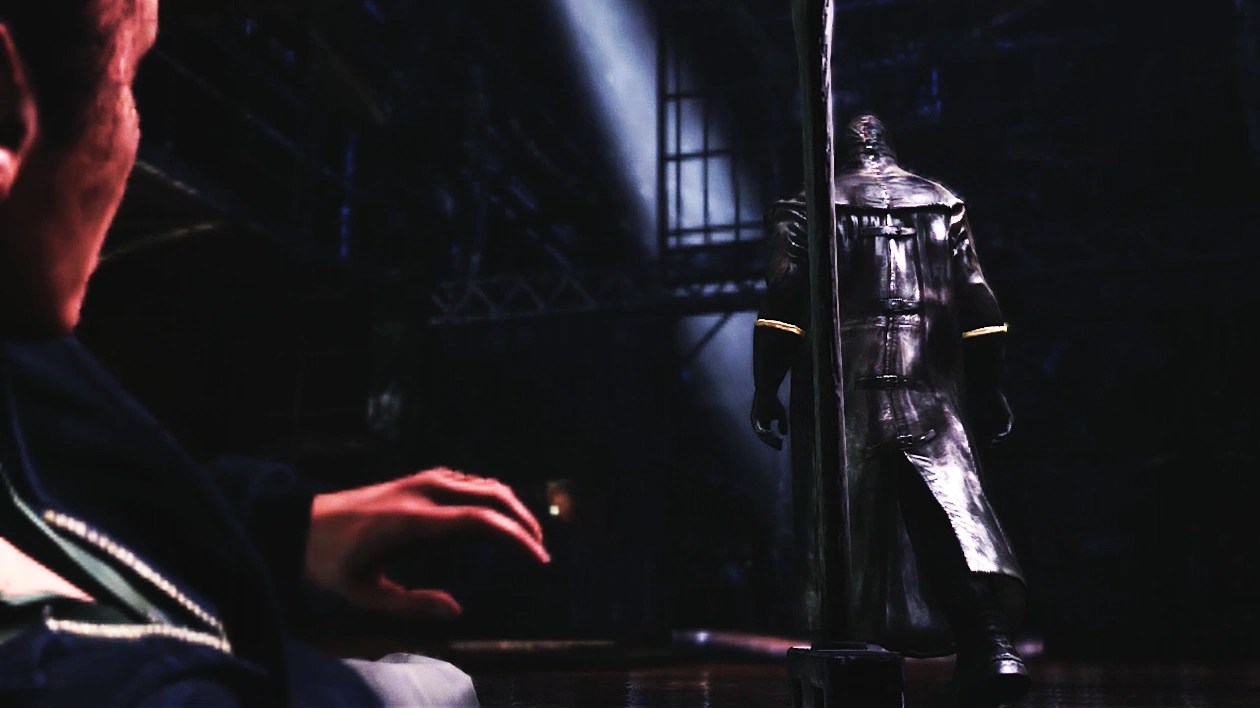
I love Pyramid Head. Who doesn’t? Konami certainly does. So does seemingly everyone else. He is iconic, menacing, and symbolically meaningful. Reflecting on James’ journey, Pyramid Head is evidently masculine and phallic – he wields both a great sword and a thrusting spear. He is present at so many iconic and memorable points of Silent Hill 2.
But Masahiro Ito, his creator, is sick of him. That’s fine. Who wouldn’t be sick of answering questions on Twitter about a monster you designed over twenty years ago?
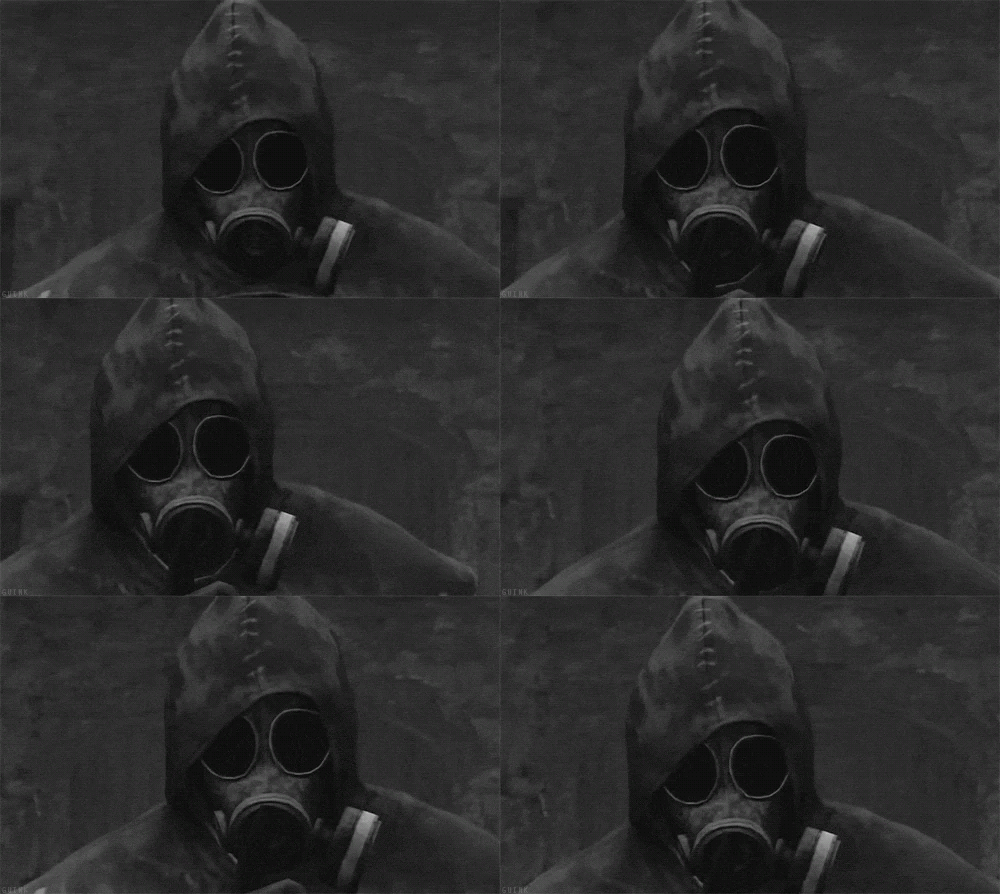
The Bogeyman, at first glance, is just another Pyramid Head wannabe, much like Origins’ Butcher, or Homecoming’s insistence that this is a slightly different monster, also called “The Bogeyman”. And yes, on the surface level, Downpour’s Bogeyman is another large male character with no discernable face and a large weapon – in this case, a sledgehammer, rather than a large blade.
I was never a fan of Pyramid Head appearing beyond James’ story. It’s not to say you can’t do it – if you want to tell a story with Pyramid Head in it, go for it. But you have to understand why you’re doing it. Pyramid Head appears to James for a reason. He’s a regular looking guy, despite the horrible deformity spawning out the back of his head. Pyramid Head is not particularly muscular, and he is relatively slow-moving. He’s iconic because of what he represents to James, because beneath that helmet, James could just as easily fit.
So when the movie scaled him up to be a six-foot killing machine with killer abs that rips a woman’s skin off of her body with about as much effort as you would use to swat a fly, I was frankly disappointed when future games followed that trend. Making monsters bigger and more intimidating often misses the reason the monster might have been scary in the first place. Innocuous monsters are often more frightening. At least monsters that function as subversions – surely the whole point of monsters in the first place. I much prefer monsters that keep me up at night because of the idea that something I hold to be a truth of the universe might not be true at all. The act of questioning oneself and one’s place in the universe, I have discovered, is far more valuable than insular thinking. Monsters should be a way to explore ideas that you find unsavoury, but still in some way potentially compelling – causing you to reflect on yourself. Pyramid Head did that in 2. He did not do that elsewhere.
The Bogeyman is cleverly utilized within the context of Downpour’s story because he represents a kind of fresh start to Silent Hill’s Pyramid Head problem. Murphy Pendleton, an oddly compelling protagonist (especially after the disaster that was Travis Grady in 2007), sees the Bogeyman as representative of his own failures, but also the monster that began his whole journey, the child molester who killed his son.
The previous games have cued us, mostly, to believe that each monster appears unique to each individual who wanders into Silent Hill. Sure, James sees Angela’s Abstract Daddy monster, but in a way totally different to how Angela would see it. But the Bogeyman also belongs to Anne Cunningham, a prison guard who loathes Murphy. The final boss segment where you play from the Bogeyman’s perspective and stalk Cunningham is fiendishly clever, showing that while Murphy has begun to let go of his hatred and understand where that hatred had taken him, Cunningham has not.
The Bogeyman, this indomitable force, is teased throughout the game – showing up in several Otherworld sections just as a background monster – threatening but not interested in killing you just yet – until the monastery orphanage section. Unlike Pyramid Head, the Bogeyman essentially gets an entire dungeon all to himself, with a children’s nursery rhyme the player must assemble in order to let a kid unlock the door for them. The rhyme is actually cleverly put together.
Poor little Steven Skelter
Even the chaplain won’t forgive you.
Forever lies, your pleading cries
But Suzy knows you felt her.
Nowhere left for you to run,
Every fault laid bare in the open.
Along with your skin, splayed out from within,
Once the monster has his fun.
Take heed, it’s not too late,
Mistakes needn’t haunt you forever.
Though you have regret, you can’t just forget,
You alone decide your fate.
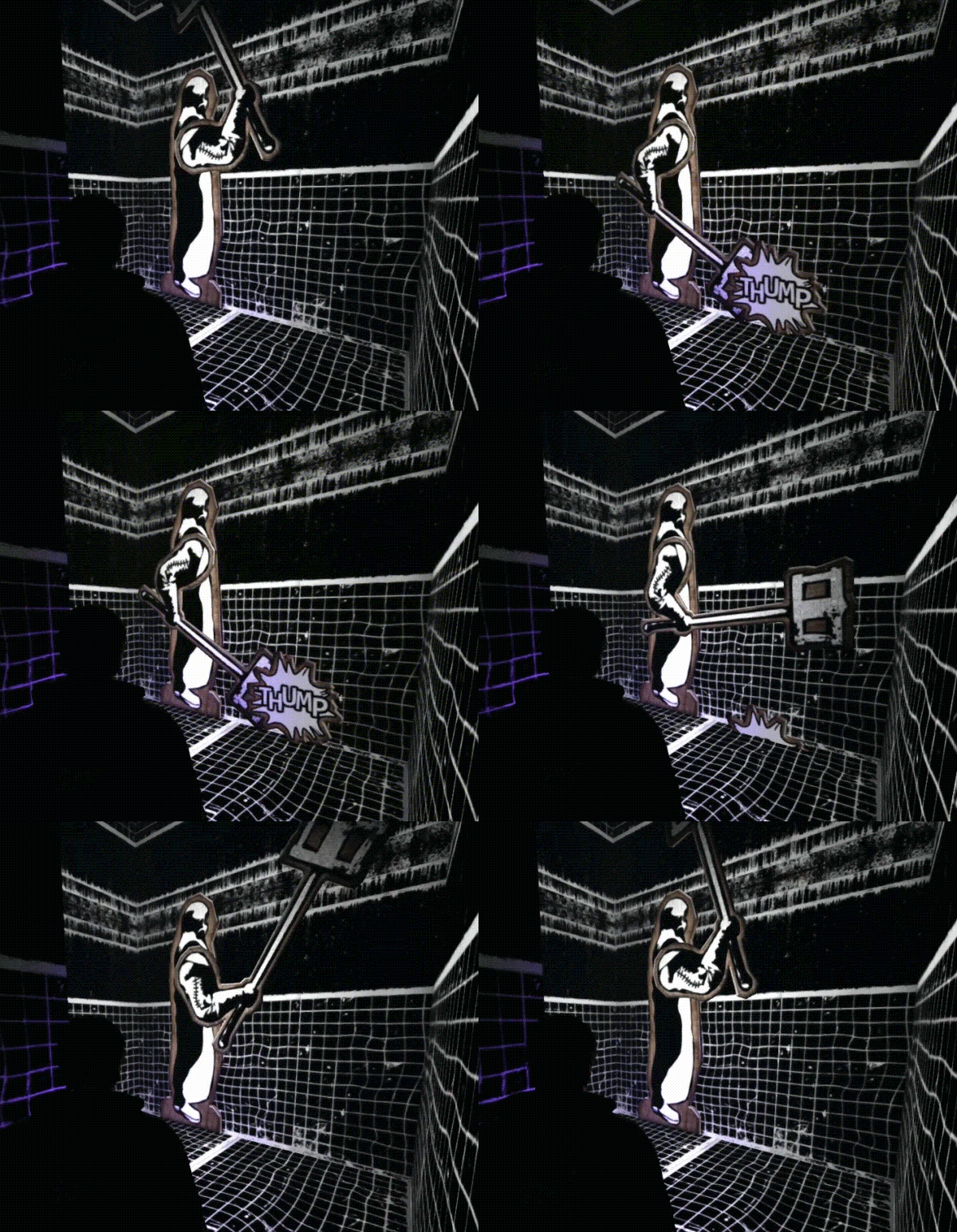
While the entire poem is relevant to Murphy’s story, the last four lines speak to Silent Hill as a whole. It is, at this point, a series fixated on recreating past glories. Silent Hill 2 is like this inescapable vortex, something from which the franchise has never been able to escape. Silent Hill 3 and The Room were valiant attempts, but no-one forgot James’ story. Nor should they – but it was clear by Homecoming that the series had to move on. At one point the Bogeyman himself is transformed into a cartoon cutout, emphasizing the monster’s thin veneer of humanity. He’s there for the satisfaction of those seeing him, more than anything. He’s a carnival ride, if the carnival ride was all about blind hatred.
In some way, The Bogeyman is the perfect step forward for a series that was struggling with recycled monster ideas. Yes, he’s a big guy with a gas mask, a raincoat, and a big hammer – but that’s the point. Certain games in the series subtly change the look and feel of certain monsters, but in ways that just make it frustrating. Apparently Silent Hill is out of ways to torture the human psyche. Nurses are all we got, certain entries in the series seem to say. Nurses and those straightjacket guys, the Lying Figures. It’s not like either of them were also enmeshed with James’ twisted psyche.
The Bogeyman, much like Pyramid Head, dredges up the mistakes, regrets, and failures that haunt the protagonist. A harrowing scene involves watching the Bogeyman kill a child and hold him up to the camera to taunt both the player and Murphy. But it is only when the Bogeyman is killed that Murphy can begin to appreciate the toll endless regret takes on a person. While reflection is important, and understanding oneself even more so, demonizing oneself, and others, is a terrible attitude. The Bogeyman represents anonymized hatred. We don’t even see the person beneath the mask anymore, we just see a monster we constructed for ourselves, a kind of fetishized loathing.
The Bogeyman is representative of our regurgitated popular culture, a kind of faceless monolith that we can put all of our feelings onto. A way to lighten the load, to see what we want to see, to always be stuck looking out for a big monster with a big weapon. But if there’s any lesson that Downpour wanted to impart, it’s that we need to stop looking for the self-affirming, the faceless, and the certainty created by our own biases. We instead need to see the monsters in our own lives – the monsters we create and attach ourselves to – as things that can teach us about ourselves, and cause growth. We put ourselves in Silent Hill, to lighten the load, and then get frustrated with newer entries in the series when they don’t respond the way we think they should. Much like the discourse around comic book characters, Silent Hill seems to have attracted frustration with the way characters and themes are presented.
Silent Hill is about this, or that, or something else altogether. People take sides. People insist on definitions. But people define the series by 2, most of the time, and that hurts. We put our sadness in Silent Hill and get frustrated when it doesn’t work the way we want it to. When nostalgia doesn’t take precedence over trying new ideas, and pulling away from old things – including monsters – people get angry. People take it personally.
The boss battle against the Bogeyman, on a small, foggy shoreline, led there by Murphy’s son’s cries for help, could almost act as a kind of anticlimax. The game could have ended there, Murphy haunted by his failures, but understanding of where he needs to go now. But the game continues and shows us the true cost of Murphy’s failures by letting us see the impact it has on someone other than himself.
Silent Hill continues. But, surprisingly, it needs to learn from Downpour more than any other title in the series. Like so many other entries in the franchise, Downpour is a case of what-ifs. What if the series hadn’t died for a time with Downpour? What if there were actual lessons to be learned from a game that was trying so hard to forget the monsters that came before?
Given that the Silent Hill 2 remake trailer ends with a dramatic shot of Pyramid Head, and he’s been printed on who knows how many t-shirts… chances are, we will never know.
 Horrorgameanalysis