
A flurried frenzy of movement.
I am a thief in the night, moving across paved stones and poorly tiled rooftops alike, feeling the heat of lasers a hair’s breadth from my nose as I somersault through the defenses of the world’s most fiendish criminals.
Ghosts hurtle themselves at me with aplomb and I respond with a hearty whack from my cane. I am five years old, experiencing the world through new eyes.
Sly Raccoon was a game that gave me something I didn’t quite appreciate at the time. Reflecting on it, I think what I saw in it was hope. That we didn’t have to be defined by what we were once. And I didn’t need that message then, but at a certain point, I needed it very much. I needed to know that we weren’t created by our mistakes, or defined by what others have taught us.
“The Thievius Raccoonus doesn’t create great thieves. It takes great thieves to create the Thievius Raccoonus.”
Clockwerk looms throughout the whole game. As you traverse the globe and take out villains framed as though they are from Saturday morning cartoons, you begin to notice something. Silhouettes lurking just in frame in cutscenes, at occasional moments. The game begins to give way to something else. Not truly horrifying, no – it’s not one of those games that tries to be kiddy and then peels back the frame to reveal something gory or awful – but something that changes what you thought you knew about the world. And I love that.
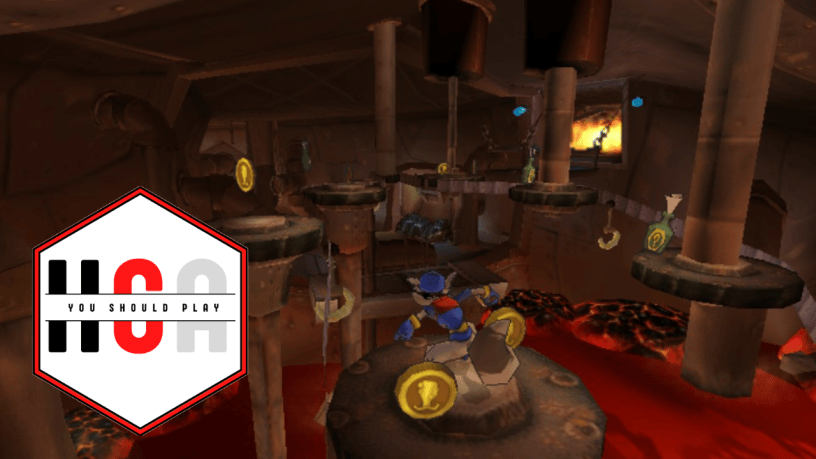
Clambering on boats that rest beneath flying storm engines the shape of blimps. Traversing the flooded casino staffed by dogs, in a city abandoned to a criminal empire in Utah. The depths of the Haitian jungle, corrupted by Hollywood-Voodoo, while a giant sculpture the shape of a maned crocodile skull looms above you. The snowy mountains in China nursing an illegal fireworks factory, run by a homicidal pyromaniac panda bear. These things are all very tongue-in-cheek. So at first it’s hard to see the difference between these earlier levels, and between the Russian volcano, lava bubbling away, while an enormous death ray the shape of an owl’s head fires beams down at you.
But the difference is in the final boss, where everything comes together. Clockwerk the immortal. He gives a villainous speech for the ages, and everything climaxes in a dogfight that gets the heart pounding passionately every time.
But despite how good Clockwerk is, I’m actually not sure whether he’ll be the last memory I have of this game, when I’m old. No, I think I’ll have other, smaller memories that feel more intrinsic to me, somehow. Everyone experiences Clockwerk. Not everyone stays and lingers in a place.
Fleeing from searchlights, I leap onto a spire and pirouette deftly, landing as though I had always been able to do this. All it takes is a little practice. It’s intuitive. Smashing the alarm off, I wait around for a minute, looking out at the vista.
I take the disc out of my PlayStation 2 and think for a moment. It’s going back to the video store today. But I can still hang out in the Kun-Lun mountains in China for a while longer yet.
I remember feeling weirdly, oddly sad when I wander the grounds underneath the storm machine. The water droplets are a defined part of the music, and I choose to rest beneath them, letting the cool air and numbing water accompany my heist.
Sly stands the test of time for a number of reasons. It is, certainly, not the most refined Sly game. Later games would change the formula, most would say for the better. Later games cut out excess minigames, and made the story feel even more cohesive. They got rid of the lives / lucky horseshoe system for a health bar and checkpoints, and made everyone in Sly’s gang actually playable. Sly 2: Band of Thieves and Sly 3: Honor Among Thieves are both fantastic games.
But later games would also not have the pure simplicity of a game from this particular era. Sly may still have been looking for his niche, so the developers at Sucker Punch naturally decided to engage with similar 3D platformer ideas at the time. The first game has hub-based level systems, with a bunch of collectibles and somewhat silly, gamey framing. But it also has character.
Smack a vault with your cane, and Sly will bounce back dramatically, his whole body juddering. Carmelita leaps through the air with an absurd level of enthusiasm, somersaulting around just like you do in an effort to catch Sly. Sly sticks his cane in his mouth when climbing up ropes. Everything about the game is cozy to me. I once used the China music to accompany a school slideshow, a long, long time ago now. I don’t know if a single person in that room had ever played Sly before, probably not, but the game’s masterful soundtrack by Ashif Hakik was enough to transport them somewhere else.
The game is a classic heist film in kid format, but also with enough wit, charm, and atmosphere left over for adults to have fun with too. Sure, there’s the occasional frustrating level, but it balances out when you hit one of the fantastically designed platforming/stealth levels.
I’m really very tired as of writing this. I’m definitely suffering from some burnout, but there’s still another few waves to ride, a few more hills to crest. I’m not sure how often I’ll be around in August this year, but to anyone who is reading this, I’m grateful for the time you spent here, reminiscing or discovering something new, or anything in between.
Sly Raccoon is one of the most important games I’ve ever played. It sparked my imagination in ways I could not even predict. I learned to overcome my fear of enormous crocodile skulls, and strangely haunting ambient tracks, making them comforting rather than confronting. It made me aware of horror and the effect it can have on people – as well as how rewarding it can be to get better.
I hope that I do it justice, as with every game I love very dearly.
You Should Play: Sly Raccoon
 Horrorgameanalysis