
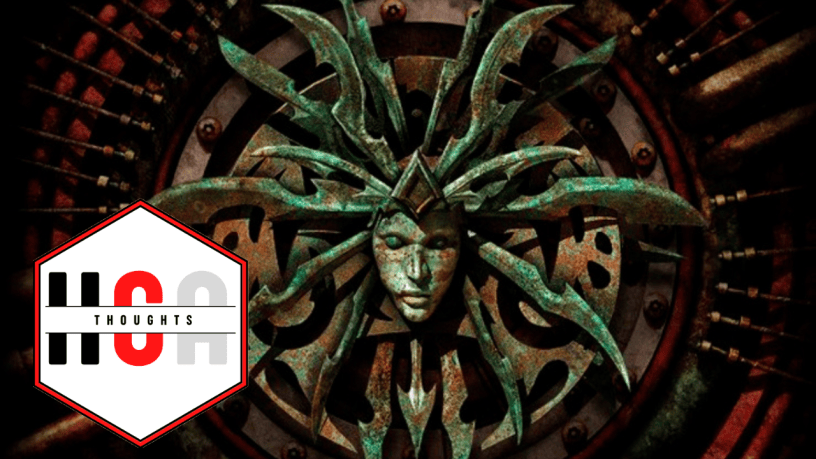
The 1999 computer roleplaying game (or cRPG, for short) Planescape: Torment is really very good. This should be of great surprise to approximately nobody, given that it is a routinely lauded game. I’ve played about eight hours of it so far, having bounced off of it many years prior, and I have loved almost all of it. It is one of those games where I am left wondering how I could have neglected it for so many years.
Planescape is a substantial milestone in video game writing, taking a setting already rife with philosophical themes and dredging up as much as it could in addition. It is, so far, a thoughtful, considered story, with characters who are so well-considered it is hard not to wish there was more. I love getting lost in dialogue trees, in wondering about just how much there is to this digital person in front of me. But there’s already so much, it feels greedy to want even more. The sheer quantity of well-written, expressive dialogue is remarkable. Every NPC has at least their own generic “faction” dialogue tree. But then there’s this guy wandering around the northwest area of town. Called some flavour of “Frightened Townsperson”, and just doing the same aimless meandering that is a restriction of the Infinity Engine. But I spoke to him twice, and on that second time, he remembered me. “Eh? What is it this time?”, he asked, eyebrow raised, concern flitting over his features. And that’s all it takes for the magic to happen. The game remembers I did this, I think, and it wasn’t even anything all that important. The fact the game has talking to this one nameless NPC as a tracked boolean (true/false) variable somehow means the world to me.
Responsiveness in an RPG is one of the common yardsticks that is used to determine whether the RPG in question is one of the good ones. A person’s desired responsiveness from their video game is totally subjective. Some people are fine with the game’s cutscenes not being prerendered, for instance, so the character is wearing the clothes or using the weapon that you gave them during gameplay. It might be a small thing, but it’s easy to remember. Ratchet & Clank: A Crack in Time did this particularly prominently in my memory in a few specific moments, which made other pre-rendered cutscenes in the game stand out even further.
RPGs are funny beasts in that they tend to go one of two ways with expressions of responsiveness. Either someone tells you something in dialogue, such as an expression of approval or disapproval for an action a player took during gameplay, or someone often shows up to fight you because of an action you did. You killed x’s friend, so x shows up later to show you what for. The former seems to be the emphasis of Planescape, at least so far – certainly there have been many opportunities where my actions have created tangible conflict within the world, but not necessarily ones that direct me towards violence.
The reactivity of the world does not feel limited because of the lack of violence. It’s certainly a good thing the game isn’t too violent, not too demanding of a player’s mastery over AD&D rules. Second edition D&D can be a fraught system, particularly when the game moves at a remarkable speed and doesn’t really take any time to contextualize the system itself. Which I’ve always found is a problem in games from this era – they rarely explain the relatively obtuse systems that are actually at work behind the game. Obviously they have a step-up on quality of life from even earlier RPGs, which are, for the most part, arcane beings themselves, but there’s still something to be desired. Even speaking as someone well-versed in any number of different tabletop roleplaying systems, I have found that with many RPGs (and not just from this era), the character creation screen being frontloaded onto the player is terribly intimidating. Even though I know what STR is, what CON does, and why WIS is important, I still don’t know, by and large, what kind of game the developers have made for me. Is it going to be combat heavy? Or a fraught social game, wherein every extra point of CHA counts? Planescape seems to be a game where social stats are preferred. They certainly allow easier (read: better) ways out of certain quests, where you don’t have to wrangle with watching the flailing plasticine characters act out stage-fights, where no-one actually seems to hit anything in a blur of effects and pixelated blobs. Where death is cheap and luck can spell your end. While this is fantastic fun around the table, where a GM can accept ingenious solutions to problems, or can even pull punches (something I’m not fond of doing, but it has happened a few times before for dramatic effect), death being so easily obtainable in an RPG like this can spell problems for later.
Planescape’s main advantage over other Infinity Engine RPGs, particularly the original Baldur’s Gate, is provided by its compelling narrative framework. The fact that your main character can return to life at full health for no cost and can easily obtain a freely rechargeable resurrect power for your party members, cuts out the horrible feeling that comes when you die in Baldur’s Gate, and you get a game over screen, before hoping you saved properly. Planescape’s method is far more agreeable, meaning trying a fight is a much neater process than hoping you saved sooner. I’m absolutely rubbish at quicksaving in games, and I also often can’t trust the autosave system (if the game even has one), so I often make very deliberate manual saves before going into dungeons or boss fights. In Planescape, my methodology actually works, which makes me feel much better inclined to the combat than I otherwise would be.
It’s really difficult to actually get tabletop combat feeling as though it naturally translates to the video game realm, because tabletop combat is abstracted out a bit for simplicity, at least in most cases. Some RPGs have a lot of tables and charts, and seem to have less and less of them these days in more modern tabletop games, but what video games have is the crunchy mathematical power of a computer on their side. Demanding that a video game follow the rules of a tabletop game can sometimes feel a bit counterintuitive.
In the case of conversation, I think Planescape utilizes D&D’s check system to the maximum extent possible, while also making everything feel natural. At one point I got a bit stuck as to what I was supposed to do, as I’d unfortunately run into a bit of a glitch where a small side quest wasn’t resolving itself. Along the way of figuring out what to do next, I discovered that if I’d had a few more points of charisma, new dialogue options would have opened up. But during gameplay, I hadn’t known such an option was there, since my character wasn’t charismatic enough to resolve the problem that way.
In dialogue options like that, there can sometimes be a bit of a tension between what the character knows and what the player knows. Ideally, I think, RPGs should allow for players to see those options, but also fail them: I believe this is Fallout’s method. The disconnect comes when I don’t know I can fail those options but still click on them. This also isn’t necessarily a problem, and can be welcome because they prompt a player to choose options that might lead to a more rewarding (narratively or otherwise) “fail state”. One of my favourite cRPGs, The Age of Decadence, does this. The potential pitfall for The Age of Decadence was the game’s ritual adherence to the skill checks some things required. Some characters end up unable to finish their main questlines because they aren’t specced enough, didn’t find the extra skill points when they needed them. While I love the world and system behind The Age of Decadence, and I found it rewarding when a new character managed to beat a problem their predecessor did not, I understand many players disliked that system very strongly. That’s a viewpoint I can respect, if not quite agree with. Planescape chooses to dodge this problem of tension between player/character knowledge by not having the dialogue choices be visible. This is also something I can respect, as if I hadn’t needed a guide to avoid my own personal problem where something broke, I would have been perfectly satisfied knowing I picked the “best” option for me at the time.
One of my favourite things about cRPGs is the really simple dialogue option that goes like this:
“No, I don’t believe it… you’re alive! How is this possible? Have you come back to help me? Have you remembered your vow?”
Truth: No, I’m sorry. I don’t remember you. I can’t help you.
Lie: No, I’m sorry. I don’t remember you. I can’t help you.
This is a pretty generic example that I just made up off the top of my head, but the power of the prefixed word: truth or lie… that is power in roleplaying. Sometimes that is all I need to fire off some set of neurons in my brain and a pathway is traversed. I imagine what this person might mean to me if I say that I truly don’t remember them, or how our relationship might change if I lie to them about not remembering them. Intent is such a large part of roleplaying – how we speak is just as important as the words we say. It’s so trite, but so true. Just being able to modify my character’s intent is powerful, even if it has no bearing on the conversation, or on what I can do later. I am slowly realizing that even if I produce, say, three to four individually-made games over my entire life, one of them must certainly be a cRPG. I have spent more than enough time working on tabletop RPGs, and definitely more than enough time poring over games like this, adoring every small flourish, that it would be fantastic to give back to it. I recently bounced off Wasteland 3 because it seemed to prioritize combat. What was supposed to be an action-packed start felt slow and weightless because I didn’t have any established stakes for what I was seeing. While Planescape has a slow opening, it is a slow opening that establishes quickly the character-driven stakes of the game. It is best to start with characters, then zoom out to the world. If there’s one thing I’ve learned from RPGs, it’s that stories are much more interesting when they let the people shine, rather than the lore that so many people believe powers the world. Lore is powerful, lore is wonderful, but it should not trump story, nor character.
Planescape, so far, is a rewarding journey into a fantastic setting, which compels with the power of its dialogue. It is a world deep and rich in imagination, with already moments of profound melancholy and enlightening hope sprinkled throughout. I hope the game continues to live up to its reputation, because I have found it a wonderful narrative experience so far!
 Horrorgameanalysis
Great thoughts, well put. I’m very happy to hear you’re enjoying Planescape. It’s one of those games that feels ever at risk of being bogged down by its more cumbersome elements (looking at you, AD&D rules) but, like you say, the sheer brilliance of so much of its writing always shines through. And yet I’d never claim it would be better as just a book: somewhere in that jumble of armour class and experience points – maybe not entirely separable from those things – there’s the pure CRPG magic that makes it all click.
I especially like your note on character intent. If I remember correctly there are several more great instances later on, but even though it’s not a CRPG, Kentucky Route Zero might just be the game that does it best. There are plenty of times the game pays careful attention to the decisions you make, but equally impactful are all the little choices, those that have no effect on the game itself but rather on the player, and their perception of the character. Like whether it was your mother or your father who wouldn’t let you watch TV, or the things you say alone at night to your dog. It’s something I hadn’t quite found the right word for before now, so thank you!
LikeLiked by 1 person
That’s the important distinction, isn’t it – it has to be a game, rather than a book. Something about the choices you make along the way are more important than being given a prescribed narrative without any play elements. It’s within play that we seem to unlock the story’s true potential.
And I really need to play Kentucky Route Zero! Intent is so cool though – I really feel it is an underutilized part of some RPGs. I always love the little spins and twists it puts on my character in my mind, even if it amounts to very little in mechanical terms.
LikeLiked by 1 person