
Content Warning: This has discussion about the nature of video game violence and how it is enacted. It refers to recent real-world events that may be upsetting for some readers. Please read with discretion and stay safe.
Spoiler Warning: Contains spoilers for Silent Hill 2 & 3, Spec Ops: The Line, Resident Evil 7, and Call of Duty: Modern Warfare.
You might be the same, but it’s hard to describe exactly just how frustrated – how exhausted – the ads for the newest Call of Duty game have made me. We live in a world where we are witnessing ever-more horrifying acts of violence and atrocity committed (or ignored) by a variety of states that are supposed to uphold the rule of law. We also live in a world where witnessing those acts of violence is easier than ever before. Some of the coverage of some of these wars can be frustratingly vague or one-sided, deliberately obfuscating facts in order to make one side seem better than the other. But regardless of how or where you get your news, the fact that children are being massacred by the thousands is disturbing.
Civilians – other human beings – are being dragged into wars fought with high-tech missiles, some of which have been shooting blades into hospitals, severing limbs and causing horrific fatalities and injuries. People have been slaughtered and taken hostage. Land mines sown in fields, and children ripped away from parents. Following coverage of the various wars around the world is exhausting and depressing. Yet in the comfortable position I am in, how can I at least not look? A few dollars, where I could spare it, have been going to refugee charities to support people displaced by war, or those who have gone hungry. I wish I could say I have been able to do more. But it is never enough. All we can do is try our best. At the very least, we owe it to those people – other human beings – not to look away from the injustice of their tragedy.
This brings me, somewhat mundanely, onto Modern Warfare III and the subject of video game violence – violence representative of the violence that we see and experience in news media, or in real life. I have not played a Call of Duty game since Ghosts. The only one I was ever properly into was the original Modern Warfare III, and that was because it had a great split-screen coop mode where me and my friends could defend ourselves against waves of bots. Ghosts was rubbish and convinced me satisfactorily never to touch another Call of Duty game again, though occasionally a friend drew me in for a Zombies match or something here and there.
Call of Duty is a franchise lorded over by Activision – and soon to be Microsoft. Neither company is exactly sparkling in reputation. Activision forced this newest Call of Duty game out in a reported eighteen months, causing developers to have to work nights and weekends. An appalling practice, to be sure. The game is also now being thoroughly advertised across the internet, and I find the way it presents itself really troubling. Not that I’m surprised that a Call of Duty game is acting as military propaganda, or at least as a thing that softens the idea of the military, but still.
I can’t say I was ever one of those people that thought war was cool, but I do remember thinking as a child that at least war was supposed to be honourable. I know now that war is the furthest thing from honourable that there can be, that war is abhorrent and incomprehensibly destructive; but I thought that when I was very young. Stories about war that I experienced growing up were, now that I think about it, mediated by superheroes. By people who fought one-on-one, whose disputes were resolved in climactic, obviously cool-looking battles. World War II was a clear-cut war; Age of Empires was a game where battles were fought, for the most part, on level playing fields. You had access to the same stables of resources – from there, you could put up one hell of a fight. Yet these kinds of things have started to make me feel less and less comfortable, as silly as it may sound. What does our pursuit of realism mean?
Violence in games, for me anyway, needs to be sufficiently distanced from the actual feeling of violence (like cartoon violence, such as in Ratchet & Clank), or the game needs to do something with the fact that the game in question is presenting realistic violence. Horror games often do – though games like Outlast tend to be the exception. Outlast presents violence against people of all kinds, one could say universalizing it, but presenting it in such a generically violent and cynical way that I end up feeling dirty after I play it. Dirty in a bad way, too. The violence there is for shock value. In those games, the violence is the destination.
Violence against monsters, too, is easier to stomach than watching a knight chase down a group of fleeing civilians in a strategy game and watching them be cut down with a variety of cries and screams. It’s easier to shoot a large enemy with enormous tentacle arms than another human being. That’s why in Silent Hill 3, Vincent’s “they looked like monsters to you?” still maintains a sense of power over the audience that heard it. People are fascinated by that implication – by the implication that it’s not just the protagonist Heather who enjoys the violence, but us, the players, the people behind the game, that enjoy the violence. We’re the ones who are fascinated by enacting pain and hurt, by doling out death and destruction, by stomping on enemies and leaving bloody footprints behind as we walk away, looking for our next fix. We might not be thinking this as we play, but that moment forces us to reconcile our actions with our feeling of pleasure. We are enjoying playing this game – but why? Why do I enjoy killing monsters with a handgun when I feel dissatisfaction from doing the same in a military shooter? Is there a difference?
Games have no necessary obligation to be moral vehicles, and we also don’t need to treat them like simulators that will teach us how to act and how to respond to things at all times. We also need to acknowledge that games don’t turn people into killers. I’ve played lots of Just Cause 2 and I didn’t end up as a gun-wielding, parachute-using grapple-hook maniac. But what games are capable of – just like all visual media – is desensitizing us to the act of violence. And what video games can do that other media can’t is that it can put us in the shoes of the person delivering the violence.
People remember the white phosphorus sequence from Spec Ops: The Line because it is the visceral result of a player’s button inputs. While there’s no choice to avoid the sequence (beyond putting the game down, which calls into question completionism and our desire to “finish” things yet again), it still makes us think. The scene makes us question how complicit we are in other acts of video game violence.
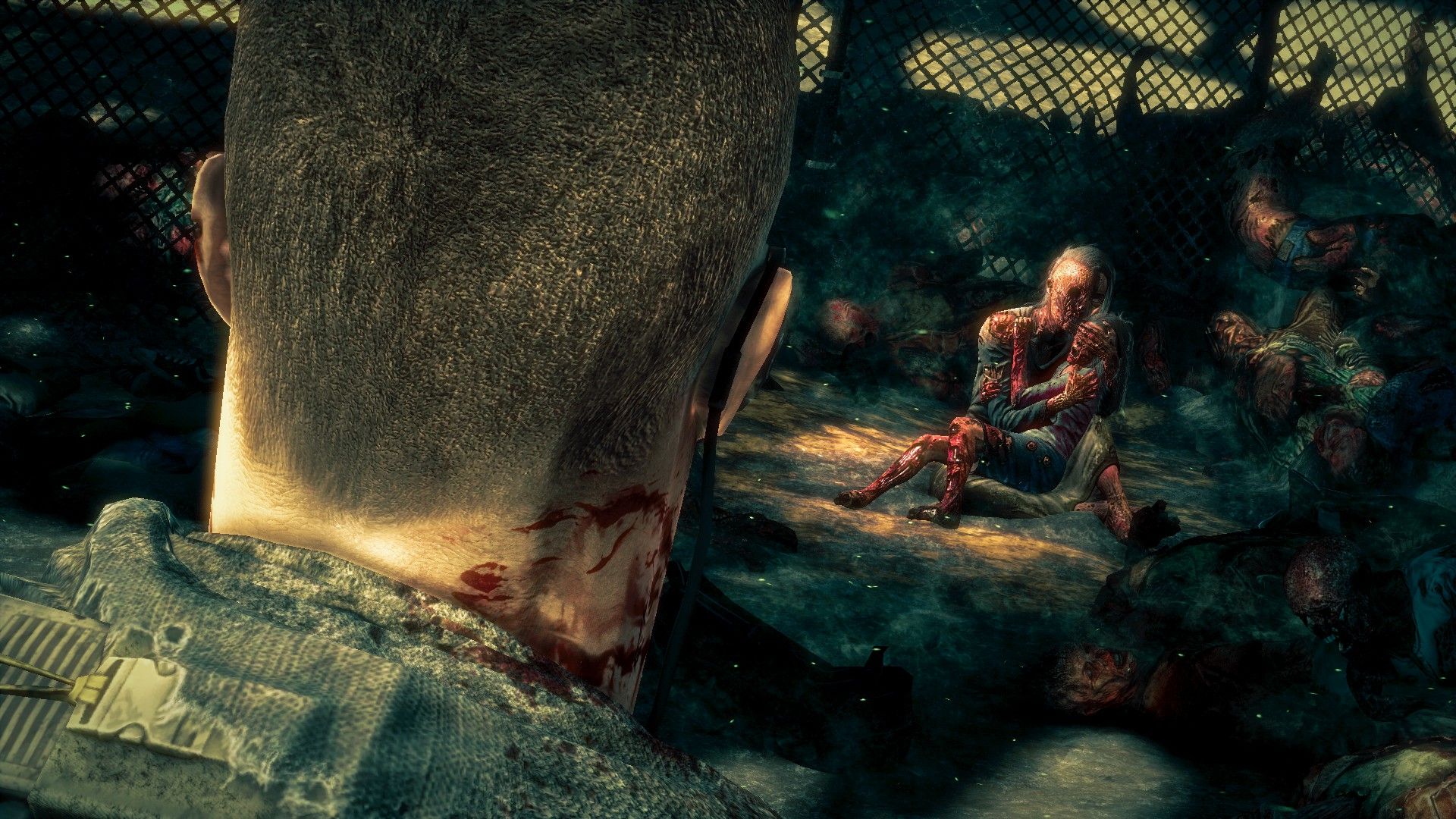
Call of Duty, then, resurfaces its ugly, tortured head at this moment in this piece. It is a franchise that has been long abused, treated as a cash cow – but also as a propaganda machine. A tool to desensitize and gamify not just violence, but modern violence. Violence on terrifying, inhuman scales. I can’t bring myself to play one of these games – let alone spend money on them – these days, but these ads, which show bombastic, exciting shots of grizzled military men shooting each other with high-powered assault rifles in a variety of urban settings… well, they contrast with videos like this (warning: viewer warning of distressing content) in our current news cycle.
I do not write this piece to provide some kind of counter-propaganda to Call of Duty’s relative military fetishism. I know and remember that Call of Duty: Modern Warfare was capable of delivering a stark anti-war (or at least, anti-nuclear) message when the game shows the nuke going off, your character unable to escape the terrifying finality of the blast. Yet other Call of Duty games have nuclear detonations or other such large destructive bombs as rewards… for slaughtering people. I am also not writing this to simply say that Call of Duty is the only franchise that has ever glorified war. Because it is not. Far from it. And I know that many people in many countries are themselves struggling, and desire for some escapism and some fun with their friends for a while. I can’t begrudge anyone that. But I just see a profound sadness in the game’s popularity with the general public – it is a game that encourages identification with the military. That idealizes it, to a degree – or so it seems. The trappings are cool, the kills are meant to give you a rush of endorphins, and recognizing military hardware is an essential tool. We are made to identify with our character as we play from our first-person viewpoint. We can call this the subjective shot – the method of identification that infers that we are playing as ourselves – or as someone representative of ourself, more our own character than an individual. We control them more than they control themselves. Through them, our understanding of the world is enforced.
Violence in Pathologic is short, brutal, and sharp. We control our character, we understand them, but we ultimately control them. Sure, they occasionally take control away from us, or exert a near-equal amount of pressure from their end to make us feel and think differently about the world we are playing in – but we’re still the enacter. We’re the one who makes the final decision. The buck stops with us, the player.
Alexander R. Galloway argues in reference to the first-person shooter genre as a whole, “[a]s an entire genre, the first person shooter also illustrates this type of allegorical interpretation of info-politics. Dash the naysayers, the shooter is an allegory of liberation pure and simple. This complicated genre is uncomplicated. There can be no better format for encoding and reprocessing the unvarnished exertion of affective force” (Allegories of Control, 104). Here, Galloway specifically indexes two games from the 90s – Unreal Tournament and Counter-Strike – as being “unvarnished exertions of affective force”. When we play these games, we are engrossed in a kind of power-fantasy – playing out violent scenarios without fear or threat of death ourselves. We play with violence, reducing it to a level of non-harm for ourselves. If I’m not getting hurt, who is?
Galloway cites André Breton, who wrote about the desire to burst into the street with a pistol, firing quickly and blindly at anyone complicit with what he called “the petty system of debasement and cretinization”. This petty system of debasement and cretinization – an unfriendly term, to be sure – can be aligned with the machoistic violence of these military-led first-person shooters. It is a sense of immediate power – a gun in one’s hands, and the invulnerability to deal out violence at will.
Violence is short, sharp, and brutal. It can and does change lives – but in video games, that change can often be reversed, ignored, or itself immediately changed. Didn’t like the consequences of one’s actions? Rewind, reverse, and see what happens if you make the other decision.
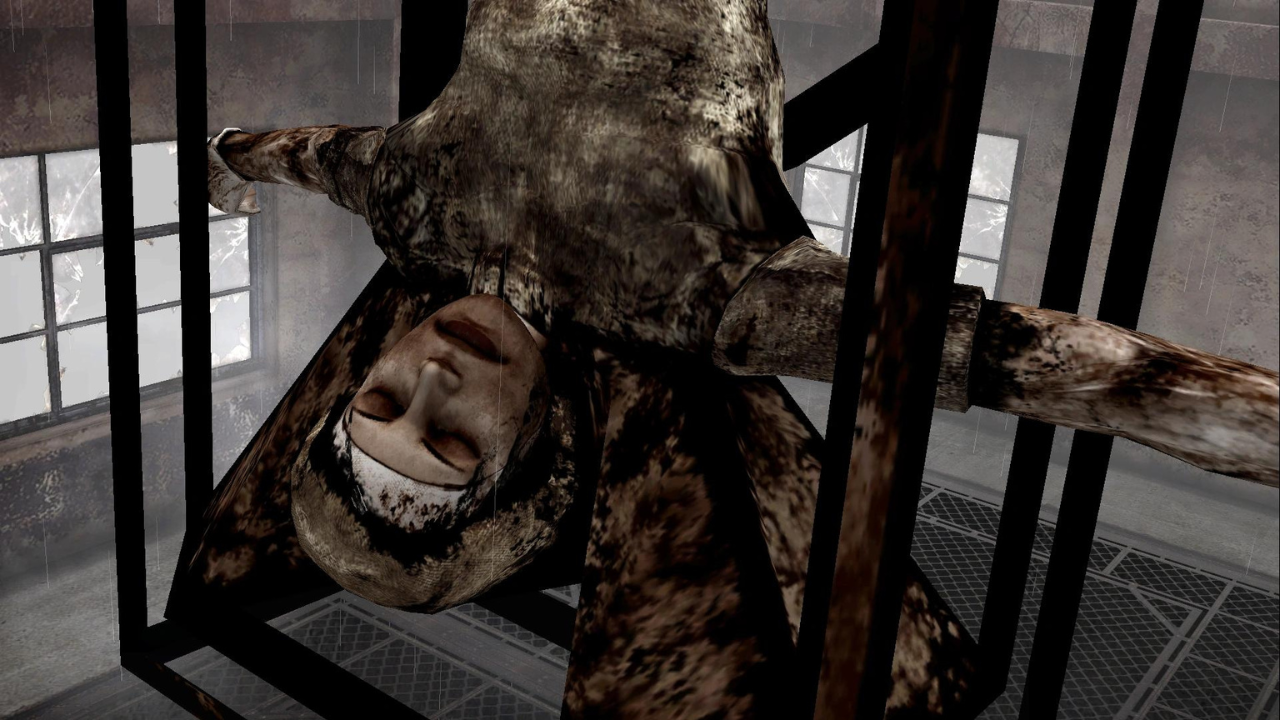
I reflect on the violence present within, what else, Silent Hill 2, and recognize that all of it is pertinent. I maintain, I will always maintain, that the game is lightning in a bottle. It created a story that reinforced all the tropes of a survival horror game of the time, meaning that every action you take reinforces the narrative that the protagonist James is experiencing. Killing an enemy is symbolic. It has weight and purpose beyond just removing an obstacle, or clearing an enemy. The enemies themselves are mostly sad, pathetic-looking creatures. Monsters is hardly the word for most of them, particularly the Mannequin enemy, just two sets of feminine legs sewn together. No way to express themselves, no way to threaten you.
The final boss of that game, Maria, is someone you have known as at least human-presenting throughout. She herself has been the victim of so much violence – killed three times throughout the game, she always comes back to haunt James. Yet when she transforms into a flying monstrosity with a tentacle that can shoot butterflies, the player finds it almost comforting. We can kill her because she’s a monster, now, duh. We’re allowed to. Yet this approach is deliberate, and I argue that it is deliberate because of the final moment of gameplay that we are offered. The boss fight ends with an enormous screech and a scream as Maria topples to the floor. Yet she is still alive. Her head shaking back and forward, mouth flapping uncannily, she nonetheless manages to whisper the word, James. James. James. Over and over again. Until you deliver one final blow. The final statement of our game, no matter what we get, is violence. James reached Silent Hill in the first place because of violence. It makes sense that he ends his trip there with it, too. The only difference is that we, the player, are made to control this final act. Together, you and James are woven together. Complicit.
Zombies in Resident Evil are of course, ubiquitous – human civilians made shootable by virtue of their monstrosity. Presumed to be incurable, they become things to be slaughtered rather than understood. Violence against zombies is both allowed and slightly discomforting. Yet this is unfair; disingenuous. A circular argument. Because throughout all the best horror games – Resident Evil included – are reminders of humanity. We recognize those people that are zombified, sometimes by name within the game, other times just because it sparks a memory of someone else. A creature wandering the halls, sad, alone, and hungry – but wearing clothes of a person you once knew. Eyes glittering in the right light… you wonder if they can ever come back to you.
You might presume my sensitivity on reading this kind of thing. And yes, perhaps I am. But I am not squeamish – I did play Outlast and Outlast 2, after all. I am capable of enjoying, even relishing violence in games. The violence in Resident Evil 7 was glorious – watching a man yank out his own fingernail in front of me was delightfully horrifying. Seeing a screwdriver impale my hand was something I will never forget. The violence dealt to me – via the subjective first-person view – was reflective. And the violence I dealt to others was heartbreaking. Seeing as the hatchet, in a frenzied boss-fight, sunk into my wife’s neck, and she paused, the spell breaking – I realized with horror the brutality of the violence, the horror that I was witnessing. But the important thing was the moment, the pause, that allowed me to realize what I had just done. The game afforded moments of slowdown, of humanity. The animation where the protagonist Ethan’s hands reach out to catch her as she topples down to the ground is so human, it hurts. I was responsible for that grief – but caught up in the violence, I had not even stopped to think about what would happen if I won. I’d have to live with it.
So when Ethan’s wife, Mia, comes back from the dead just a few minutes later and chainsaws his hand off in retaliation, I was shocked by the rawness of the violence. It’s similar to the sack-headed chainsaw Salvadors in Resident Evil 4. It just has an even more intimate bent, as we watch our own limb hacked off from a subjective view. But Resident Evil 4‘s beheading, as the sack-headed Salvador leans in and carves Leon’s head from his shoulders, is violent in a gut-wrenchingly fast way. The death is instantaneous and cruel. Yet because it is a video game, we can go again. We can try to learn from our mistake. We can avoid the violence.
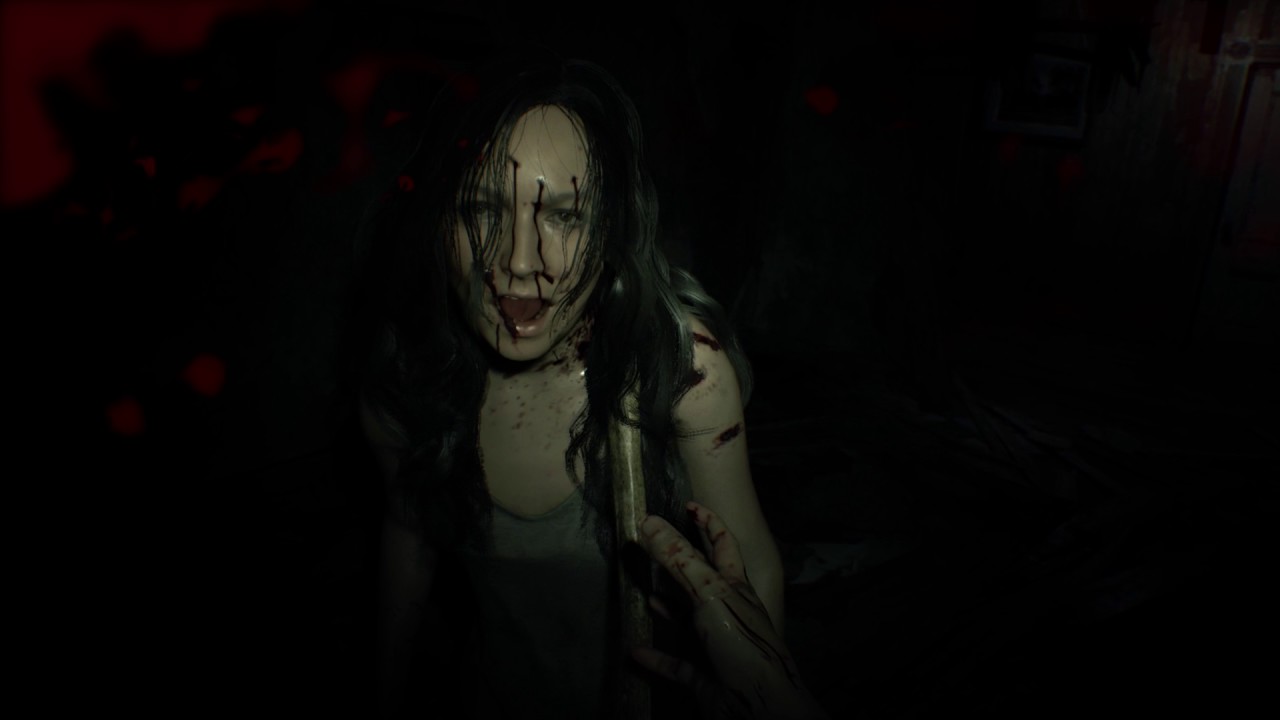
Back in Resident Evil 7, I was shocked also by the end of the boss fight in the attic, where, after one more headshot, she slumps to the ground, defeated, and says, I love you. Then, her strength exhausted, she crumples to the floor and dies a second time in front of you. Both times, you were the cause of her death. This time, with a handgun.
Within the bounds of a first-person shooter game like Call of Duty, which impresses on its players the desire to never stop moving, to get more kills, to get more guns, to get killstreaks in order to get killstreak rewards in order to get nukes – I can’t help but feel dwarfed by the cynicism on offer, the potential of the game’s inhumanity. There is no moment to breathe – there was no moment to connect with anyone in Call of Duty: Ghosts, for instance. What is the nature of violence, in the games that replicate the violence we see in the news, sanding it down to be both as realistic and as gamified as possible? To be palatable to people? What is the nature, and what is the cost?
Peter Wollen observes that one of the ways that media can either be conformist or nonconformist is what he calls Pleasure v. Unpleasure. The classic conundrum. Are video games meant to provide pleasure, or do they have a responsibility to prove to us that unpleasure is just as valuable? When a horror game shows you the impact of violence, I reflect on the nature of military simulators and first-person shooters that never slow down. When I see the tragedy of something as small as a broken home in P.T., torn apart by excessive violence, I am prompted to think of violence as something more profound than other games are wont to allow. In Age of Empires, the cost of the violence is placed on my economy. I lost five villagers, so I lost two hundred and fifty food, and also control of that gold mine. The effect on people is never felt. It doesn’t necessarily have to be – but it’s also becoming harder to think about for me, without considering how it makes a player think about violence. Calvin and Hobbes probably did it best – violence in media doesn’t cause violence, but it can do a lot of other things.
I find comfort within horror because I know it has the tendency to help explain human beings. It is a place where we can slow down and go for reflection. Even if those reflective moments are punctuated by big scary monsters screaming “boo” in my ear… I still value them. Horror games are special places, where violence can become something more than just gore (even if it quite often just is gore). There are moments that mean more.
And in a world that is so in need of more than just violence… I wish we had better than ads on YouTube yelling about win streaks, people dressed up in faux-military gear, and images of assault rifles barraging our senses.
Fortunately, we have each other, instead. Stay safe, everyone. Look out for one another.
 Horrorgameanalysis
