
Show him what he’s won!
Jak X, a 2005 “combat racing” game originally for the PlayStation 2, is one I hold very near and dear to my heart. It’s the fourth and final Jak game developed by the original developers, Naughty Dog, and as such tends to be the last one really worth talking about. Daxter was okay too, I guess. But Jak X is essentially a more mature kart racing game. Instead of fun little karts, you race large cars bristling with machine guns, hovering attack drones (also with machine guns), and heat-seeking missiles. Not to mention, well, the unavoidable bolt of lightning known as the Peace Maker that annihilates anyone coming in ahead of you. There’s some dissonance that comes in when you realize that you are killed every match many times, and there are cutscenes that discuss how the stakes are high and you could die out there. Heaven forbid.
Coupled with this is a hard rock, 2000s-era soundtrack that kicks some serious ass, and a variety of delightful, sneering characters. One of the best racers in the game, and a primo villain, Razer, is one of my favourite aesthetics, full-stop; the fact that he’s queer-coded is not something I recognized consciously when I was younger, but I appreciate it very much now. It remains a game of its time, to be sure – but it’s still an awesome experience, with a serious learning curve. And with a serious learning curve, comes a serious skill ceiling.
As with many such games of the era, Jak X functions as a nostalgic beacon for a time that has passed me by. Jak X never made it to PlayStation 3 in the re-released Jak & Daxter HD Collection, which I remember being frustrated by at the time. Does this mean Jak X will be forgotten, I wondered? I wondered that as I also reflected on Jak X’s propensity to corrupt PS2 memory cards, causing the PlayStation to forget everything else except Jak X, as a faulty autosave script ran over and over again.
Jak X is a special game. It has controls that seem to fight you at every opportunity, weapons that are so deadly that they are barely survivable, and cars that smash into walls at any moment you give them the chance. But it’s also incredibly fun. It’s a grand feeling to get through a race without your car having been turned into flaming paste more than once, and an even better feeling to do it quick.
So, considering these two factors (nostalgia and a desire to go faster,) it is no wonder that Jak X is, so far, the only game I have treated even halfway seriously as a speed game. There are lots of different moving parts to consider. From the car you’ve chosen, to the speed you are travelling at, to the angle of approach to specific corners, each track has unique challenges that change how you react. Split-second decisions are the name of the game, and going as fast as you possibly can is a matter of perfecting your knowledge of the track and what’s up next – as well as handling any errors you might have made previously that mean your calculations have to be adjusted.
I spent some time last week with COVID speedrunning a few different level categories. These have been:
Spargus City Freeze Rally
Badland Sanctuary Freeze Rally
Sewer Speedway Freeze Rally
Green Eco Cup Grand Prix
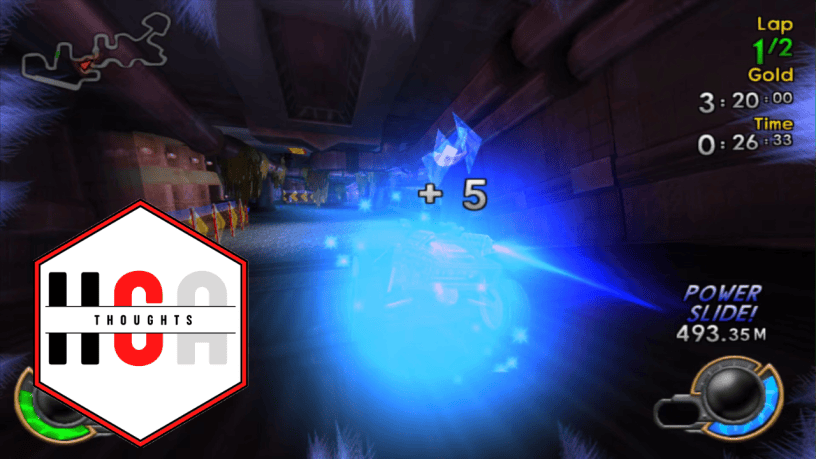
To explain the categories – freeze rallies are your classic “collect time tokens to stop the time”. As opposed to time trials, freeze rallies require you to complete two laps instead of just one. And, using the Jak X rules on speedrun.com, we need to add on ten seconds at the end of each time, as getting all the time tokens means you lose ten seconds. Therefore, it’s basically essential to collect all the tokens for a good time.
These categories are not exactly hotly contested. However, I am pleased to say that one of these categories, the Green Eco Cup, had someone else already topping the leaderboard. After plenty of practice, I managed to clinch first place, and therefore have obtained a world record, which I’m inordinately proud. I managed to beat someone else out for second in Spargus City, ended up third (but dead last) in Badland Sanctuary, and fifth out of sixth in Sewer Raceway.
Speedrunning is kind of a strange experience. It’s one of those things I want to spend more time on, but also simultaneously realize is really an exclusionary practice. How can I play one game for countless hours, just to top a digital leaderboard? As such, I often drift in and out of speedrunning Jak X – I tried for the first time about a year ago, and have ventured in a few times this year. With COVID, I figured I might as well try it again, and try to leave a mark on a few smaller categories (not having the strength for a full game run, which takes in excess of four hours, but more likely about six). So, hopefully, I’ve managed to do so.
Yet it made me wonder: what’s the benefit to speedrunning? Is it just another branch of completionism? Part of it is a way of demonstrating my love of the game, a game I’ve loved dearly for eighteen years now – but demonstrating it to who? If I didn’t have this blog, or if the game didn’t have a leaderboard, would I bother? Is the act of speedrunning one that is aided by a sense of performance?
I had a solid collection of games when I was younger, helped by my dad, who also loves to play games. But that collection was still finite, and I found myself returning to a set of solid classics over and over again, and sinking hundreds and hundreds of hours into them. I learned tricks and memorized entire cutscenes, pushing each game to its limits. I made up stories using the level frameworks, telling new stories and ignoring in-game dialogue, basically modding the game inside of my head. I shared games I loved with friends, getting them to play through it while I watched and helped out from the sidelines. My childhood inspired in me a deep, endless love of video games.
So replaying a game over and over again can not just be a way to show one’s love for the game – it can be a necessity. With nothing else to play, it can be comforting and a good way to pass the time if you can become better and better at the few favourite games you do have. Yet I don’t have a small amount of games. I’ve stopped buying new games recently, but it’s still a problem. That mountain of games is looming there, just as threatening as it was at the start of the year. I finished Unpacking today… but is that really enough? I don’t think so. But I indulged in Jak X because I was in the mood for a challenge. A game that I’ve played for countless hours can still provide extra challenge, extra room for growth – and not in the strictly analytical sense either, as more narrative-heavy titles do. Getting better at the game is another way of giving back – both to the game, and to myself.
Yet speedrunning Jak X can be frustrating, because of how close all the margins for error are. I imagine it’s like engaging in high-level speedrunning – in individual levels, just like high-level full game runs, every single bit of movement counts. Everything can be going great, but just as similarly, things can be destroyed by one small wrong turn. The car landing a jump wrong can cause your car to swerve for instance, losing you a precious half-second as you fight the steering to get it back on course. I am nowhere near a good enough player to be properly optimizing my runs – half the time, I’m just happy if I can get to the finish line without having smashed into too many walls on some of the narrower tracks.
Spargus City is the game’s first track proper in the story mode, and it’s where you immediately come up against the game’s terrain system. Spargus’ sandy streets are made up of three different kinds of terrain: the aforementioned sand, which is essentially the track’s version of tarmac, wooden bridges that take you above certain areas of the track, and rocks. Rocks are the track’s way of saying “go to hell”, as you are often sent just slightly off-course driving over them, especially if you hadn’t accounted for your tires straying just a tad too close to a rocky patch. This can slow you down immeasurably, or just kill a run outright if you careen into a wall and explode. Dying costs you between two to four seconds as far as I’m aware – and that’s a significant chunk of time in races that are separated at the top level by literal milliseconds.
Sewer Speedway sucks. [NOTE TO SELF: fill the rest of this out at some point]
Green Eco Cup, aside from being the one I actually managed to get the world record on (however long that lasts), was easily the most enjoyable. This was probably because it offered the fairest level of challenge and novelty. Instead of just racing against yourself (and the ever-present clock), you are racing against five other computer racers, across three different tracks. The first track is Forbidden Jungle, easily my worst track of the lot, being made up of a large variety of different terrain and having some rough turns to navigate quickly. The second is Mountaintop Highway, easily my best track of the lot, which has the most generous placement of weapons and boost, and is also a very wide, easily navigable track. The final track is called the Northern Tour, which basically splices all the desert tracks in the game together. A clever idea, but also makes for one hell of an endurance race. So I was always pretty bad in my first track, before feeling very pleased with the second, leaving me down to the wire in the third. Nabbing the record by five seconds was joyous but also nerve-wracking.
As for the racers, they fire a huge variety of weapons at you, obtained by picking up Yellow Eco canisters placed around the track. You can deflect these with Red Eco canisters, which fire defensive weapons backwards. So you deploy a smoke screen or an oil slick to deflect homing missiles. The trick in Jak X, however, is the fact that heat-seeking missile pickups fire two missiles at a time, and come with two ammo. Meaning you can fire two rounds of missiles. Two rounds are enough to destroy most cars, and even in the toughest car you can drive (the one I chose to use), it still leaves you one or two taps against a wall away from death. Meaning that knowing where Red Eco pickups are is basically essential to beating back the competition.
Worse was the first-place killing Peace Maker, certainly, which can only be blocked with a shield. I was basically hoping and praying every time I hit a Red Eco canister that I got the shield – unfortunately, the shield seems to be incredibly rare. Some runs were ended because the AI were lucky enough to get multiple Peace Makers, meaning I was routinely annihilated in the closing turns of a race over and over again. One shield can block two Peace Makers if you are lucky enough – but otherwise you just have to hope you reach the finish line before it reaches you. They are essentially impossible to outrun, meaning that if an AI fires one, you’ve probably lost about five seconds when it inevitably hits you. Some runs had lots; others had just a few. But there’s no way but the shield to avoid them.
There’s a lot to be said about how good Jak X is, and how well it has aged. The soundtrack is a key component of why it remained in my memory all these years, to be sure, but it’s not the only reason. While it was certainly nostalgic to relive such a large component of my childhood – it was a game that I would challenge family members to, and one that they would eagerly join in with… and one that I could sit back and watch two other, non-gaming family members have heated races in, which is an experience more precious than even myself playing the game against them – I was also encouraged by the ability to give back, somehow. I really do think it’s a way of proving something, even if nothing has to be proved. I already know I loved the game – but I wanted the game to know that, somehow. I left my mark on a single category, and put my name in second or third in a few others. I’ll try more, I imagine – you’ll probably see me practicing on stream sometime next year – but I can’t imagine I’ll be a super hardcore competitor either. It’s just for fun, nothing more.
I missed the game, I think, in the years that I did not have it nearby, or on hand. I was reflecting today to someone just how crucial it is that games remain accessible, and accessible off of the hardware that they were originally developed for. I have seen firsthand the result of the devastation that Adobe Flash’s death has wreaked on small communities of artists in New Zealand. For a game like Jak X, such a small game in the grand scheme of things, to still be playable and accessible on new hardware without any iffy problems, technical difficulties, or, ahem, illegalities, is precious. For people to have access to the closing chapters of my childhood, or to the new favourites I hold dear now, is so important. If I could not access your favourite games, the world would be a worse place.
Even if this whole article read like a bunch of nonsense, I hope that it encourages you to return to a game that meant a lot to you over the Christmas period. Who knows – maybe you’ll set some new records 🙂
 Horrorgameanalysis