
“As my feet walk from the ashes of Katarr, I shall not fear, for in fear, lies death.”
I played Knights of the Old Republic fairly late, all things considered. I bought the discs at the relative tail end of the whole “being able to buy PC games on disc” thing. Now I can’t find a store that sells anything but old Sims expansion packs. That’s besides the point, though – I can track my appreciation for the art of video game storytelling through a few serious games. Knights of the Old Republic II is one of them.
The original Knights of the Old Republic is fantastic. It’s a fun, exciting romp through the Star Wars universe, but 4,000 years in the past. That means everything is both recognizable and also fantastically new. You fight the (Sith) Empire as a Jedi Knight for the Republic, and struggle between – being fantastically good and terribly evil. The main issue with Knights of the Old Republic, for me, has always been the binary nature of its choices. And this is not to say that Star Wars in general doesn’t succumb to this trap, because it does. The original Knights of the Old Republic gamified the moral structure underpinning the franchise. Good, selfless things bring you closer to the ephemeral Light Side of the Force; evil, selfish actions draw you deeper towards the Dark Side. The Dark Side brings with it physical distortion and corruption – bully someone, and your veins begin to turn black, your skin crusting over in a mouldy grey colour. On the flip side, your character portrait gains an angelic glow the closer you draw to the light.
Taking the bones of what BioWare had created with the first game, Obsidian, ever-beleaguered developers, still created one of the greatest CRPGs of all time despite time restraints. The thing that makes Knights of the Old Republic II stick out to me is still the moral framework that you can roleplay within. Before this game, Star Wars had always been pretty clear-cut to me. I mean, in Revenge of the Sith, Anakin’s heel-turn flip to the evil side means he kills a bunch of children not even five minutes after he wails, “what have I done?”. The absurdity of it also makes clear that Lucas’ universe has demands of its good characters, and of its evil ones. But there are also moments within the films that ask a little more of you, that start to show what Star Wars is about, and could have better utilized, particularly within the context of the Prequel trilogy.
The cyclical nature of the Star Wars universe – that there are always wars between factions, that there will always be champions of light and dark – these are ideas that come up in The Last Jedi, but that were drawn from Knights of the Old Republic II. Kreia, the blind old woman who travels with you, is stubborn, enigmatic, and, to a certain degree, pretty unlikeable. In a few instances, the game’s mechanics and roleplaying opportunities screech to a halt in order for her to moralize to you about the lack of nuance in Star Wars. The first moment this happens is when you’re asked to either give a beggar some credits – or tell him to piss off. Both actions, in their “extreme”, irritate Kreia. She is frustrated by either your charity – because you aren’t allowing him to help himself – or by your rampant selfishness, which serves to create harm too. There’s no in-between choice in this moment, but I remember really being floored by it. Because I did always pick the easy charity option in a game. Because being good was always the right thing to do – right?
I can’t say I agree totally with Kreia – that giving someone help is a bad thing – but it did make me think and reflect on the automatic way I’d been playing certain RPGs before this point, Knights of the Old Republic included. If I wanted “good guy points”, I’d pick the obviously good option, and vice versa. Knights of the Old Republic II still runs with the same overarching Light Side / Dark Side point system, which can still feel somewhat crippling – but it works that crippling overspecialization into Kreia’s arguments. She frets about the influence of the Force, that it demands all or nothing, either way. Knights of the Old Republic II deconstructs basically everything about the Star Wars galaxy, but does it in a way that I find to be mostly loving. It is still a Star Wars game at its heart – you face three separate Sith Lords that all recall traits of Darth Vader in certain ways, you overthrow (or support) monarchs, and you explore a range of diverse planets.
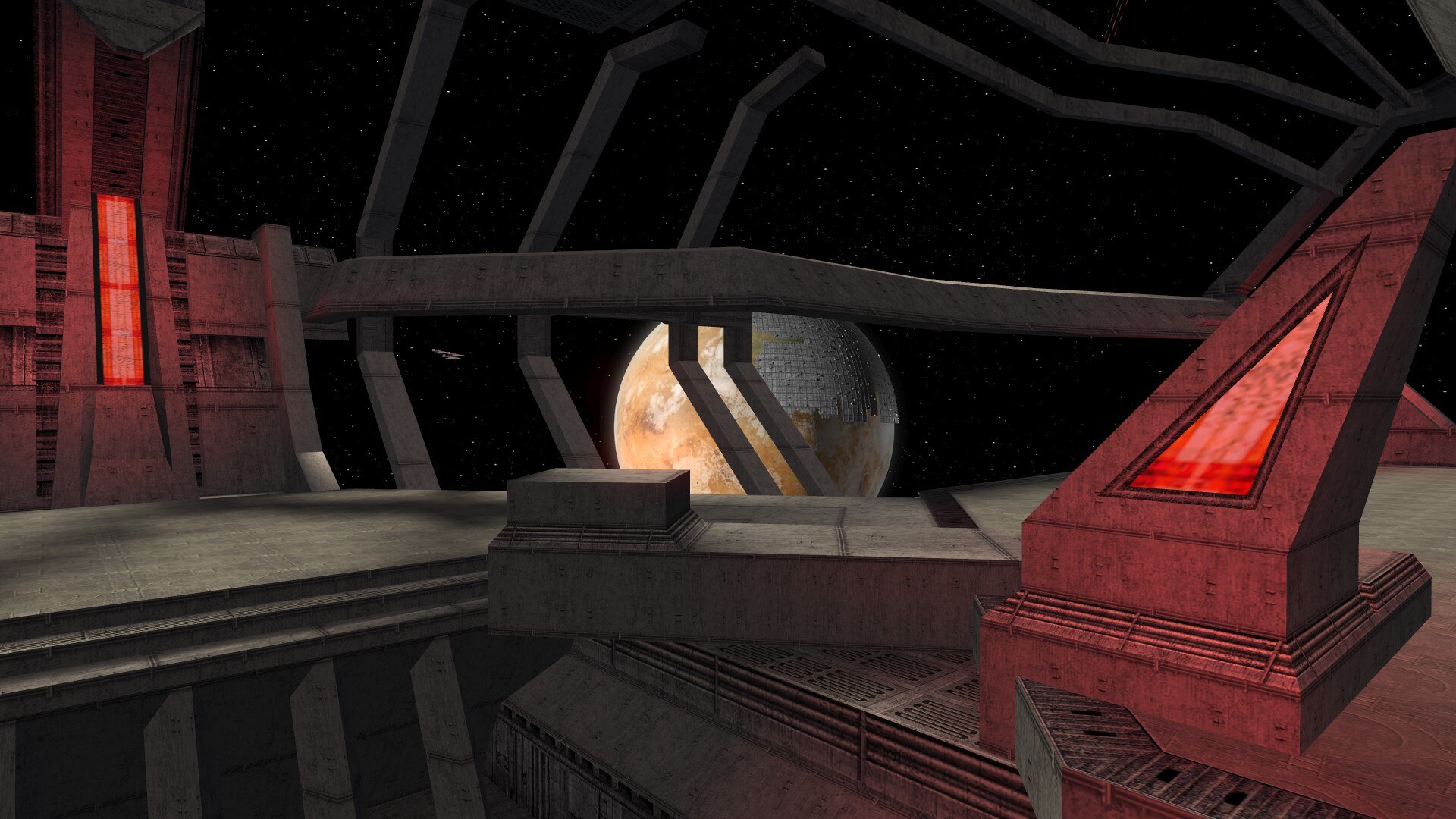
The planets themselves can be quite melancholic, too. Exploring the ruins on Dantooine shows the cost of the war from the first game. Several discussions you can overhear (or have) throughout the game show that the war has brought the Republic to the brink of bankruptcy, and helping everyone is an impossibility. The crushing post-war depression, coupled with the practical death of the Jedi Order at the hands of not an imperial war machine, but silent Sith Assassins, gives the game a feel that no other Star Wars game, to my mind, has replicated. There are elements of swashbuckling adventure, but tempered with moral choices that can’t fit neatly into the light / dark framework, at least all the time. Sure, there are choices between evil corporation and good ecologists, but each choice at least is tempered with a pragmatic angle. The ecologists will take years to restore the planet, and people will be out of homes for a long time. The corporation is obviously, painfully evil, but at least they get results, dammit!
The game is at its best when it is challenging your worldview, forcing you to make decisions that will have ramifications beyond the immediate moment, or at the very least, forcing you to make decisions that will colour how you view yourself. I remember talking with a companion, and them revealing something to me that would change how I viewed them forever. That confession, one born of trust and friendship, destroyed the simple way that I looked at that character. I had never really had that experience in a game before. Before that point, characters other than myself were relatively straightforward – and if they had anything to reveal about themselves, it would be attached to the main plot, or wouldn’t be that important. But when this happened, I was beyond impressed. This was a moment that I earned – and one that I felt not every player might see. That’s a special feeling, in an RPG. When your decisions actually culminate in something important, something that shifts the status quo for you.
The combat is something I’m still fond of. A real-time with pause system, where you schedule attacks, it always felt intuitive and flashy enough to me. The game offers a bit more difficulty than the previous one, wherein every fight in the first one was painfully easy aside from the final boss, which was a tremendous difficulty spike. The second game has a bit more consistent (occasionally a bit unfair) challenge. There is the infamous matter of the game’s opening to contend with, though.
As good as Knights of the Old Republic II gets – one of the greatest roleplaying experiences of all time, and it is even better than that if you’re fond of Star Wars – there’s the issue of the opening segment. It goes on and on for what feels like forever. And it is atmospheric – exploring a desolate mining facility, where mining droids have been driven to insanity and everyone seems to be dead – is fantastic. But the game doesn’t start to really show what it’s capable of until after you leave the mining station. This is a shame because the mining section can take close to two hours on a first playthrough, and probably about an hour to ninety minutes on each successive playthrough. It’s a large barrier to hurdle each time, given how slow-paced it is, and how repetitive it feels. There are some great, great bits in here, don’t get me wrong – but it’s easily the worst part of the game. Frontloading a game’s worst part can get the bad stuff out of the way, sure – but it also means that recommending it to new players can be tricky, given I have to couch it in “oh, by the way – you have to struggle through this bit to get to the stuff I’m actually talking about”.
But it is worth it. I remember feeling genuine attachment to characters in the game, feeling tied up in their stories and wanting them to succeed and be happy in ways I hadn’t felt before, not even for the assigned love interests in the first game. This was a story that I didn’t want to end, the best kind of story – because when a story overstays its welcome, it is even worse. Even in a twenty-plus hour experience, I still wanted just a little bit more. It is clever, it is morally interesting, it is jam-packed with exploration and roleplaying opportunities – it is a special kind of magic. I don’t want to be one of those people, but I just don’t see how a Star Wars game like this will be made again anytime soon. It is one of those lightning in a bottle things – made at the perfect intersection between the franchise’s incredible popularity, and a relative hands-off approach to corporate custodial duties when it came to the video games, Knights of the Old Republic II tells a story worth telling. But better than that – it lets you tell it.
Apathy is death, the game outright argues. To be paralyzed by choice is a choice in itself – the game’s breadth of choices also create the trap that so many players of RPGs fall into. To capitulate to the demands of the characters in the game, to flip-flop depending on who’s in your party to gain favour and influence. But playing this cynically is disencouraged in Knights of the Old Republic II. Instead, the demand is that you play someone, not a collection of stats you min-max your way to the end with. If you don’t get invested in the story you’re telling with the game, then what’s the point? Crawling my way through an ancient Sith Tomb, I am confronted by my past in an effortless way. My past – not my character’s. That line was crossed hours ago. I am immersed in the world. I am confronted with actions I did not take – and made to reckon with them as if I had. It is a quintessential roleplaying experience, and remains so to this day.
 Horrorgameanalysis
You’ve been knocking it out of the park with your posts lately! I’ve been thinking about this one in particular because KOTOR 2 is one of my favourites, and really quite formative for me. On a rational level, I can agree that Peragus is the worst part of the game, but I just love it – it seriously terrified me as a kid. It’s imbued with that indelible sense that something truly ruthless and terrible happened in these eerily empty rooms, and then there’s that great escalation when the half-destroyed cruiser floats in like some reanimated corpse and you realise you’re still very much being hunted. For me, that *almost* makes up for it being a total slog. It’s maybe also the only time Star Wars has really unnerved me with the barren expanse of space. I almost feel as though Peragus could have been a survival horror game. Maybe in another life.
Kreia has to be one of the most interesting characters in gaming in the sense that she is the game’s thesis personified. To really understand the Force (or Star Wars as a whole), you have to go beyond the good/evil, light/dark, Jedi/Sith dichotomy that defines it, even if, as you point out, it’s ultimately inescapable. It rejects the essence of Star Wars only to be subsumed back into it in a way that I find really compelling – I’ve never found the Force particularly interesting outside of the strange God-form it takes on in KOTOR 2, cruel and beautiful and overwhelming.
LikeLiked by 1 person
Thank you!
KOTOR 2 was formative for me in certain ways too. It is very interesting to hear how much you love Peragus though, given that I thought it was a bit of a pain when I first played it, even when the sense of mystery was on its side. But I get what you mean – those feelings you describe are ones I have felt too. I just wasn’t able to have them outweigh my own youthful impatience with the game. I like your idea about Peragus being a survival horror, though – as you say, perhaps in another life. Darth Sion is one of my favourite villains in Star Wars (I think he is often underrated in front of the “cooler” Nihilus), and his appearance here as a malevolent stalker brings to mind Vader. But it also takes on a darker tone, tinged with the knowledge that this is a man who refuses to let death overtake him. He is the quintessential “stalker” archetype, a slasher movie villain, who hardly gets the chance to show himself off in the story. But he makes an impact, nonetheless.
I do agree that it is that attempt to go beyond the binary of Star Wars, but ultimately acknowledge that it is that binary that *defines* Star Wars, that makes KOTOR 2 so very compelling. There is no way to escape that binary, but Kreia tries, nonetheless. It makes for a view of Star Wars that we have never quite seen since – which, for such a large franchise, is incredibly valuable.
LikeLiked by 1 person