
LEGIE (hereafter referred to as Legie) is an odd game in many ways. But it does appeal to me – and not just because of its brevity. I love roleplaying games, but I hardly have any time to play them at the moment (next year I hope that will change as I finally take my foot off the accelerator and take some time to myself). Legie, though, is a good intermediary until I get a chance to slow down – and may, in part, be a fairly good look at the style of 3D video game I would make when I have time.
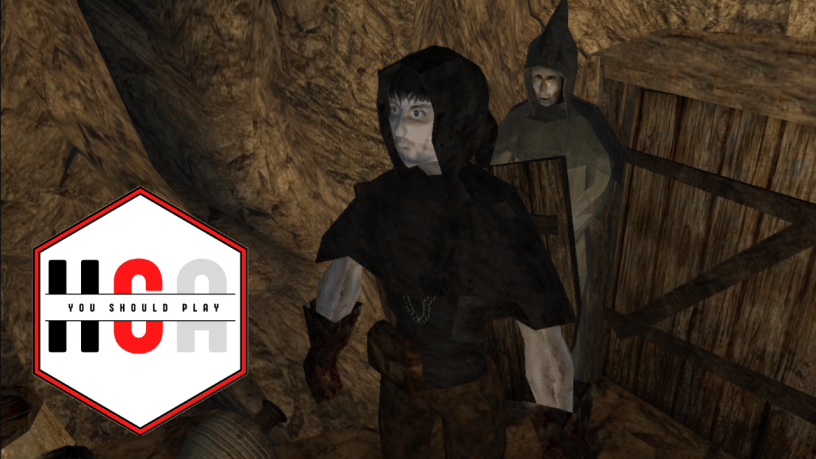
In the medieval Czech village of Jilemnice, YOU play as a down-on-their-luck barkeeper’s assistant, forced to perform menial tasks and run the bar for the bald, broken-down and bastard of a bartender. These first moments are perhaps the game’s best. You are trapped inside, forbidden to leave by a bartender who, by all accounts, used to be a nice man, before the world around Jilemnice fell apart. Yet when the latest shipment of beer fails to arrive, you are sent on a chain of quests that lead you to not only becoming a bit of adventurer, but confronting the devil himself.
Self-described as a “hybrid of adventure game and classic grid-based dungeon crawler”, Legie is incredibly immersive. You play from a first-person perspective, wherein you click on a section of the floor and move over to it. You can pan the camera all around, looking around the lovingly constructed, bleak world of Jilemnice. Jilemnice is a world unto itself, with a sparse colour palette that immediately cues you into what kind of world you’re in.
It is a world crushed by varied disasters. The smallness of it helps it rather than hinders it. Other games can fall into a scope trap. Legie is not one of those games. I find that wandering around the small, cramped bar, with its depressed patrons and bossy bartender, offers ten times the experience of wandering around some large, shiny worlds. Stories of endless rain, of mines shutting down, of people coasting off of their savings, frittering them away on drink – it is bleak, sure, but with a delightful edge. The world seems full of promise despite that bleakness. Because it is a game, we have a feeling that what we are being told is setting us up to encounter the answers to these questions. The promise of adventure – the call to it – is so immediate, a contrast to the bleakness of the setting. It is like the RPG dial is turned up to eleven, in order to accommodate for the shortness of the game. Everything feels worth rebelling against and exploring. As Alexander Galloway argues in his book Gaming: Essays on Algorithmic Culture, we are the subverter. The role of the player is an act of defiance and of rebellion. Given that everyone in this game is incredibly depressed and doesn’t want to do anything except sleep or get drunk (seemingly), it feels fitting that we are the agent of change in this world. All because of a few beer barrels.
Galloway writes that “[v]ideo games don’t attempt to hide informatic control; they flaunt it” (90). The person playing the game makes a cyborg of themselves, becoming closer to the game the more they play it, understanding the algorithm. For every moment that we are not playing the game – and even concurrently while we are – the game is playing us. Legie encourages us to view this bleak world with cynicism, sure – but also to see a way out. A light in the darkness… even if that light turns out to be far brighter and itself much more cynical than we had initially hoped. We slot seamlessly into the world, understanding its rules after just a few minutes of playing. We can’t walk ourselves, we must click on where we want to walk next. We can look around, making each tile we explore weirdly immersive, despite the fact we can’t walk everywhere we might want. It’s a game about quiet exploration, checking out fine details, and picking up resources to help you progress deeper into its weird world.
The game can never be played in full-screen. It is locked into a 512 * 512 window (making it practically unplayable on a 4K screen) – this, surprisingly, does not destroy how immersive it can get. Whether you are plunging into a dungeon and wandering through the marsh, Legie‘s illusion rarely shatters. It helps that you have a character with a strong personality to play as. When you come across a dead horse and a dead man, who both drowned in the mud outside the city – a bleak image reflective of the medieaval world you find yourself – the character’s concern is only for the horse. The drowned man is not worth sympathy – but the horse is. That speaks volumes. Yet the character is also harsh and discriminatory against the local foreign merchant. We get a sense of the character – however weird and uncouth they are. These moments of personality, discomforting and misanthropic as they are, remind us that we are playing someone totally imperfect – who can forget the moment where the character wants to crush a cabbage beneath their boot, all because it reminds them of their boss?
Playing as a character, learning about them as you play, is a really valuable experience. You discover more about them as you play. While it’s not the most refined game or anything, Legie allows for dialogue choices to help define yourself in relation to the world. But there are moments where you find out more about the kind of person you’re playing as, where they define themselves against you, potentially.
There are moments of interactivity that simply aren’t done in other, larger games, that give it a touch of humanity. When pouring the beer (in what initially looks like a cutscene) you can under or overpour, meaning the bartender will berate you for your failures. Either it spills on the floor and he yells at you for wasting it, or he spits at you that you shouldn’t underserve his customers.
The game is kind of a dungeon crawler. But it’s not a particularly great one. The combat has three distinct “phases” in the game. First, you don’t have a weapon. This is a problem because you can’t withdraw from combat. If you get caught by an enemy in that initial state where you don’t have a weapon (a possibility, but it doesn’t take too long), you will die without recourse. Saving is generous and free (there are five save slots), but it’s still frustrating. When you find a weapon, the game then turns into “mash and pray the enemy dies before I do”. Then, finally when you obtain a shield, the game becomes trivially easy. Raising the shield blocks all enemy attacks, so you can just hit then immediately raise the shield.
So if you were coming to this expecting a game where you have satisfying combat – well, you’ll be a bit disappointed. There are only four enemy types. But it’s the atmosphere and the weird characters and puzzles that will keep you invested. The combat is just a quick way to break up the gameplay, give you some variety.
Given that the game is about fourteen megabytes, it impresses me that Legie is so interesting. It does so much with so little, even if some of what it does is misjudged, awkward, or uncomfortable. Yet it is still somehow endearing, despite mistranslations and sometimes obtuse objectives. There’s a guide here which is worth using if you get stuck. But Legie is still a game worth experiencing for oneself, just to get in touch with how video games can be different, and can foster different emotions in a player. It’s weird, I’ve not quite played anything else like it – but that’s what makes it worth experiencing.
You can buy LEGIE on Steam.
You Should Play: LEGIE
 Horrorgameanalysis