
First things first: I actually quite like The Forgotten City. For all the criticism that follows, I enjoyed much of my time with it. It is earnest, human, and a game that defies both its budget and its small team. It builds a really compelling setting and weaves a mystery that held my interest for the game’s runtime. However, I wanted to discuss two weird decisions that sink the game in the end – but it is worth playing. This article is basically going to be a weird You Should Play. Spoilers follow for the entirety of the game.
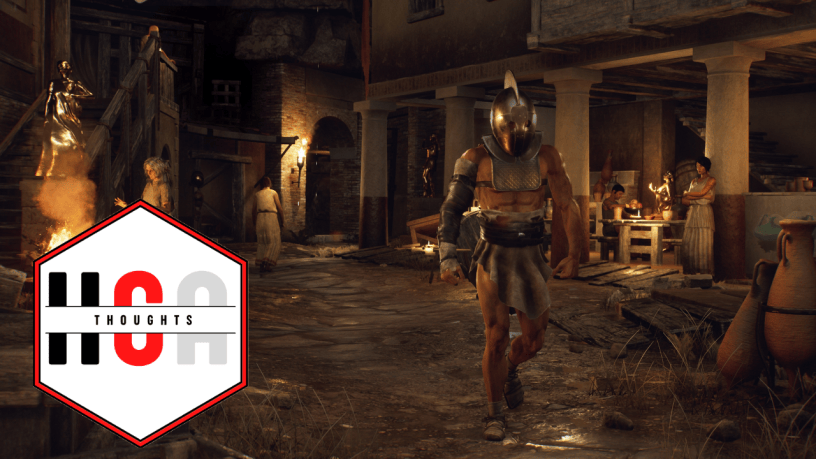
The Forgotten City‘s two flaws can be boiled down to puzzle design and writing. The basic concept of the game is that you are exploring a city governed by one rule – The Golden Rule. Essentially, the Rule is “do unto others as you would have them do unto you”. The Rule is always broken by the end of the day, and one of the citizens of the city has created a time loop that allows you to cycle back in time to the beginning of the day, attempting to break the cycle of breaking the Golden Rule. When the Rule is broken, the citizens of the city are all frozen into golden statues.
There is a disjunction between the time loop and how easy everything is to solve. You retain your inventory between loops – a decision that at first seems like a relief, compared to other time loop games. And it is – but to a degree that trivializes challenge. There’s a person who has been poisoned, and to save them, you just need to nab a bottle of the medicine from the corrupt stall owner. The moment you grab it, of course, you break the Rule – but you cycle back through time, and keep the bottle – forever. It never runs out of medicine, meaning you can save the person reliably every time, in every subsequent loop.
Instead of having to navigate a complex set of actions, memorizing what you have to do in order to get things to turn out in an optimal fashion, you quickly (in my case, in about four loops) find everything you need to obtain the ideal scenarios for basically every small challenge in the game. And this was disappointing. But it’s not just this inventory being retained that trivializes the challenge. It’s the way the game feeds information to you on a silver platter.
Take the case of the assassin who infiltrates the city. You are first informed of this man by Fabia, the baker. Fabia, in the first loop, will always wander into a shrine that immediately collapses on top of her head. It’s a tragedy – and it’s a tragedy that means the assassin cannot be killed or attacked without breaking the Golden Rule. And he always breaks the Golden Rule. This is a really clever set-up, and I admittedly hadn’t quite figured out how I was going to deal with him on the second confrontation. But the game immediately gives you a new dialogue option on a second loop where Fabia has been convinced not to go into the shrine – also incredibly easy to achieve. This dialogue option is basically just “go into the shrine”. It appears as soon as you talk to the assassin, and requires no extra convincing. He just wanders into the shrine and dies.
I hadn’t thought of that as a solution yet, but the way the game just feeds it to you made me quite disappointed. I felt like the decision was being taken out of my hands. And it’s hard to conceive of an immediate change that would fix this issue, given the game is dialogue driven. But having to lead them there might have been a good fix. Or having the option not be so obviously the correct one. Having to convince the assassin might have been nice. I just didn’t want it to be so easy.
It gets worse (or better, perhaps) when you can delegate all of the tasks to Galerius, the first guy you meet. He’s lovely, but he also does everything for you after you’ve discovered what to do once. He’ll save people from committing suicide, save Fabia, tell the assassin where to go, make the corrupt politician drop out of the election, at the drop of a hat. I get why the developers added this in. Time loop games can be frustrating when you have to repeat certain actions over and over again. But the entire concept of The Forgotten City seems to be figuring out how to save a doomed city. If you remove the “figuring out how to save” part, the focus therefore shifts to the writing.
For the most part, the writing is serviceable and, at times, even good. There are touching moments, haunting moments, and moments of true revelation that feel earned. There are also “Karen” jokes, discussion about having lived through a pandemic, and other contemporary references that immediately date the game, which is a problem, because the game is trying, in a sense, to be timeless. A game about exploring history? A fairly well-researched one, at that? Why include these contemporary references? They aren’t funny (the Karen memes always had an uncomfortable misogynistic edge to them, in my opinion), and they take you out of it. Fallout 2 is similarly dated – but a bit funnier.
Putting aside these unfortunate elements, The Forgotten City is all about ethical arguments. What does it mean to follow this Golden Rule? To treat others as you would like to be treated? What does it mean to live in a utopia? What is tyranny? What does it mean to be free? Merely asking these questions elevates The Forgotten City above quite a few other video games and their writing. Some of the discussions around these things are very interesting and can be thought provoking. Discovering that the Roman city was built on top of the cities of other, earlier civilizations is a fantastic moment, and one of my favourite in any game I’ve played thus far this year.
But the final discussion of the game, with the creator of the Golden Rule, upset me, even as it was happening. And it took me a little while to figure out why. But it essentially boils down to the arguments you can use to refute the Golden Rule.
The creator of the Golden Rule turns out to be, sigh, an ancient alien with advanced technology, who was perceived by ancient humans as a god. I don’t like this trope at all, aside from a few rare cases. Here, it feels predictable, despite the way they tried to differentiate it from others, given that he has taken human form. In a way, he has become human himself. He himself has come to believe he is a god, and can do no wrong. You can refute him one of two ways – either you shoot his beloved, take her crown, loop through time, and show him the crown as evidence you are willing to kill her over and over again (what a fantastic method of intimidation) – or you must talk him down.
Having the final boss be a conversation plays to the game’s strengths. There is the idea that he has become human, which I like a lot. If he is human, therefore, and has a social structure that he came from that treated him unfairly – then he made a mistake, as did the person above him in his social structure. That’s it. He realizes he’s made a mistake and undoes everything.
In a way, this should feel satisfying. But it doesn’t feel like you’re disarming the ethical quandary at the heart of the game, it feels like you’re disarming this petty god. Which, I mean, fair – you are. And that’s what it takes to break the cycle and escape the city. But you end up arguing that society has trended forwards, that we move closer and closer to utopianism – of a sort, anyway. That we’ve moved beyond who we were, and became better for it. That we always trend forwards. The god tries to argue that our form of mortgages and loans is just like his form of rule. We can basically refute it by saying “no, that’s good, actually, because people can earn their way to success”.
We are disarming him by virtue of our own biases. This god is made to admit that our modern rules and sensibilities are seemingly by virtue of time alone, good. That troubles me. I am not one to defend the imperialism of the Roman Empire, or demand a return to the glory days of Pax Romana or anything like that. But we don’t get everything right. You can argue “Why does wisdom and technology make you superior?” The god rebuts with the fact that we do not shelter and house insects, and never harm them. To lie to him on this point is to invite your death, as he identifies it is a boldfaced lie. But there are moments in the game where you can lecture the ancient Roman characters on how wrong their beliefs are. Some of this is fair enough, but at other times it feels unnecessarily preachy. We ourselves can take the rhetorical position of the god of the underworld – perhaps the game is about learning from this fallacy. If it is, the hypocrisy of our own character is never made clear – and this is because of one final gesture from the game. This gesture comes in the best ending.
The game’s best ending transports us back to modern times. And, surprise, all the Roman characters are there, provided we saved all the ones that can potentially die! Well, except for one, who was imprisoned in gold anyway for their sins, which I guess were orders of magnitude larger than everyone else’s. The more morally dubious characters all end up suffering karmically for their various misdeeds. This feels deeply uncomfortable. Everything is tied up in a neat bow – all the good characters get together and all the bad ones get punished. I get it – it’s meant to make you feel good. And I’m an optimist! Mostly. But even I don’t believe the universe is this neat and tidy. Stories should dissatisfy sometimes, be at least a little uncomfortable. I’m not saying the good characters need to be punished, but the scummy characters don’t all have to be punished either.
Look – the game literally places you on a pedestal at the end and has all the people who used to be imprisoned in gold statues applaud you. That’s the last thing that happens. A big old statue of you, bigger than the ancient Greek heroes the game has referenced, and a crowd of people applauding you. It just feels uncomfortable to me. You potentially made some pretty crummy choices to get to the end. Others might not remember it, but you made choices that resulted in pain, death, or entrapment.
When you argue with the god, you do learn that the game doesn’t believe anyone can truly adopt the “treat others always how you like to be treated”, at least on a societal scale. And we do learn from the game that there is no way to enforce that rule without being a tyrant. And, we can argue that tyrants therefore make this alleged utopia no longer a utopia at all. These are pertinent and interesting questions in a time where so many are turning to security over freedom; to a lack of privacy in exchange for perceived safety. People might be looking through my mail, but I haven’t done anything wrong. I won’t be punished. These fallacious arguments disturb me.
The Forgotten City argues that history is a progress chart. Like Francis Fukuyama’s End of History, which argues that liberal democracy is the natural endpoint of all civilizations (however long it takes us to get there), the game enforces that viewpoint through the dialogue we can choose. The game’s final big argument is basically just “well, nobody’s perfect – not even you”. But it also weirdly argues that we’re getting closer to perfection, that time is progress. While I’m a pretty big fan of the ideas of liberal democracy, even living in one of the best ones on the planet, I’m fully aware that it’s not perfect. That there are still injustices rooted into even one of the most progressive places on earth. And if it’s not perfect here, how can we argue that time is inherently healing? Currently, the newly elected government here is stripping away support programs, all so they can fund the tax cuts for landlords. I am not a fan of the idea that progress is inevitable. Progress must be stood up and fought for.
Which is why The Forgotten City disturbs me so. Funnily enough, as I was working on finishing this article, I found an article on Kotaku that similarly agreed with me, and why I found it so discomforting. They write:
“At one point, when debating with the God of the Underworld, you can bring up debt bondage. You argue that forcing people to work to pay off debt is obviously a sin that should be punished as such. He argues for the rule of law. You can then say that it would be totally unacceptable in the 21st century, at which point he asks how people raise their social standing. You tell him that people go into debt for life in order to get a shot at economic advancement. He then equates these two things. And he is right to do so. But he is also the villain, and framed as a hypocritical moralist and idealist who you can epically own with facts and logic” (Price, 2021).
His hypocrisy is the ultimate crime. But you are also a hypocrite. You are capable of murdering someone endlessly, over and over again. You are a person who – judging by the references to COVID and Karen memes – lives in a system that is itself potentially harmful and repressive to many, many people. You can lecture people – including this god – on how great everything is. You yourself can play the hypocrite – and the game never recognizes you as such. Instead, it applauds you.
Hypocrisy is a frustrating trait. But is it really the ethical gotcha moment that the game thinks it is? I suppose refuting the god on simple terms – this is wrong and here’s why – won’t appeal to someone with that particular moral superiority. But there’s something that still doesn’t sit quite right with me about the game’s finale.
I stress that the game is worth playing – it is mostly very well made, entertaining, silly, and pretty endearing. But it also frustrates me deeply, because a game about the ethics of utopianism instead just becomes “let’s all make fun of the hypocrite”. Let’s dethrone an ancient alien because he doesn’t know the difference between right and wrong. What is right and wrong? Well, he can’t decide – but apparently we can.
The Forgotten City is Weird
 Horrorgameanalysis