
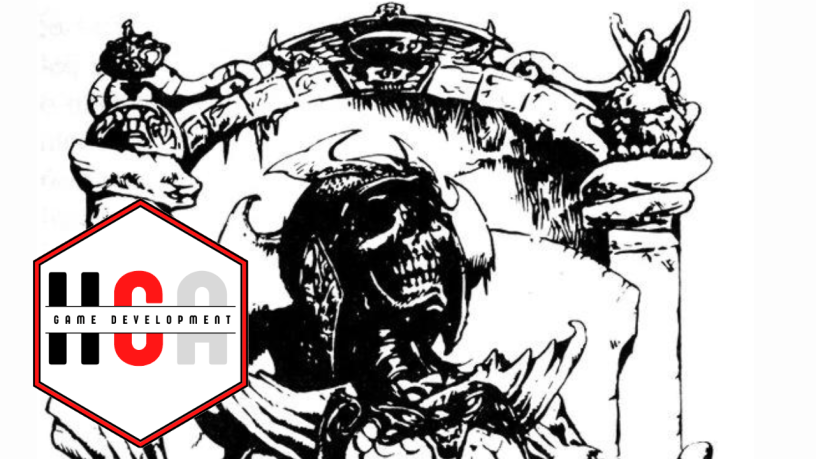
Header art credit goes to Ian McCaig’s wonderful artwork, done for the Fighting Fantasy, Deathtrap Dungeon (1984).
Time is a funny thing. I have seen people changed by it in ways they could not have possibly guessed for themselves. Indeed, who can predict the paths that life may take? The thorns, the crashing waves… obstacles wherever you turn. Yet, of course, there is but one constant, one surety – Lord Ethal will endure.
After writing over a hundred and fifty pages of dialogue & description for my Inquisitor game, I have come to realize that Twine has no way to deal with something like this in a manageable, safely editable state. Hence, I have been looking at alternatives. But, while I was looking at alternatives to develop this dream game of mine, I have also been brainstorming something that would pave my way more clearly to Inquisitor – a short exploratory role-playing game, which is set in a small, richly detailed part of this world I have been making. Of course, when it comes to game development, nothing is simple, nor would development be short.
But I want this Inquisitor game to shine, and in order to do that, I need to have a game to learn development lessons from. With that in mind, I’ve been contending with three additional game design documents. Each one, I think, has wound up posing a similar question to me about narrative and space in video games. Three of the documents (Inquisitor included) are based in this world of Ethal’s that I have created. But across the three documents, I’ve grown the world in subtle ways, and ways that make each individual game stronger, even if I were to only make one of those three.
The fourth game is a horror game with a much more personal bent to it, with a clearly defined scale and set of limitations – yet in order to make it work, I would need to be seriously confident in my ability to craft an ambient, immersive space in a 3D world.
Hence, we return to my fascination with space. What does it mean to inhabit a space? As much as I enjoy 2D games, I just don’t think I can achieve what I want to achieve with a “mere” two dimensions. I know it would, perhaps, make my job easier. It seems to me to be “easier” to make two-dimensional art, though I know that in itself is not easy, given my scattershot attempts at pixel art here and there. Good work takes time – see Blasphemous. But I want games that provide a tangible sense of time and place, and I think in order to achieve that, I need to learn how to 3D model. I want to control space in three dimensions to get the effects I really want.
So I put three of four games on the backburner and thought about the last one I chose long and hard. How do I make it work? I have thought about level design and what makes it special. We remember spaces not because they are large and expansive necessarily, but because of fine details.
The fourth game is to be a game with a few discrete levels – a tutorial level, a small hub area, and two, perhaps three, other areas to explore. It will be a short game, and a test of many of the systems I want to refine and put in place .
I have given the matter much thought. If Inquisitor‘s ideal form is an explorative city / mystery with time pressure, and a variety of moral decisions and ethical arguments – akin to, what else, Pathologic – then this game’s ideal form is a focused narrative experience, with well-written characters, strong dialogue, many moral dilemmas and ethical questions raised, and the ability to shape one’s own personal narrative. Instead of crafting a narrative that will by necessity shape the wider world, I wanted to write a story that would let the player reshape, or redeem, a character who has already been through a lot.
In order to do this, I will be creating a variety of maps, sketches and attempting to do some low-poly 3D modelling in order to create a look vaguely reminiscent of the original Pathologic or Morrowind. I will hopefully be able to create at least the tutorial area over the next twelve months and have a technically “feature complete” game, wherein I can do all the basic stuff I’d like to do, and then all that would remain are the meatier bits.
Part of the exercise of developing this game is also to develop a framework I can develop the next game off of. I do not want all that dialogue I’ve written for Inquisitor to go to waste – but I also want to make it a game that leverages the space of the medium. I’m not sure whether I am up to the task, but my lofty goal is to release at least two of the games I’ve written these design documents on. Because I like the ideas present in all of them, and I think in making them, I will be able to better understand video games as a medium, and what it actually means to make a space.
“Terrible things, I have seen. Terrible, terrible things. But the things you will do – ah, I wonder if it will be any better, or any worse, than what I have already been forced to observe.”
The game I am focusing on, therefore, is a short role-playing adventure wherein you take control of a bitter old hero of Lord Ethal’s empire, who is dragged back into the game for one last mission. It will have a tight and concerted focus on three aspects: 1) dialogue that allows you to reshape yourself and other characters, 2) environmental design, and 3) combat. I want an immersive experience, but not a sweeping one. I am well aware of the irony of saying this, having written absurd dialogue trees for characters in my previous pitch, but I want to contain the game to a small number of environments, a small number of characters, and perhaps two weapon types at the very most.
When we consider heroism in games, I think we often consider acts of selflessness. But I wanted to make a game – or games, really – that question selflessness, that ask how much you’re willing to give up for a place, a person, or an ideal. These are games that, to me at least, seem to be driven by this question. I hope I can do these ideas justice – I want to complicate heroism. But I don’t just want it to be a side quest kind of thing – oh, you helped x but it turns out this actually really harmed y – I want it to be a focal point of the game.
I don’t want to argue that this currently nonexistent game has an essence, because it doesn’t. But I want to pursue the Fighting Fantasy feel of ancient dungeons, threatening monsters… and of an empire fraying at the seams, held together only by the people who force it to continue to exist. For not all is well in Lord Ethal’s grand empire, as much as we would like to claim otherwise. Chaos is on the rise – and it is only with YOUR help that it can be defeated.
Fantasy, though, is a funny thing. Because what might constitute fantasy fiction to one person – enormous dragons, sights that could not be seen in our own actual world – would be totally unengaging to another. As for me, I think I enjoy almost all kinds of fantasy, but I tend towards creating lower levels of fantasy than higher. I like the sensory detail and immersive quality of works that deal with mud and grit. The feeling of the sunshine in the sky, radiant and warm, is just as important as the weight of the flaming sword a person carries. I enjoy these details; they make a world come to life.
The world I am making, also, is not High or Late Medieval. If it has an analogue, it is the Low Medieval period, or the “Early Middle Ages” – or, the Dark Ages. I am basing the general technology level – barring a few obvious exceptions to account for style, magic, or circumstance – on the 8th century AD. This parallel was initially drawn because I wanted to evoke the reign of Charlemagne. His idea of the loyalty oath, for instance, is one I am very interested in examining further. But the western art of the period is also fascinating. It is very insular, and of course, is also very religious. I wanted to combine the clothing and architecture of western Islam of this period, or thereabouts (for an example of the kind of ruin I would like to chase, search for the Kalâa de Beni Hammad) with the styles of artwork found in the Carolingian Empire. Mosaics, stone carvings, and so on – all with a religious bent – were extremely common. I want it to be a weather-beaten world, but one tied together by people, by characters.
I want a sense of something new yet familiar. I don’t want to fall into the Two Worlds (2007) trap, wherein everyone speaks (or in my case, is written) in some hokey medieval accent and who all live in small wooden shacks, or in great western castles. I want a world that is pieced together by iron and will, but also one that is deeply reverent. A slow world, with a similarly slow threat of decay. A world learning about itself, at the same time that you, the player, will learn about it. And, learning about the person that you control. You will shape them – and perhaps, they will shape you.
“Where do I come into it?” He asked. “There is nothing here for me to do. No great story for me to tell. The world has already been saved. By the grace of Lord Ethal, order is here.”
The room was still for a moment. She leaned back in her chair and placed her gauntleted hand on the arm of the chair. Her fingers rapped once, twice, against the wood, before she answered.
“Where do you come into it?” She sighed. “Order must be fought for. You are naive to think that just because you are sitting here behind your stone walls that Chaos does not fester beyond them. Just because your dining hall is tidy does not mean your kitchen is.”
My efforts this year in terms of thinking about games has been about the fusion between rules and fiction. To that end, I have also been examining the world around me. The decay I’ve seen in small places, where humans forget to go, or where money does not reach. Public infrastructure in good condition in one place; broken pipes and cracked concrete in others. So, is it possible to make a game earthy? Pathologic, I think, succeeds through virtue of colour palette and thematic content, let alone the feeling of wandering the Steppe.
But I cannot afford to begin so ambitiously, especially given I shall walk most of this development path alone. The project I embark on is a set of discrete levels, partitioned off from one another by loading screens. Rather than a large town or city that at least appears seamless, I am not yet giving myself that much room to manoeuver. I must retain some level of focus. To that end, I’ve been designing the form and function of each short level. It will not be a long game – it may even take the shape of a long demo, a precursor to the games I feel even more strongly about. But I do feel strongly about this project.
Heroism can be easy in games. Very, very easy. Because it often comes at no cost, and happiness is easily won. In many games, that can be the point – that good inevitably triumphs over evil. There will always be champions to rise to the occasion. I want there to be tension to that idea in the narrative of this game. The person you play as – partially defined by you, but also by myself – is washed up. Their golden era is already over, their great feats already defined. The hero’s call is recurrent, however, and I have a narrative structured that allows a player to take the hero’s call as it comes up again – or even reject it. I want something that feels “lived in”, one that allows a player to truly play a role. Of course, all roleplaying games must start with such lofty ambitions. I aim to
If there is an evocative mission from another game I wanted to emulate, my mind keeps returning to a particular quest in The Age of Decadence. In this mission, a player must defend a rich merchant lord from a deadly assassin. What makes this mission so fascinating is that on another playthrough, the player could, in fact, be the assassin. I want there to be a few similar pivot points in the structure of this game – and perhaps even build a similar scenario within this game. I find the idea inspiring in ways that go beyond mere narrative structure. Atmosphere and space in a scenario like this are key, and even in an isometric circumstance, The Age of Decadence succeeds with a desolate, tense atmosphere. Lives aren’t merely lost through arbitrary acts of hot-blooded violence. The coldness of backroom deals and words – these, too, can spell destruction.
Perhaps ambition is already creeping in, but with five levels I want to build (some very small indeed), a short side questline, and a main quest with a few diverging paths and well-written dialogue, I feel as though I serve myself relatively well for something that could take shape into a commercial product eventually. But for now, this project is a way to sharpen my game design skills before I carve into the three larger projects that I want to bring to fruition.
If there are issues I will run into, particularly with my own limited skillset, it is composing music, general sound design and engineering, and my aforementioned learning curve that must be done with Blender. Alas, these are things that I shall have to learn if I do indeed aim to succeed. And I would love to bring a project like this to life.
I will continue to update with more as I continue with this secondary project. When it is complete, I should have an adequate framework to bring Inquisitor to life. But to get there is a serious challenge. A real mountain to climb. I look forward to climbing it.
 Horrorgameanalysis